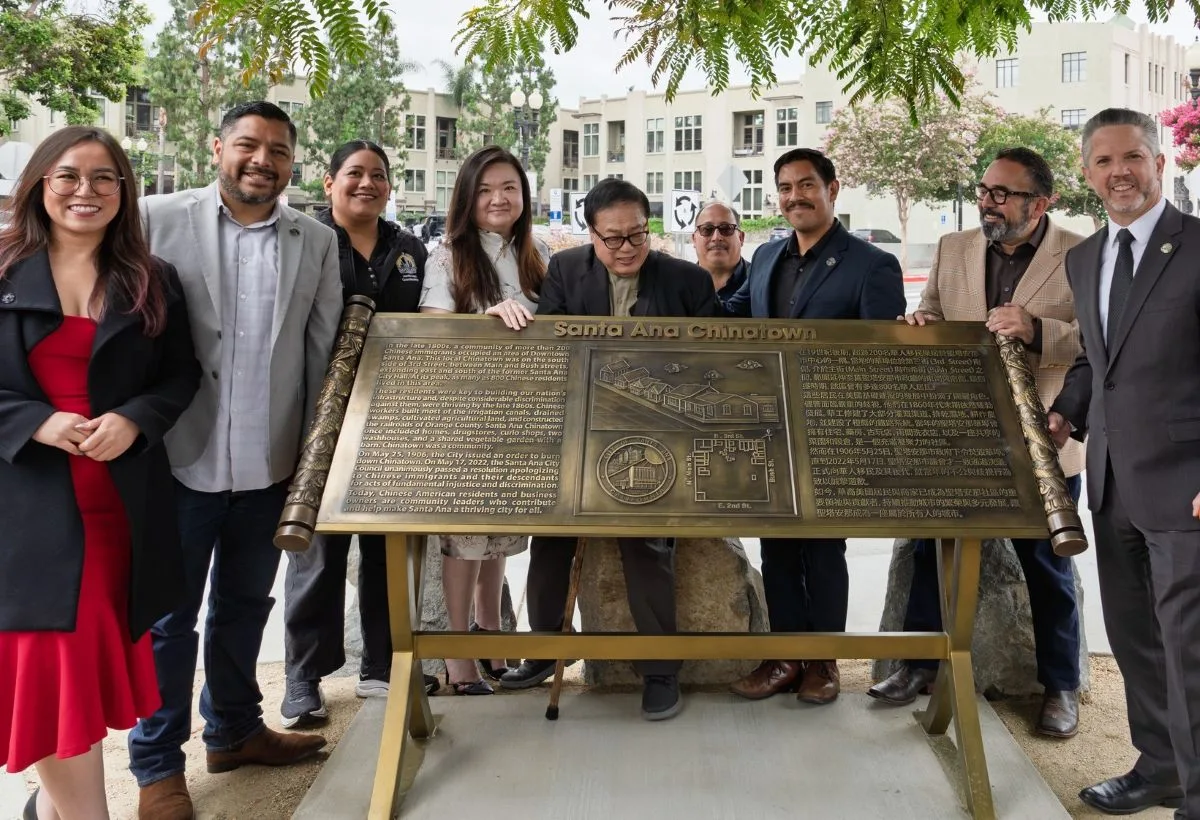
SANTA ANA, CA — Over the weekend, the City of Santa Ana officially unveiled a new Chinatown Memorial at the corner of 3rd and Bush streets. The monument features a detailed historical map and a plaque dedicated to correcting a dark piece of municipal history. In May 1906, city leaders weaponized a manufactured public health scare—falsely claiming a resident had leprosy—as a pretext to unanimously vote to burn the entire neighborhood to the ground for an “urban renewal” project. Over 1,000 residents cheered as homes and businesses were destroyed, forcing the Chinese community out with zero compensation.

Following a formal council resolution, this new physical monument stands as a vital and necessary step toward municipal accountability. Yet, as city leaders rightly atone for the racist actions of 120 years ago, a glaring omission remains: the city has never made any effort to formally apologize for, or even publicly monument, the original and far larger theft of the very land Santa Ana is built upon.
The Erased History of the Acjachemen and Tongva
Long before the Spanish land grants or the incorporation of Santa Ana, this region was the thriving homeland of the Acjachemen (Juaneño) and Tongva (Gabrieleño) nations. These tribes maintained deep spiritual, cultural, and ecological relationships with the land, managing the area’s natural resources for thousands of years.
The theft of their land was not a single event, but a multi-tiered campaign of violent displacement:
- The Mission System Collapse: Beginning with the Spanish Portolá expedition in 1769, local Indigenous populations were forced into the Spanish mission system (primarily Mission San Juan Capistrano and Mission San Gabriel). Under the guise of assimilation, tribes faced forced labor, the brutal suppression of their languages and religions, and devastating European diseases that decimated their populations.
- The Mexican Land Grants: Following secularization, rather than returning the land to its rightful Indigenous stewards, the Mexican government carved up the region into massive private ranchos. The land Santa Ana occupies today was stripped away via the Rancho Santiago de Santa Ana grant, pushing local tribes entirely off their traditional hunting and gathering grounds.
- The Sovereign Erasure: When California transitioned to American statehood, the federal government negotiated 18 treaties with California tribes in 1851–1852, promising them millions of acres of reservations. Instead of honoring them, the U.S. Senate hid the treaties in secret archives, leaving local tribes landless, legally unprotected, and unrecognized.
Institutional Shifts: The Case of the Bowers Museum
This pattern of selective remembering and literal erasure isn’t confined to city hall; it is mirrored in Santa Ana’s premier cultural institutions. Consider the evolution of the Bowers Museum, located just north of downtown.
Opened in 1936, the museum originally focused heavily on local history and preserving California’s early indigenous culture, displaying an immense, world-class catalog of Native American basketry, tools, and pottery. However, following a major multi-year closure and restructuring in the late 1980s and early 1990s, the institution rebranded itself as a museum of “Cultural Art.”
Over the subsequent decades—culminating in massive expansions like the Dorothy and Donald Kennedy Wing—the Bowers pivoted its primary public footprint toward international blockbuster programming, transitioning to hold highly publicized permanent Chinese exhibitions and massive touring showcases like the ancient Terracotta Warriors. While the museum still curates a profound, 24,000-piece Native American repository in its collections, its visual brand and dominant public galleries shifted heavily toward Asian and global antiquity.
This corporate and curatorial pivot effectively decentralized local Indigenous narrative from the heart of Orange County’s cultural capital, shifting the local community’s focus from domestic historical accountability to global artistic appreciation.
Accountability Cannot Be Selective
The Chinatown Memorial proves that municipal governments have the capacity, the resources, and the historical records required to confront their past institutional evils. Acknowledging the targeted destruction of an immigrant neighborhood is a massive victory for justice in Orange County.
The state-sanctioned destruction of Santa Ana’s Chinatown was an overnight act of targeted municipal displacement with no recorded direct fatalities, whereas the displacement and death of Native Americans in Orange County was a century-long demographic collapse driven by forced labor, introduced diseases, and systemic violence that impacted thousands of people.
Prior to 1769, an estimated 5,000 Tongva lived in about 100 regional villages across the Los Angeles basin and northern Orange County, alongside thousands of Acjachemen in southern Orange County. By the late 1800s, both tribes were entirely dispossessed of their ancestral lands, leaving virtually no tribal land trust or recognized sovereign reservation space within Orange County borders.
The local death toll was heavily documented by Spanish priests. At Mission San Juan Capistrano alone, which drew primarily from the Acjachemen population, church records note 3,153 recorded indigenous deaths against 4,317 baptisms. These deaths were primarily caused by introduced European diseases (like measles and smallpox), abysmal living conditions, and forced labor.
Following American statehood, state-subsidized militias and settlers actively hunted, murdered, and enslaved Native Americans. Statewide, the indigenous population plummeted from roughly 150,000 to just 30,000. While the most explicit massacres occurred in Central and Northern California, Native people in Orange County were legally stripped of basic rights, forced into indentured servitude under local ranchers, or driven completely into hiding to survive.
At its peak in the 1890s, Santa Ana’s Chinatown housed an estimated 200 residents and none of them were killed when Chinatown was burned down. resident named Wong Woh Ye was quarantined outside the neighborhood due to a leprosy scare, and the remaining residents were cleared out before the structures were torched.
Ignoring the foundational displacement of the Acjachemen and Tongva implies that some historical injustices are worth correcting while others are too inconvenient to name. If Santa Ana truly wishes to build a future rooted in reconciliation, its leaders must recognize that the dirt beneath the new Chinatown monument—and every city building—remains unceded Indigenous territory. True healing cannot stop at the borders of downtown; it must extend to the very origins of the land we live on.
Sorry, Art, but this isn’t municipal government confronting past institutional evils. It’s political hacks patting each other on the back while staging a photo op to garner votes. They didn’t apologize to the Juaneños and the Gabrieleños because, unlike Asians, they’re not a big enough voting bloc to court.
Well said!!!