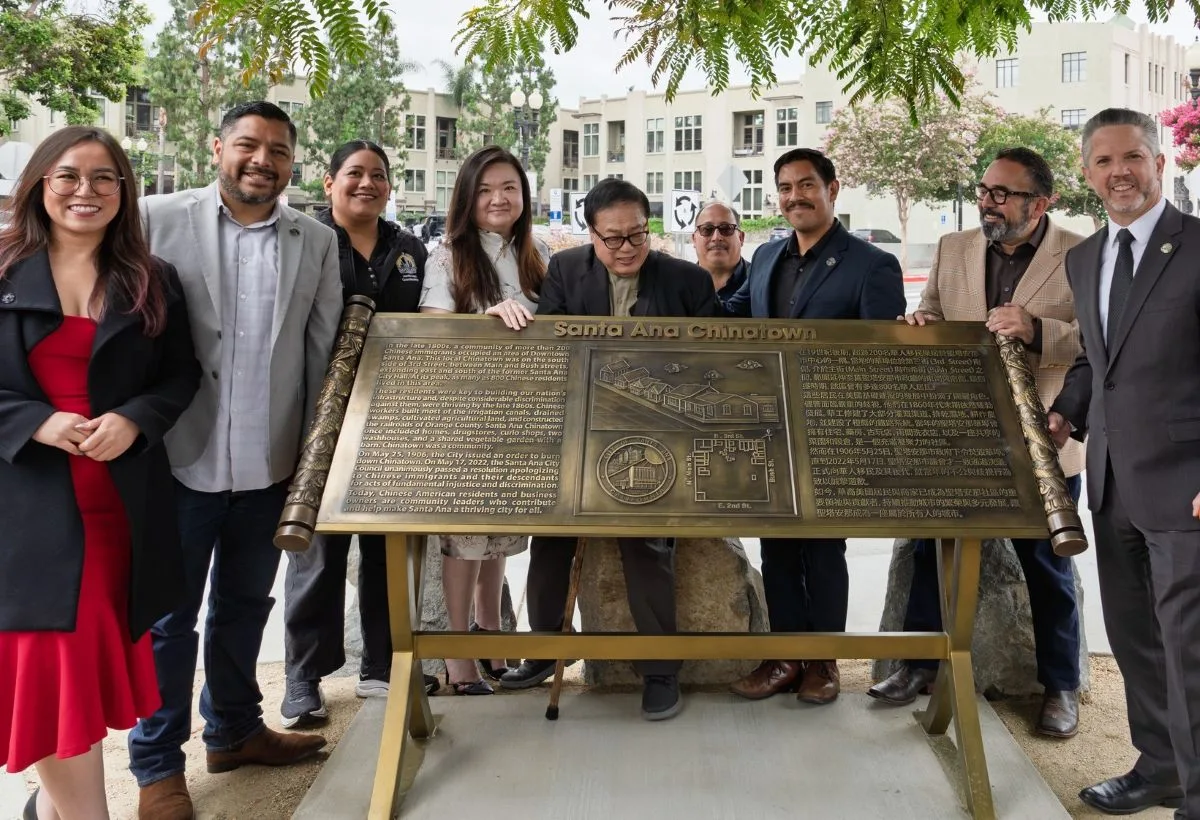
The Santa Ana City Council recently wrapped up another round of historic hand-wringing. With great fanfare, city officials unveiled a memorial and pattons on the back following their formal apology for the 1906 burning of Chinatown.

Let’s be entirely clear: what happened in 1906 was a tragedy driven by xenophobia. But the current council had absolutely nothing to do with it. No one alive in Santa Ana today did.
If this council is truly determined to apologize for the short-sighted blunders of their institutional predecessors, they need to stop digging through the 20th-century history books to find easy symbolic victories. Instead, they should apologize for a catastrophic error that actually crippled Santa Ana’s modern economy: the rejection of South Coast Plaza.
The Blunder of the Century
Decades ago, when the Segerstrom family was looking for a home for what would become an international shopping destination, Santa Ana city leaders famously dropped the ball. Driven by a lack of vision and bureaucratic hesitation, a previous council essentially rejected the massive development.
The Segerstroms took their revolutionary concept right across the border to Costa Mesa.
The rest is history. Costa Mesa embraced the vision, and South Coast Plaza grew into a global retail titan, generating roughly $2 billion in annual revenue.
The Staggering Financial Toll
While Costa Mesa spent decades coasting on the massive sales and property tax windfall, Santa Ana was left out in the cold. Consider what Santa Ana lost because of that single, short-sighted council decision:
- Billions in Lost Economic Activity: South Coast Plaza isn’t just a mall; it is one of the highest-grossing shopping centers in the United States.
- A Massive Sales Tax Deficit: Costa Mesa fills its municipal coffers with tens of millions of dollars in direct sales tax every single year from the plaza.
- The “Measure X” Crisis: Because Santa Ana lacks that kind of self-sustaining, elite commercial tax base, the city had to pass Measure X—a hefty sales tax hike—just to keep public services afloat. City officials are now panicking about a massive “revenue cliff” as that tax begins to sunset.
If Santa Ana city leaders had shown an ounce of foresight decades ago, residents wouldn’t be facing potential cuts to public services or begging for new revenue sources today. The city would be the undisputed economic powerhouse of Orange County.
Real Accountability vs. Performative Politics
Issuing an apology for an event that happened 120 years ago costs the city council nothing. It requires no political courage, fixes no broken roads, and funds no police beats. It is pure performance.
If the City of Santa Ana wants to take institutional responsibility for the mistakes of past councils, they should look at the financial scar running right along Sunflower Avenue. It’s time to apologize to the taxpayers of Santa Ana for handing Costa Mesa a multi-billion-dollar economic engine on a silver platter.
The City of Santa Ana has continued to make development blunders. Critics frequently point back to a pivotal city policy that required any company trying to build a mega-retailer or “supercenter” to undergo an extensive economic and neighborhood impact analysis. This ordinance mandated a conditional use permit, effectively giving the city council the power to block or heavily condition massive stores. The policy was widely viewed as a direct hurdle for Walmart Supercenters, which combine general merchandise with large, non-taxable grocery sections. Local business advocates argue that this strict regulatory environment is the explicit reason why mega-chains like Costco, Sam’s Club, or Walmart Supercenters have bypassed Santa Ana for neighboring cities.
In May 2026, the Santa Ana City Council did it again as they unanimously passed an ordinance imposing strict rules on grocery stores over 15,000 square feet and retail pharmacies. It mandates a 1-to-3 employee-to-machine staffing ratio for self-checkout kiosks, limits self-checkout to 15 items, and bans the purchase of locked or age-restricted items at kiosks.