The Orange County Fire Authority’s Unified Incident Commander Craig Covey posted a video update today on their X page explaining the status of the ongoing chemical tank incident in Garden Grove.

In the video Covey said that yesterday he had said that the tanks were stable and they thought the temperature might be going down as they were trying to keep the tanks cool. They have been using a drone to do temperature readings of the external side of the tank that has been the main concern. However the drone is not able to obtain temperature readings of the inside of the tank.
Covey explained that the OCFA has been in a defensive posture up until now but last night they opted to go on the offensive. They made the decision to put OCFA crew members in harm’s way with support from the OCFA’s chemists and emergency response team members.
The OCFA emergency team went in last night to attempt to neutralize the additional 15,000 gallon chemical storage tank next to the 7.000 gallon tank that has been undergoing a chemical reaction. The plan was to neutralize the product to remove its explosive potential.
The members who went into the tank area were able to see the tank gauge that up until now had been covered by water as the OCFA crew had been steadily pouring water into the tank area in an attempt to keep the tanks cool.
The bad news is that the gauge showed that the internal temperature of the 7,000 gallon tank is now at 90 degrees F. Yesterday morning, the last time they had been able to check that gauge, the internal temperature had been at 77 degrees F. Covey said that the internal temperatures have been going up by an average of one degree F per hour.
At this point the OCFA emergency crew still has only two options – the smaller tank either ruptures and spills its contents or it blows up, in a process referred to as a BLEVE, or Boiling Liquid Evaporating Vapor Explosion. In either case the chemical, which is currently in a liquid form, will become a vapor when it leaves the tank. In the case of a BLEVE the explosion will be vast and will likely also rupture the larger tank next to the 7,000 gallon tank. The result will be a huge vapor cloud that will threaten the entire area.
Currently Covey believes that the influx of water into the tank area is allowing the chemical in the 7,000 gallon tank to cure at a slower rate. What he is referring to is that the chemical in question, methyl methacrylate, a highly flammable plastic epoxy used in manufacturing, is in the process of curing.
This chemical usually needs a catalyst to begin the curing process. However in this emergency the liquid in the 7,000 gallon tank began an uncontrolled chemical breakdown known as auto-polymerization. Because MMA is so volatile, chemical manufacturers mix in a chemical stabilizer/inhibitor (usually Hydroquinone or Topanol) to keep the liquid stable during storage. Over time, or if exposed to contamination or localized hot spots, these inhibitors get consumed and run out. Once the inhibitor fails, the MMA molecules begin reacting on their own. This reaction is highly exothermic (it generates its own heat). As the chemical creates its own heat, the temperature rises. For every few degrees the temperature increases, the speed of the curing reaction doubles. This creates a catastrophic feedback loop called a thermal runaway.
Under normal protocols, if a facility sees a storage tank beginning to auto-polymerize, they immediately pump in a heavy dose of a neutralizing stabilizer or “killer catalyst” to freeze the reaction.
At the Garden Grove site, Orange County Fire Authority commanders reported that a faulty, gummed-up valve physically blocked emergency crews and the facility’s response team from injecting the neutralizing agent. Because they cannot access the inside of the tank, the chemical is trapped in a self-cooking cycle, creating the immense pressure and bulging that officials are fighting with high-powered water cooling lines.
According to the OCFA, the valve becoming “gummed up” was actually caused by the chemical reaction itself, rather than just a simple lack of routine preventative maintenance (PM).
When MMA enters a state of auto-polymerization (runaway curing), it does not just stay a liquid until it suddenly turns into a hard block. It transitions into a thick, sticky, highly viscous gel before completely solidifying. Because the tank began venting vapor and building massive internal pressure on Thursday, this thick, reacting chemical was forced upward into the internal components of the pressure-relief and intake valves. Once that sticky polymer gel entered the tight tolerances of the valve seats, it essentially “glued” the mechanics shut.
The thermal runaway reaction inside the tank generated extreme heat. OCFA Incident Commander Craig Covey noted that the intense heat and internal pressure actually caused the heavy metal structure of the tank to physically bulge. When a high-pressure vessel warps, the structural stress can mechanically seize or warp the valves, rendering them completely inoperable even if they were pristine before the incident.
Out of the three storage tanks at the GKN Aerospace plant, emergency crews successfully injected neutralizing agents into one tank, and the second was stable. This suggests the facility had functional infrastructure, but this specific tank’s valve failed under the unique stress of the runaway reaction.
A critical part of PM for MMA storage is regular testing to ensure the chemical’s liquid inhibitors haven’t depleted. If the facility failed to monitor stabilizer levels or missed an internal hot spot, that lack of oversight is what allowed the auto-polymerization to start in the first place.
Ultimately, the valve became a casualty of the chemical reaction. The OCFA confirmed that the valves were “gummed up with agent,” meaning the chemical literally cooked itself inside the machinery, trapping the remaining 7,000 gallons inside.
The temperature at which the chemical will BLEVE is 100 degrees F. It was already at 90 degrees F a half hour ago and as Covey noted the temperature is going up one degree F per hour.
If the tank splits open at these elevated temperatures, the sudden drop to atmospheric pressure causes the superheated liquid MMA to instantaneously flash-boil into a massive gas cloud. Because MMA has a incredibly low flashpoint of 50°F (10°C), the rapidly expanding gas cloud will instantly ignite upon contact with any spark or the friction of the metal tearing, creating a catastrophic chemical fireball.
At this point the OCFA is trying to use more equipment to validate the situation in the tank area. They are also talking to chemical specialists all over the country and are bringing in more specialists to the emergency site area. They are definitely trying everything to prevent a BLEVE.
The OCFA has developed contingency plans for a fire and/or a BLEVE. They are working on setting up diking to divert any liquid spell to a holding area. They are looking to push the liquid down into an area below grade such as a ramp down to a shipping area. They are aiming to prevent the liquid from getting into public storm drains.
As the danger persists they are continuing to ask local residents to stay out of the area.
This emergency is poised to be a complex, multi-million dollar General Liability (GL) claim, likely exhausting the company’s primary layers and pushing deep into their excess and umbrella policies.
Emergency Evacuation Center Updates
- The Red Cross has announced that they are opening an overnight shelter at Freedom Hall in Fountain Valley. Pets are welcome! Red Cross Shelter at Freedom Hall, located at 16801 Euclid St., Fountain Valley, CA 92708.
- There is also an emergency shelter at Oceanview High School, located at 17071 Gothard St., Huntington Beach, CA 92647.
- An additional evacuation shelter has also been opened at John F. Kennedy High School in La Palma at 8281 Walker St., La Palma, CA 90623.
- An additional evacuation shelter has been opened at Golden West College in Huntington Beach at 15744 Goldenwest Street, Huntington Beach, CA 92647.
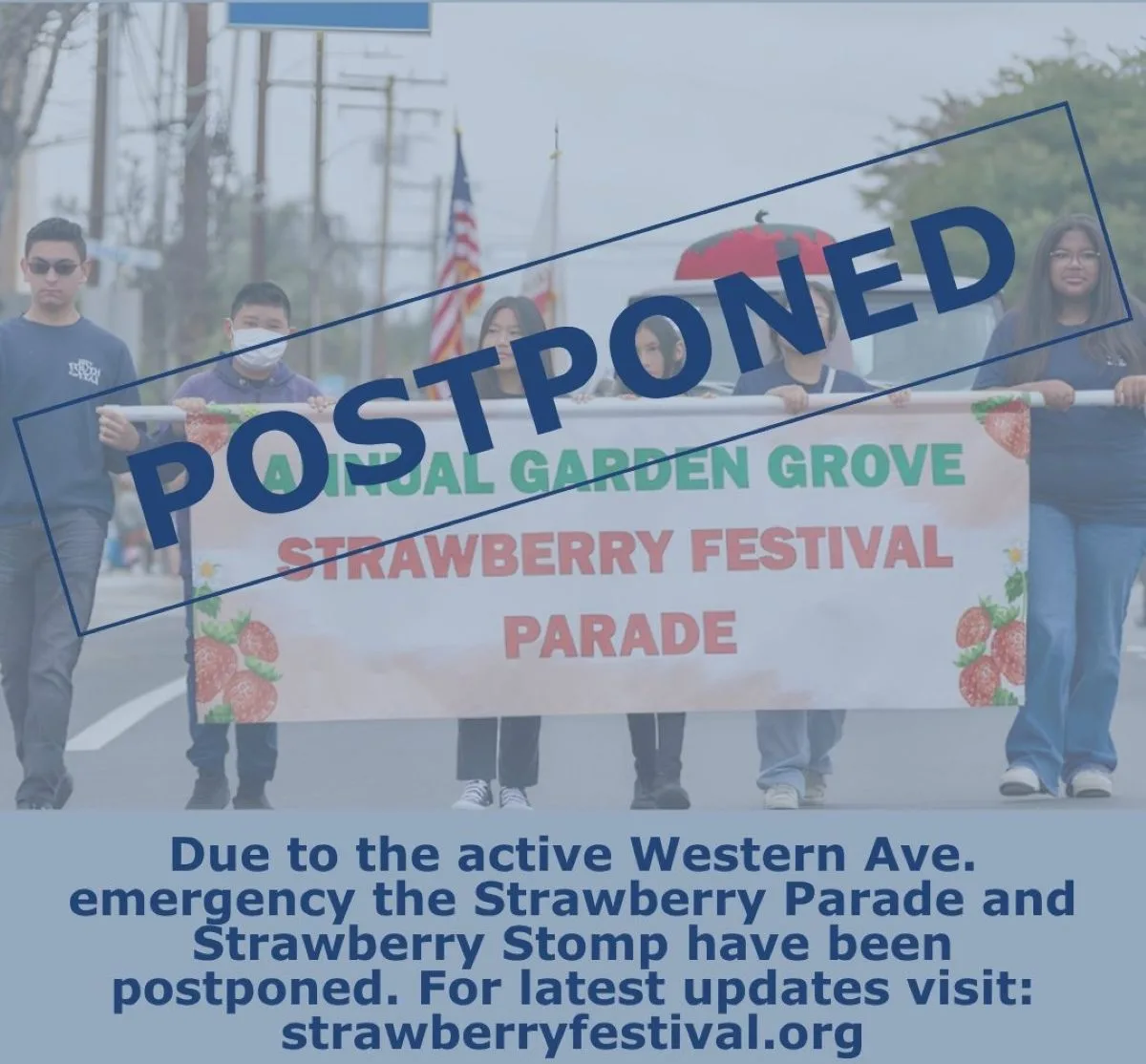
Strawberry Parade and Stomp Postponed
The 66th Annual Strawberry Parade and Strawberry Stomp 5K have been postponed.
The City of Garden Grove, The Garden Grove Strawberry Festival and Sister City Association of Garden Grove made the decision in coordination with public safety and emergency response partners as City resources continue to be dedicted to the active incident response occurring.
Scheduling options are currently being evaluated and updates on festival activities and rescheduled events will be shared through City and Strawberru Festival communication channels. For Updates on the Strawberry Festival visit: strawberryfestival.org. For the latest information regarding the City’s emergency response, visit ggcity.org/emergency.
About the Editor
The Editor of the New Santa Ana blog, Art Pedroza, has worked in safety and risk control for over 30 years. He is a former 40-hour Hazwoper (Hazardous Waste and Emergency Response Operations) instructor with experience in refineries and construction. He has spent over 15 years in risk control in commercial insurance. He is a former member of the Orange County Emergency Medical Services Commission. Pedroza currently teaches for a painting apprenticeship program at Cerritos College and he is a part-time lecturer at CSUF in their School of Public Health.