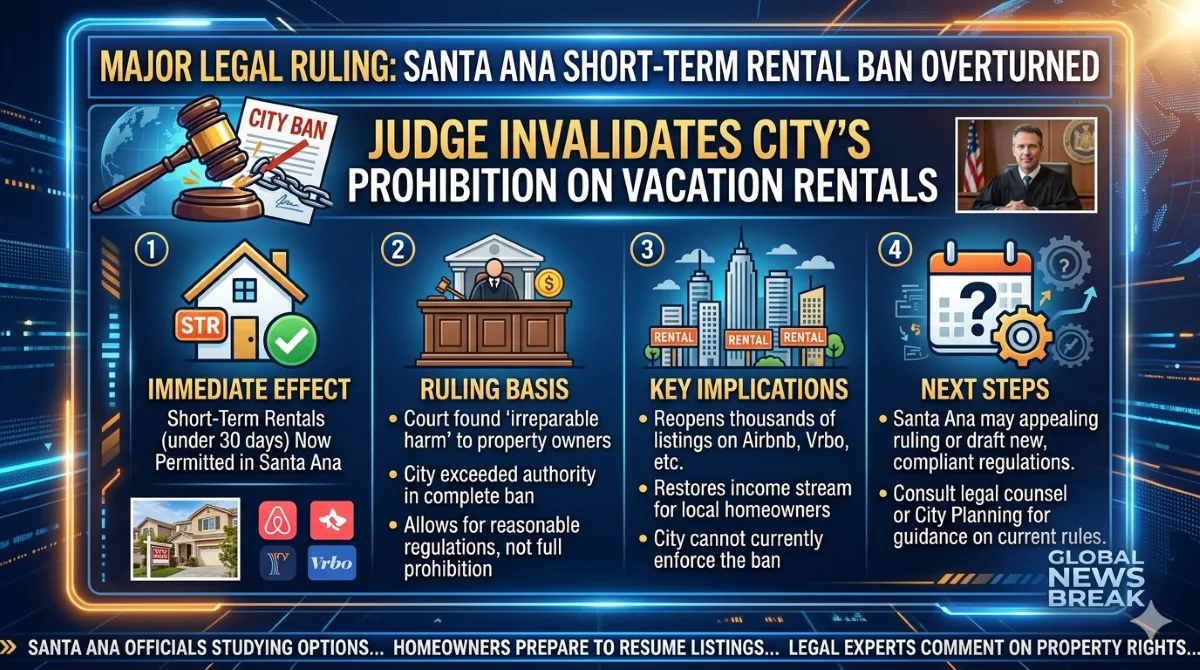
In a major legal shift, an Orange County Superior Court judge has overturned Santa Ana’s ban on short-term rentals (STRs). While the original 2024 ordinance sought to eliminate stays of less than 30 days to protect neighborhood character, recent judicial rulings have halted its enforcement, siding with property owners who argued the ban was unconstitutional and lacked environmental review.

Estimated Revenue Loss for Santa Ana Families Due to the Short Term Rental Ban
Before the ban was overturned, the financial impact on local families was substantial. Many homeowners used platforms like Airbnb and Vrbo to supplement their income in one of California’s most expensive regions.
- Per-Property Impact: A 4-bedroom home in Santa Ana averages roughly $4,500 per month on the long-term market (~$150/day), while the same home as a short-term rental could command $230 or more per day [Original Post Data].
- Total Citywide Revenue: Opponents argued that the 1,100+ identified units could have generated millions in tax revenue. Estimates suggest that even a 5% collection of potential fines and taxes could have contributed over $42 million annually to the city’s budget, which currently faces a massive budget deficit.
- Rescinded Fines: Following successful legal lobbying by the Santa Ana Short Term Rental Alliance (SASTRA), citations and fines issued to hosts between August and September 2024 were rescinded.
Next Legal Steps for Both Sides
The legal battle is far from over, as both the city and rental advocates prepare for the next phase of litigation:
- For the City: Santa Ana officials are expected to appeal the ruling or draft a revised ordinance that addresses the court’s concerns, specifically regarding environmental claims and procedural due process.
- For Homeowners: Groups like SASTRA continue to push for a permit-based regulatory system rather than an outright ban, arguing that regulation provides a more balanced solution than total prohibition. SASTRA’s legal nonconforming use claim (failure to grandfather pre-ban STRs) remains to be set for trial. On 04/17, when they argued the CEQA claims, the court set a status conference for August 20.
STR Bans Across Orange County
Santa Ana is part of a broader regional conflict over vacation rentals. Other cities in Orange County have taken varied approaches:
- Active Full Bans: Irvine, Costa Mesa, Garden Grove, and Stanton maintain strict prohibitions.
- Permitted/Regulated: Anaheim, Newport Beach, and Orange allow STRs but require specific permits and compliance with noise and occupancy rules.
Do Bans on Short Term Rentals Increase Housing Availability?
The effectiveness of STR bans in solving the housing crisis remains contested:
- The “One-to-One” Myth: A 2025 Grand Jury report concluded that there is rarely a one-to-one relationship between banning STRs and increasing affordable housing, as many STRs are luxury or large-scale homes that would not easily convert to low-income housing.
- Impact of Rent Control: Critics point to Santa Ana’s rent control laws as a larger deterrent to housing growth. A judge recently ruled that the structure of the Santa Ana Rental Housing Board was unconstitutional because it was intentionally biased toward tenants. Many developers argue that these “draconian” rent limits discourage the very apartment development the city needs to house its growing population.
[…] New Santa Ana: Judge overturns the City of Santa Ana’s ban on Short Term Rentals such as Airbnb and Vrbo […]