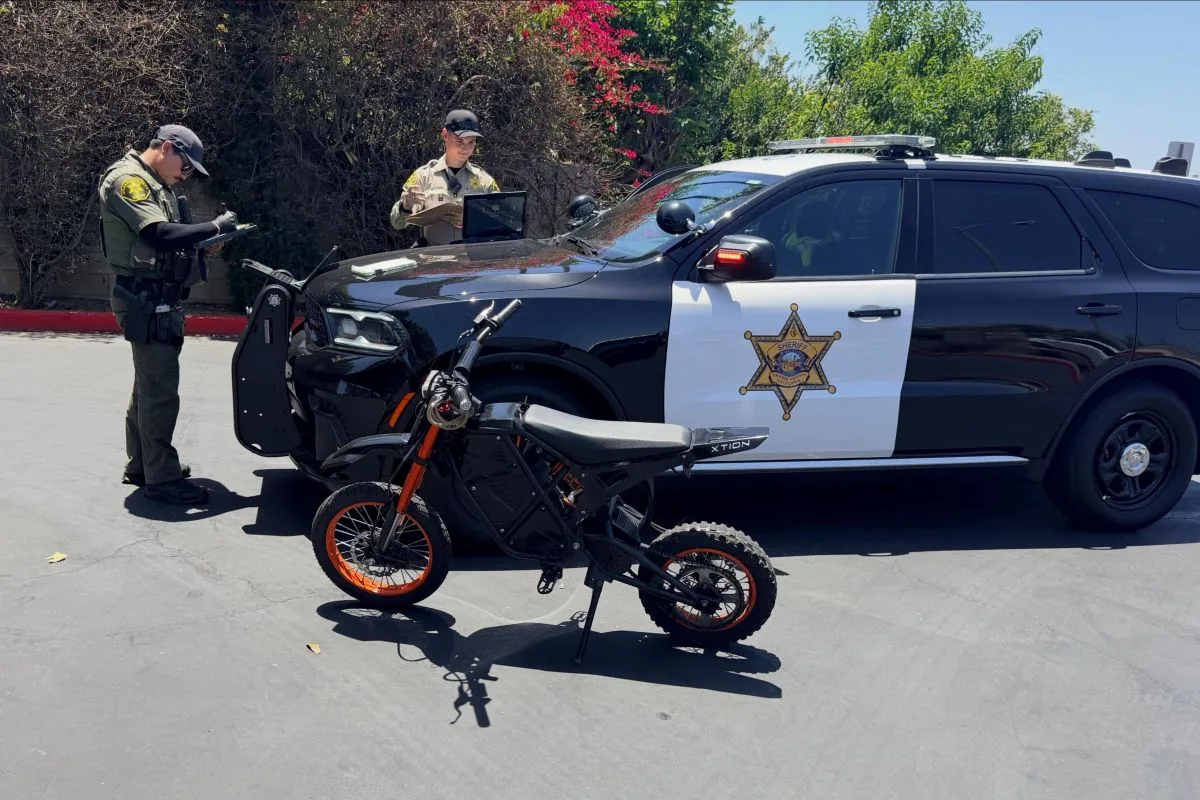
A recent traffic stop in unincorporated Tustin serves as a stark reminder that electric motorcycles are not exempt from standard rules of the road. Deputies from the North Operations division pulled over a male rider who was operating an electric motorcycle without a license plate.

The investigation quickly revealed a trifecta of violations: the rider had no valid driver’s license, the motorcycle was completely unregistered, and there was no proof of financial responsibility. The vehicle was immediately impounded, and the rider was issued citations.
The electric motorcyclethat was impounded was an Xtionland (XTION) Electric Dirt Bike (commonly sold under model designations like the Xtion Emoto or XTION 2000W/2500W). These lightweight off-road style pit bikes typically cost between $1,000 and $1,200 USD retail depending on the exact motor configuration (2000W–3500W peak) and battery capacity ordered.
Local authorities have made it clear that proactive enforcement will continue in Tustin to ensure compliance and improve safety. If you think riding an electric bike or motorcycle on public roads lets you bypass state laws, the financial and legal fallout will prove otherwise.
The Legal and Financial Penalties: What It Will Cost
Operating an unregistered, uninsured electric motorcycle without a license triggers an avalanche of overlapping state fines, court fees, and administrative penalties.
1. Court Fines and Traffic Citations
Under the California Vehicle Code (CVC), the rider faces multiple infractions that stack quickly:
- Driving Without a License (CVC 12500): Operating a motorized vehicle without a valid license is a misdemeanor or infraction. Fines can reach up to $250 for a first-time infraction, plus heavy court assessments that can triple the base fine.
- Unregistered Vehicle (CVC 4000a): Driving an unregistered vehicle on public roadways carries a base fine and requires proof of corrected registration to resolve.
- No Display of License Plates (CVC 5200): A correctable violation (“fix-it ticket”), but it still carries administrative fees once resolved.
2. Towing and Impound Fees
Because the vehicle was impounded, the financial bleeding starts immediately:
- Tow Fee: Typically ranges from $150 to $300 just for the initial haul.
- Daily Storage Fees: Impound lots charge between $50 and $100 per day.
- Administrative Release Fee: The local law enforcement agency charges an administrative fee (usually $100 to $250) just to issue the paperwork needed to get the vehicle back.
- The Catch: The lot will not release the motorcycle until the owner shows a valid driver’s license, proof of current registration, and active insurance.
3. No-Insurance Fine (CVC 16028a)
California takes driving without insurance incredibly seriously.
- First Offense: The base fine is $100 to $200, but with standard penalty assessments, the actual total out-of-pocket cost climbs to $450 to $900.
- Subsequent Offenses: If caught again within three years, the total cost can rocket past $1,500.
The Massive Impact on Insurance
The consequences of this single citation will haunt the rider’s insurance profile for years, making future coverage exceptionally expensive.
- The SR-22 Requirement: To get their license back or register a vehicle after a major insurance violation, the rider will likely be forced to file an SR-22 certificate. This is a document filed by an insurance company certifying that the rider carries the state-mandated liability minimums.
- High-Risk Classification: Carrying an SR-22 automatically labels the rider as a “high-risk driver.” Insurance companies often double or triple premiums for high-risk individuals.
- Loss of Good Driver Discounts: California law mandates a “Good Driver Discount” (usually 20%), but driving without a license or insurance instantly disqualifies you, causing baseline rates to spike.
- Long-Term Costs: These violations stay on a California DMV driving record for three to seven years, resulting in thousands of dollars in cumulative extra insurance premiums over time.
The Bottom Line on California Electric Bike Laws
The state categorizes electric two-wheelers strictly by top speed and motor wattage. While lower-speed Class 1, 2, and 3 e-bikes do not require registration or a license, electric motorcycles do. If it is designed strictly for highway use, goes fast, and lacks pedals, it must be registered, plated, insured, and operated by a licensed driver.