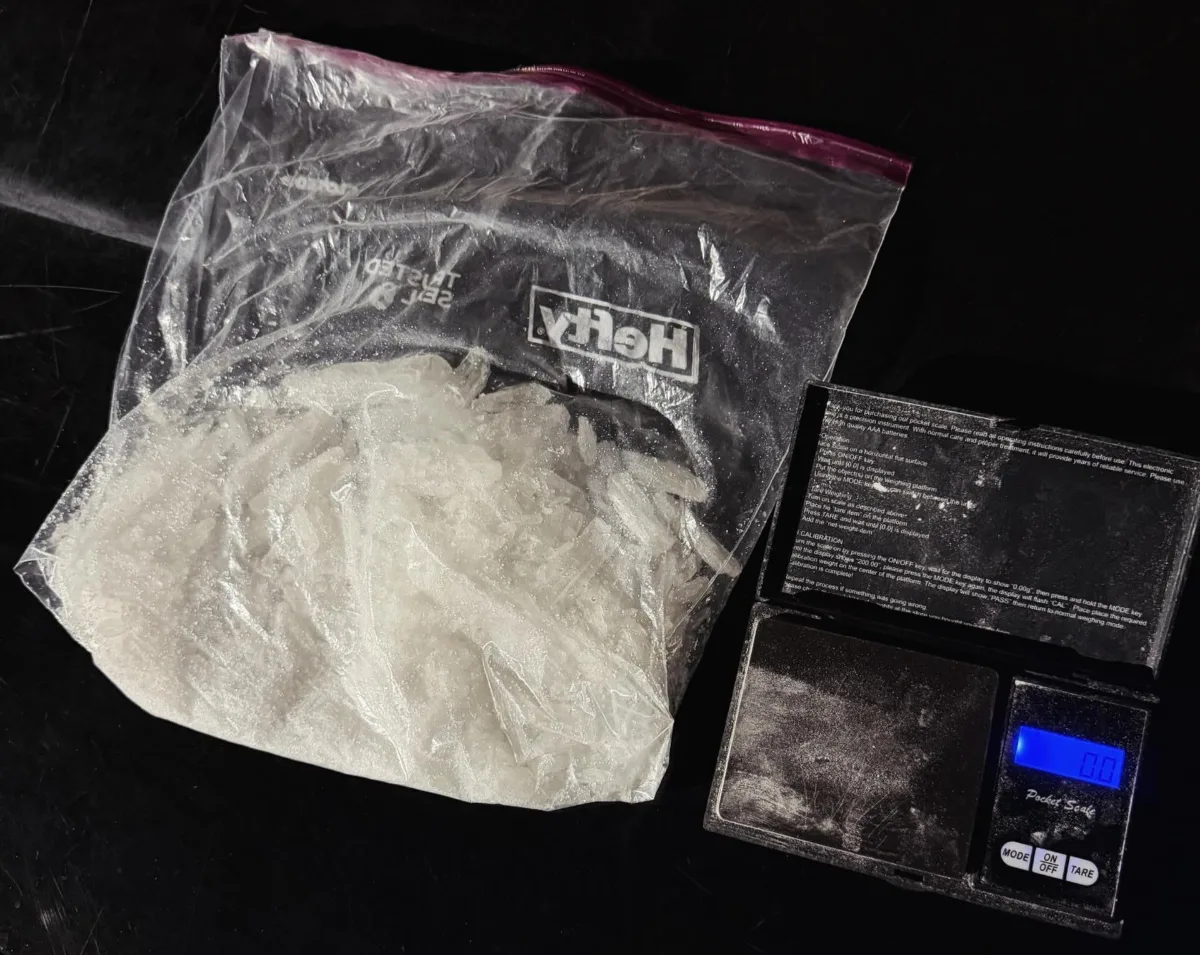
On Friday, May 29, at approximately 10:00 p.m., Orange County Sheriff North SET deputies conducted a traffic enforcement stop in the City of Santa Ana.

During the investigation, the deputies located approximately 250 grams of suspected methamphetamine along with evidence consistent with narcotics sales.
Efforts like these help remove dangerous drugs from our communities and demonstrate our ongoing commitment to keeping Orange County neighborhoods safe.
The suspect in this scenario faces a maximum of three to four years in county jail or state prison and up to a $10,000 fine for the drug offenses alone under California law, alongside severe, long-term auto and life insurance repercussions.
Because this incident occurred during a traffic enforcement stop handled by the Orange County Sheriff’s Department in the City of Santa Ana, the case will be prosecuted under California state statutes.
Legal Penalties
The recovery of 250 grams of methamphetamine (more than half a pound) coupled with “evidence consistent with narcotics sales” (such as baggies, digital scales, or large amounts of cash) elevates the offense from simple possession to a severe felony. The suspect will likely face the following charges: [1, 2]
- Possession of a Controlled Substance for Sale (Health & Safety Code § 11378): This is a straight felony. It carries a sentence of 16 months, two years, or three years in county jail and a maximum fine of $10,000. Defendants convicted under this code are typically ineligible for drug diversion programs (treatment in lieu of jail time).
- Transportation or Sale of a Controlled Substance (Health & Safety Code § 11379): Because the drugs were found during a vehicle traffic stop, prosecutors can also charge the suspect with transporting the narcotics. This felony carries a harsher sentence of two, three, or four years in state prison. If they transported the drugs across non-contiguous county lines, the penalty escalates to three, six, or nine years. [1, 2]
- Additional Enhancements: While 250 grams is a substantial amount, California’s strict weight enhancements (which add 3 to 15 years of consecutive prison time) do not trigger until the weight exceeds 1 kilogram (1,000 grams). However, if the stop occurred within 1,000 feet of a school, homeless shelter, or detox facility, a 1-year enhancement can be added.
Insurance Repercussions
An arrest of this nature triggers massive financial consequences through insurance channels, even before a formal conviction:
- Auto Insurance Policy Cancellation: Car insurance companies regularly monitor Department of Motor Vehicles (DMV) records and police data. Using a vehicle to transport commercial-tier illegal narcotics violates standard “moral hazard” and illegal-act exclusions found in almost all auto policies. The carrier will likely drop or non-renew the policy immediately.
- High-Risk (SR-22) Classification: If the driver is permitted to retain a license later, they will be designated a high-risk driver. They will be forced to seek expensive surplus-line coverage or California’s assigned risk plan, facing premiums that can spike by 100% to 300%.
- Vehicle Impoundment Costs: If the vehicle was seized as part of the narcotics investigation or under asset forfeiture laws, insurance will not cover the impound fees, towing costs, or the loss of the vehicle.
- Life and Health Insurance Denials: A felony record for drug distribution heavily impacts actuarial risk tables. Future life insurance applications may be denied outright, or premiums will be drastically inflated due to the high statistical correlation between narcotics trafficking and premature death or violence.