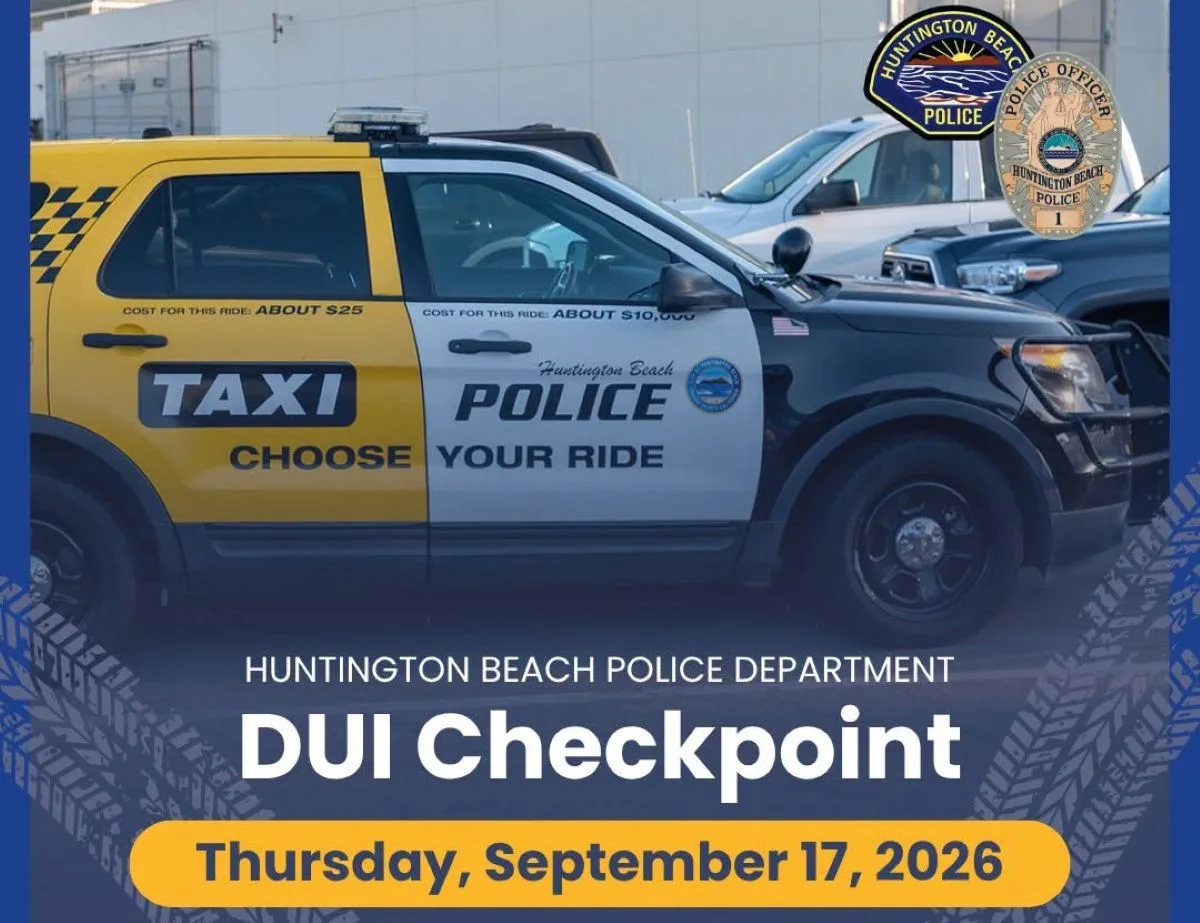
The Huntington Beach Police Department has released a new public‑safety notice confirming a CDL/DUI Checkpoint on Thursday, September 17, 2026, from 6:00 p.m. to 2:00 a.m. at an undisclosed location within city limits.

HBPD emphasizes that these checkpoints are designed to deter impaired driving, not simply to make arrests—but drivers who show signs of intoxication or licensing violations can face serious criminal and financial consequences.
Where HBPD Commonly Conducts DUI Checkpoints
While the exact location is undisclosed, HBPD historically concentrates checkpoints at high‑collision, high‑arrest corridors, including:
- Beach Blvd & Warner Ave — one of the city’s busiest DUI‑related crash zones
- Brookhurst St & Adams Ave — frequent DUI enforcement area
- Goldenwest St & Garfield Ave — near several prior fatal DUI collisions
- Edinger Ave near the 405 ramps — historically high DUI arrest density
- Pacific Coast Highway near Main St — nightlife corridor with recurring impaired‑driving issues
These intersections are selected based on multi‑year crash data, DUI arrest frequency, and nighttime traffic volume.
How Much Alcohol or Marijuana Can Lead to a DUI
Understanding how little it takes to be considered “impaired” is critical for Huntington Beach drivers. California law doesn’t require extreme intoxication — any measurable impairment can result in arrest, even if you’re below the legal limit.
Alcohol Impairment Thresholds
- 0.08% BAC for most adult drivers
- 0.04% BAC for commercial CDL drivers
- 0.01% BAC for drivers under 21
A typical adult can reach 0.08% BAC after 2–3 drinks, depending on weight, metabolism, food intake, and time. But HBPD stresses that impairment begins far earlier. Drivers have been arrested at 0.05% and even 0.03% when their driving showed signs of reduced coordination, delayed reaction time, or poor judgment.
Marijuana Impairment Thresholds Unlike alcohol, California has no fixed THC limit. Officers rely on:
- Driving behavior
- Field sobriety tests
- Toxicology results
- Observable impairment indicators (red eyes, slowed speech, delayed responses)
Studies show that THC levels above 5 ng/mL often correlate with impaired reaction time, but HBPD arrests drivers at any level if they appear unable to operate a vehicle safely. Edibles are especially risky because impairment can last 6–10 hours.
Prescription & OTC Medications HBPD reminds drivers that many legal medications — including sleep aids, painkillers, anti‑anxiety drugs, and antihistamines — can trigger a DUI Drugs charge if they affect driving ability.
Bottom Line If alcohol, marijuana, or medication changes how you feel, it can change how you drive — and that’s enough for HBPD to make an arrest.
Charges Drivers Commonly Face at HBPD Checkpoints
HBPD checkpoints routinely result in a mix of CDL, DUI, and California Vehicle Code (CVC/DVC) violations. Drivers may be arrested or cited for:
- DUI – VC 23152(a)/(b) — alcohol impairment or BAC ≥ 0.08
- DUI Drugs – VC 23152(f)/(g) — impairment from marijuana, prescription meds, or illegal drugs
- Commercial DUI – VC 23152(d) — CDL drivers face a strict 0.04 BAC limit
- Driving on Suspended License – VC 14601
- Unlicensed Driver – VC 12500
- Refusal to Submit to Chemical Testing – VC 23612
- Open Container – VC 23222
- Ignition Interlock Device Violations
- Vehicle Code equipment violations that lead to secondary enforcement
Impound fees typically run $250–$450, plus storage charges of $60–$100 per day, and administrative release fees. A first‑time DUI averages $13,500 in fines, penalties, classes, and insurance hikes.
Orange County DUI Checkpoint Arrest Data
Across Orange County, DUI checkpoints consistently generate high arrest numbers, especially in coastal cities. Over the past five years:
- OC agencies collectively average 2,200–2,600 DUI arrests per year
- Checkpoints alone account for 18–25% of annual DUI arrests
- Huntington Beach, Newport Beach, Costa Mesa, and Santa Ana produce the highest checkpoint‑related DUI totals
These numbers reflect both enforcement intensity and the region’s nightlife‑driven traffic patterns.
Worst Fatal DUI Crashes in Huntington Beach Area (Past 5 Years)
A review of major fatal DUI collisions in and around Huntington Beach shows several high‑impact cases:
- PCH & Magnolia fatal DUI crash (2022) — multi‑vehicle collision killing two
- Beach Blvd pedestrian DUI fatality (2023)
- Edinger Ave motorcycle DUI death (2021)
- Goldenwest St wrong‑way DUI crash (2024)
- PCH near Huntington St DUI double‑fatal (2020)
These cases illustrate why HBPD continues aggressive DUI enforcement.
HB Politicians Charged With DUIs
Huntington Beach has seen several political figures face DUI allegations over the years:
- Tito Ortiz — former mayor pro tem; arrested for DUI in 2019, ultimately convicted
- Grace Winchell — former council candidate; DUI conviction in mid‑2010s
- Dean Grose — former mayor; faced DUI allegations but was not convicted
These cases often become high‑visibility reminders of the consequences of impaired driving.
What You Should Do If Pulled Over
HBPD stresses calm, lawful cooperation:
- Keep hands visible on the steering wheel
- Provide license, registration, and insurance when asked
- Speak briefly and respectfully
- Do not volunteer unnecessary information
- If asked to exit the vehicle, comply safely
- If arrested, do not argue—exercise your right to remain silent and request an attorney
Tony Romo’s DUI Stop: What Not To Do
When former NFL quarterback Tony Romo was pulled over, he made several mistakes that escalated the situation:
- He argued with officers
- He refused instructions
- He made statements that were later used against him
- He appeared visibly impaired and uncooperative
HBPD officers consistently warn that belligerence, refusal, or over‑talking only worsens outcomes.
Tips to Stay Out of Trouble
- Use Uber, Lyft, or a taxi
- Assign a sober driver
- Avoid driving after consuming marijuana or impairing medications
- Read prescription warning labels
- Plan your night before you start drinking
- If you feel “buzzed,” you are not safe to drive
- Remember: a safe ride costs $20–$30; a DUI costs $13,500+