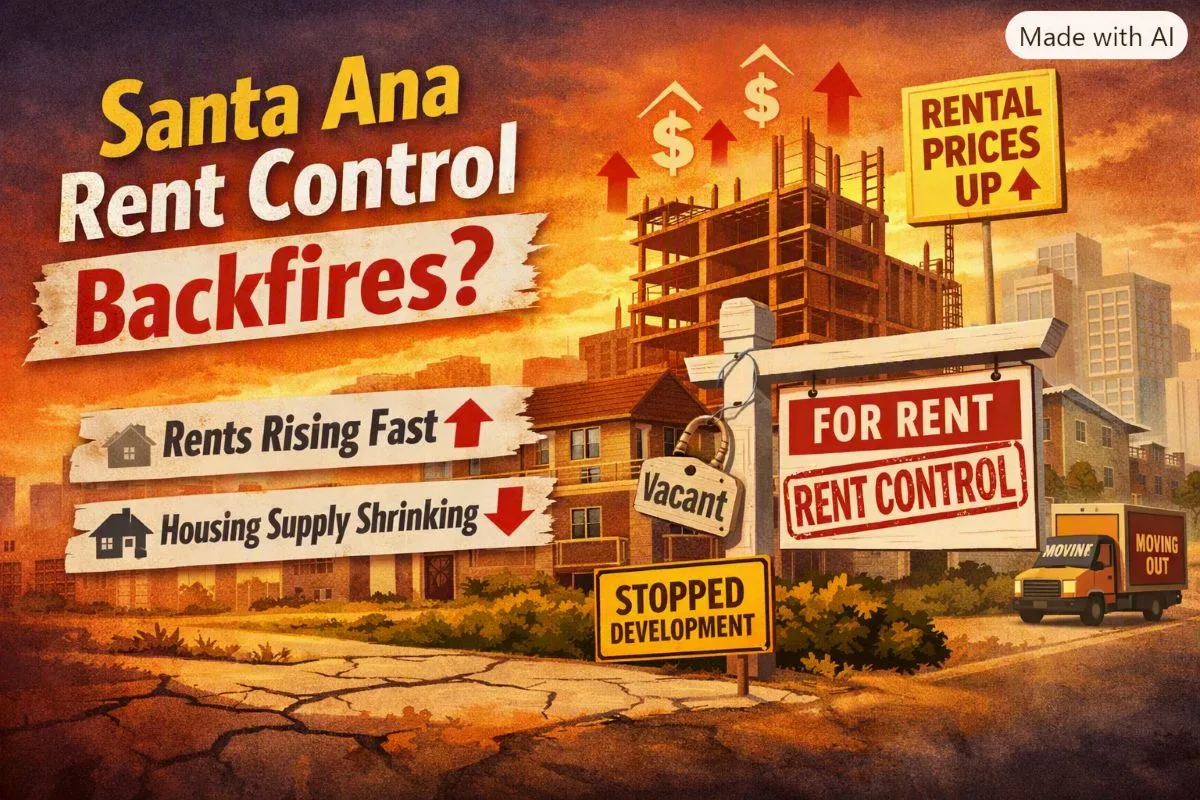
Santa Ana’s rent‑control ordinance was intended to stabilize housing costs, but current market data from Zumper shows the opposite trend: rents in the city are rising faster than almost anywhere else in the Los Angeles metro.

The ordinance caps increases only for pre‑1995 multifamily units, leaving most of the city’s rental stock exempt. Newer apartments, single‑family rentals, ADUs, condos, and small‑landlord units continue to reprice at full market rates, which is why Santa Ana shows both rapid rent growth and one of the lowest average rents in Orange County.
The ordinance protects sitting tenants in older buildings, but it does not suppress the citywide median because asking rents reset at vacancy and exempt units reprice freely.
Evidence the Ordinance Is Already Reducing Supply
Early indicators point to supply‑side pressure consistent with rent‑control distortions.
- Coverage gaps allow landlords to avoid the cap by shifting units into exempt categories or prioritizing turnover.
- Strict compliance requirements such as full code compliance, registration, and mandatory notices increase operating friction and reduce incentives to maintain older units.
- Just‑cause eviction rules and relocation payments raise the cost of turnover, encouraging owners to hold units vacant during renovations or repositioning.
- Ban on algorithmic rent‑setting software suggests landlords were aggressively repricing exempt units and may discourage professional operators from expanding in Santa Ana.
- Vacancy and leasing data show Santa Ana with a 5.5% vacancy rate and a 24‑day average leasing time, the highest and slowest in Orange County, indicating landlords may be pulling units offline or waiting for turnover to reset rents.
- Long‑term rent trends from RentDataNow show Santa Ana rents rising 30.9% from 2021–2026, outpacing Anaheim despite Anaheim having no rent control, a divergence consistent with reduced investment in older stock and increased pressure on newer, exempt units.

Who Drove Santa Ana’s Rent‑Control Ordinance and How the Council Voted
The political force behind Santa Ana’s rent‑control ordinance was Councilwoman Jessie Lopez, who made tenant‑protection policy a central part of her platform and pushed for the strongest possible version of the law. Lopez consistently framed rent stabilization as a moral and equity‑driven priority, led outreach with tenant‑advocacy groups, and pressed staff for stricter caps and broader just‑cause eviction rules. While the ordinance passed through a coalition, Lopez was widely viewed as the primary driver.
The ordinance passed with support from three councilmembers:
- Jessie Lopez
- Benjamin Vazquez
- Johnathan Ryan Hernandez
- Thai Viet Phan
These members formed the progressive bloc that backed rent control, arguing it was necessary to protect long‑term tenants from displacement and rising housing costs.
It should be noted that these three Council Members also voted against allowing the Santa Ana Police Department to use drones, which is aging badly as the SAPD has been effectively catching many criminal suspects with help from their drones.
Vazquez is running for reelection this November. Lopez is running for the State Assembly. Clearly the voters should reject them both!
The remaining Santa Ana City Councilmembers opposed the rent control ordinance ordinance. Those voting against rent control were:
- Phil Bacerra
- David Penaloza
- Mayor Valerie Amezcua
Opponents argued the ordinance would reduce housing supply, discourage investment, and create administrative burdens that could worsen affordability over time. They also warned that Santa Ana could become an outlier in Orange County, making the city less attractive for new development.
Of these candidates Bacerra and Amezcua are up for reelection this November. Penaloza is running for the State Assembly against Lopez. All three have New Santa Ana’s endorsement.
What all this Means for Renters and Landlords
Santa Ana’s ordinance stabilizes rents only for tenants who remain in covered units. Everyone else faces rising market prices driven by exempt stock and vacancy resets. Landlords operating older buildings face higher compliance costs and lower allowable increases, which may reduce reinvestment and shrink supply over time.
The early data does not yet show a formal drop in total unit count, but the behavioral indicators—higher vacancy, slower leasing, increased turnover management, and landlord repositioning—align with well‑documented patterns in cities where rent caps reduce incentives to maintain or expand housing stock.
So, if rental prices are increasing only on units that aren’t covered by rent control because landlords are continuing to increase rents on their non-covered units, then isn’t the solution to make the ordinance more far-reaching and over more units? I mean, I guess the problem also is the growing wealth inequality that enables landlords to charge those rents — for each astronomically-priced unit that gets rented, there is some high-income earner who can afford it and signs the lease (if there were no such renters, then the unit wouldn’t get leased).
But if the rent-control ordinance covered more units, then those units wouldn’t be able to see further price increases. Of course, this would actually lead to the constraining of supply that you are alluding to it causing, since it would disincentivize construction of new supply, which would in turn further exacerbate rent price increases. But I don’t think you can make the claim that this rent-control ordinance, as-is, is causing the increase in prices, since it only affects covered units.
The data does show that, as we expected, this ordinance is resulting in less housing stock. If you expand the ordinance further that problem will escalate.
The reason rents are high in Santa Ana is simple Supply and Demand. There are too many people looking for housing so that drives the cost up. To increase housing we need to make it easier to developn new housing. Currently the NIMBY portion of our population too often shoots down new housing near their neighborhoods….
Santa Ana is no longer Santa Ana, it’s now another expensive woke city filled with garbage, criminals, homeless bums that don’t wanna work, & corrupt politicians as the rent goes up
We need to incentivize people and commerce to leave the major metro areas and repopulate smaller cities and towns throughout the country. Unfortunately, our politicians have found that if you concentrate people in dense metro areas, they create solid, reliable, left-wing voting blocs. Remember, the last thing they want is for you to be middle class living in a quiet comfortable home that you own outright in the safe, mid to low-density neighborhood where you work (and in turn keep the capital of your work fueling your local community). So instead they align themselves with private equity and corrupt labor unions while stoking the fires of class divide– old money “NIMBYs” pointing fingers, a non-existent middle class, and the poor cornered and hopeless, unable to afford rent with no upwardly mobile job prospects and thusly radicalized to resent wealth and capital. It’s easier for them to win elections that way. Then add to that the most powerful economic engine the world has ever seen invests trillions of dollars a year into AI to make human capital obsolete. These are the times we’re living in. Some of the most complex structural economic and social problems in history– and we elect idiots to office based on a slogan or a hunch expecting them to fix it.