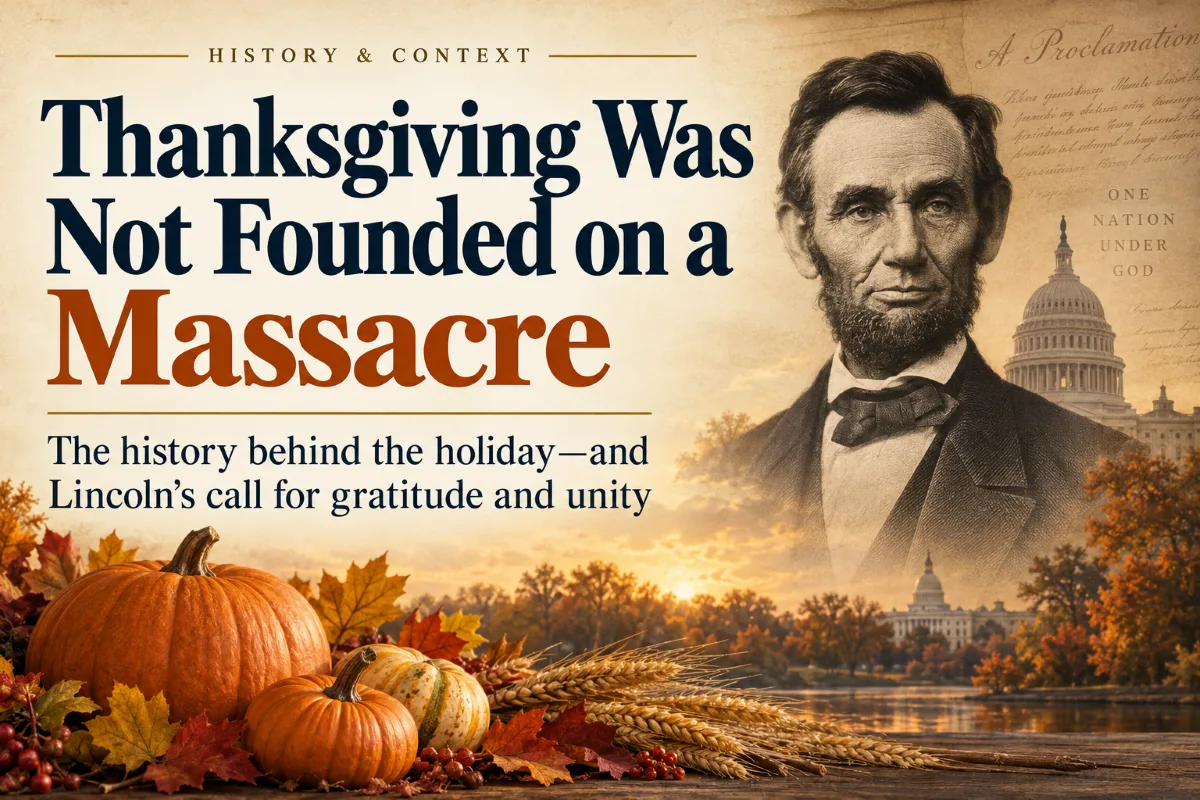
Every year as Thanksgiving approaches, social media fills with claims that the holiday was “founded on a massacre” rather than a celebration of gratitude. The claim often sparks heated debates, with some Americans defending the traditional Thanksgiving story and others arguing that the holiday ignores the suffering experienced by Native Americans after European settlement.
The historical reality is more nuanced than either side often presents.
While America’s modern Thanksgiving holiday is rooted in a real 1621 harvest celebration involving English settlers and Native Americans, it was not founded as a commemoration of a massacre. In fact, the national Thanksgiving holiday celebrated by Americans today was established more than two centuries later by President Abraham Lincoln during the Civil War.
A Harvest Feast, Not a Massacre
The event most Americans associate with Thanksgiving took place in 1621 at Plymouth Colony in present-day Massachusetts.
English settlers, commonly known as the Pilgrims, joined members of the Wampanoag tribe for a harvest feast after the colony’s first successful growing season. Historians generally agree that some version of this gathering took place, although many details commonly taught in schools have been simplified over the years.
The feast represented a period of cooperation between the colonists and the Wampanoag people, whose assistance helped the struggling settlers survive in an unfamiliar environment.
Contrary to popular claims circulating online, historians do not generally describe the 1621 gathering itself as a massacre or a celebration of violence.
Where the Massacre Narrative Comes From
The controversy largely stems from later events in colonial New England.
One of the most significant was the Pequot War of 1636-1638. During that conflict, English colonists and their Native allies attacked a Pequot village near Mystic, Connecticut, in 1637. Hundreds of Pequot men, women, and children were killed in what has become known as the Mystic Massacre.
Some colonial leaders also declared days of thanksgiving following military victories over Native tribes. Critics argue that these proclamations have become intertwined with the history of Thanksgiving in the public imagination.
As a result, many modern discussions blend together:
- The 1621 Plymouth harvest feast.
- Later colonial thanksgiving observances.
- Violent conflicts between colonists and Native Americans.
- The broader history of displacement, warfare, and disease that followed European settlement.
This blending of separate historical events has led some people to inaccurately conclude that Thanksgiving itself was founded on a massacre.
Lincoln Created the Modern National Holiday
The Thanksgiving celebrated across the United States today owes far more to Abraham Lincoln than it does to colonial-era observances.
In 1863, as the nation was being torn apart by the Civil War, Lincoln issued a proclamation establishing a national Thanksgiving observance. The United States had suffered enormous losses, and the country’s future was uncertain.
Lincoln hoped a national day of thanksgiving would encourage:
- National unity during a time of division.
- Reflection on the nation’s blessings despite the war.
- A sense of shared American identity.
- Gratitude and hope for the future.
The timing was significant. Lincoln issued his proclamation just months after the Union victory at Gettysburg, one of the war’s most important turning points.
Many historians also credit Sarah Josepha Hale, editor of the influential magazine Godey’s Lady’s Book, with helping make Thanksgiving a national holiday. Hale spent nearly two decades urging presidents and governors to establish a nationwide observance before Lincoln finally acted.
While colonial traditions influenced the holiday, Lincoln’s proclamation effectively created the annual national Thanksgiving that Americans continue to celebrate today.
A Holiday Celebrated by Tens of Millions of Americans
Thanksgiving remains one of the most widely observed holidays in the United States.
According to travel and consumer surveys conducted in recent years, tens of millions of Americans travel during the Thanksgiving period to gather with family and friends. The holiday routinely ranks among the busiest travel periods of the year, with airports, highways, and train stations seeing massive surges in activity.
For many Americans, Thanksgiving has little to do with politics or colonial history. Instead, it serves as an opportunity to reconnect with loved ones and take stock of the positive things in life.
Common traditions include:
- Family dinners and gatherings.
- Sharing expressions of gratitude.
- Community service and charitable activities.
- Fundraising drives for food banks and shelters.
- Watching football games and holiday parades.
- Beginning the holiday season with family and friends.
Many churches, civic organizations, and nonprofit groups also organize Thanksgiving meals for individuals and families facing financial hardship.
Why the Debate Continues
The debate over Thanksgiving persists because the holiday sits at the intersection of two very different historical realities.
One reality is the documented cooperation between the Pilgrims and the Wampanoag during the early years of Plymouth Colony.
The other is the tragic history of conflict, displacement, and loss experienced by Native American communities in the centuries that followed.
Many Native American groups observe Thanksgiving as a time for reflection on those historical experiences. Since 1970, Native activists have held a National Day of Mourning in Plymouth, Massachusetts, to highlight perspectives often left out of traditional holiday narratives.
Recognizing that history, however, does not require abandoning historical accuracy.
The Bottom Line
The evidence does not support the claim that Thanksgiving was founded on a massacre.
The 1621 gathering commonly associated with Thanksgiving was a harvest celebration involving both English settlers and members of the Wampanoag tribe. The modern national holiday Americans celebrate today was established by President Abraham Lincoln in 1863 as a way to promote unity and gratitude during the Civil War.
The violent conflicts that occurred later between colonists and Native Americans are an important part of American history and deserve honest discussion. But they are not the same event as the 1621 harvest feast, nor were they the reason Lincoln created the national Thanksgiving holiday.
For millions of Americans, Thanksgiving remains what Lincoln intended it to be: a day to pause, give thanks, gather with family and friends, and reflect on the blessings that endure even during difficult times.