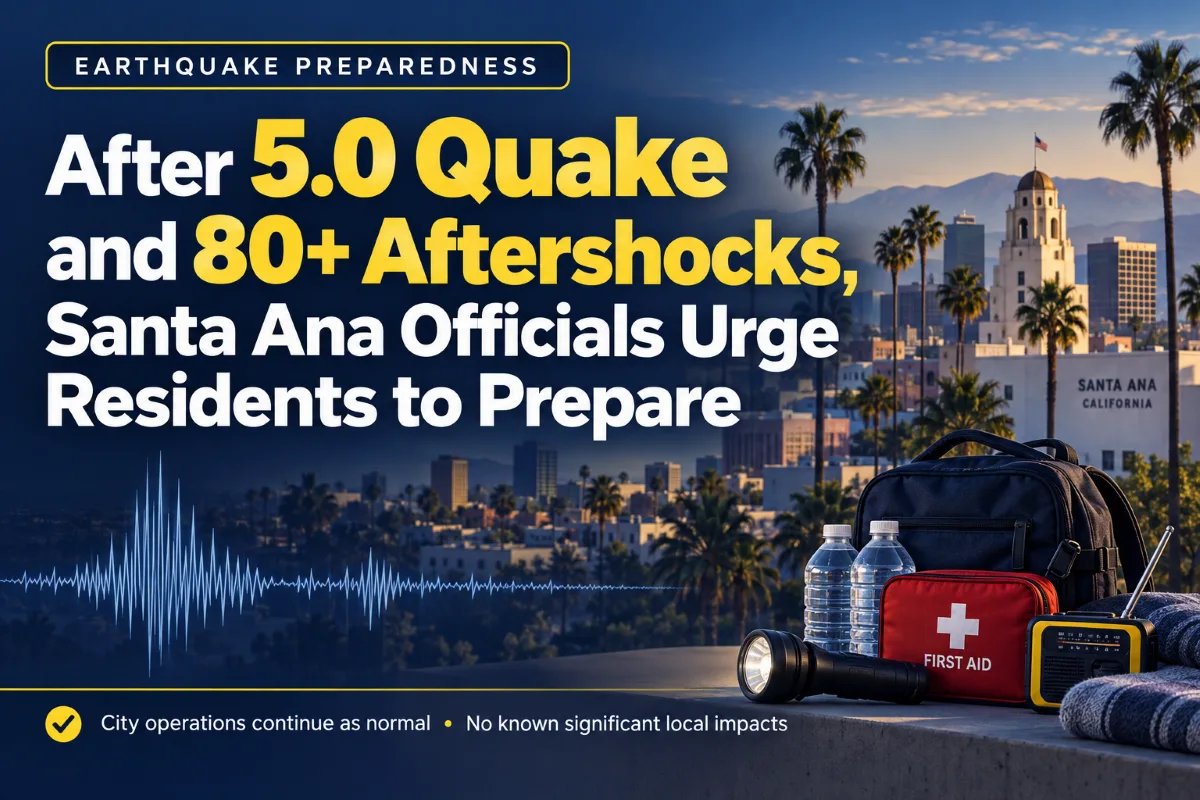
A magnitude 5.0 earthquake centered offshore near Manhattan Beach rattled much of Southern California on Saturday morning, prompting widespread shaking from Los Angeles County into Orange County and triggering dozens of aftershocks throughout the day.
In response to the quake, the City of Santa Ana announced that city operations continue as normal and that officials are not aware of any significant impacts within the community.
“The City of Santa Ana is aware of this morning’s earthquake. City operations continue as normal, with no known significant impacts to our community,” the city said in a public statement.
Residents were encouraged to review emergency preparedness information at ReadyOC.com.
Limited Damage Reported Across Southern California
While the earthquake was widely felt, early reports indicate that damage was relatively minor considering the magnitude of the event.
Authorities reported no widespread structural damage or fatalities. Los Angeles Fire Department inspectors conducted surveys of critical infrastructure and found no major impacts. Some minor damage was reported near the epicenter, including broken glass at Los Angeles International Airport and isolated reports of fallen household items. Several South Bay piers were temporarily closed while inspections were completed.
Seismologists noted that the offshore location of the quake likely reduced the amount of damage experienced on land.
Dozens of Aftershocks Follow Main Quake
The earthquake was followed by a vigorous aftershock sequence.
By late afternoon, seismologists had recorded more than 80 aftershocks, including several quakes in the magnitude 4 range. The strongest aftershock measured approximately magnitude 4.5 to 4.6 and was felt throughout much of Southern California. Experts expect additional aftershocks in the coming days and possibly weeks.
According to seismologist Dr. Lucy Jones, most aftershocks should become smaller over time, but residents should remain prepared for additional noticeable shaking.
Does This Mean “The Big One” Is Coming?
One question inevitably raised after every significant Southern California earthquake is whether it signals that the long-feared “Big One” is getting closer.
The honest answer is that scientists do not know.
According to the U.S. Geological Survey and earthquake researchers, no scientific method currently exists to predict exactly when a major earthquake will occur. A magnitude 5.0 earthquake does not necessarily increase the likelihood of a major San Andreas Fault rupture in any meaningful way.
Southern California remains one of the most seismically active regions in North America because of its complex network of faults, including the San Andreas, Newport-Inglewood, Elsinore, Whittier, San Jacinto, and Puente Hills fault systems. Geologists have long warned that a major earthquake is inevitable at some point, but they cannot determine whether that event is years, decades, or even centuries away.
What this weekend’s quake does illustrate is that Southern California’s fault system remains active and capable of producing potentially damaging earthquakes without warning.
Earthquake Preparedness Tips for Residents
Emergency officials recommend that households prepare to be self-sufficient for at least several days after a major earthquake.
Key preparedness steps include:
- Store at least one gallon of water per person per day for several days.
- Keep a supply of nonperishable food.
- Maintain flashlights, extra batteries, and portable phone chargers.
- Stock first-aid supplies and essential medications.
- Secure heavy furniture, bookcases, televisions, and appliances to walls.
- Learn how to shut off natural gas if a leak develops.
- Keep copies of important documents in waterproof containers.
- Develop a family communication and reunification plan.
- Sign up for emergency alerts and download the MyShake earthquake warning app.
- Practice “Drop, Cover, and Hold On” with all household members.
Earthquake Preparedness Tips for Businesses
Businesses can suffer significant financial losses even when buildings remain standing.
Business owners should consider:
- Securing shelving, equipment, and inventory.
- Backing up critical data both locally and in cloud storage.
- Establishing business continuity and recovery plans.
- Training employees on earthquake response procedures.
- Maintaining emergency supplies for staff.
- Inspecting older buildings for seismic vulnerabilities.
- Creating alternative communication methods if cell service becomes disrupted.
- Identifying backup locations for critical operations.
- Reviewing insurance coverage for earthquakes and business interruptions.
Understanding Earthquake Insurance
Many Californians are surprised to learn that standard homeowners insurance policies generally do not cover earthquake damage.
Earthquake coverage is typically purchased separately or through policies offered by the California Earthquake Authority (CEA), the state’s largest provider of residential earthquake insurance.
Coverage can help pay for:
- Structural repairs to homes.
- Replacement of personal property.
- Debris removal.
- Temporary living expenses if a home becomes uninhabitable.
However, earthquake policies often carry deductibles ranging from 5% to 25% of the insured value of a home. For a home insured for $800,000, a 15% deductible could leave the homeowner responsible for the first $120,000 in losses before insurance coverage begins.
Business owners may need separate commercial earthquake policies and should carefully review whether business interruption losses are included.
A Reminder for Santa Ana Residents
Although Saturday’s earthquake appears to have caused only minor damage in Southern California and no major impacts in Santa Ana, emergency managers say the event should serve as a reminder that the region remains vulnerable to larger earthquakes.
Residents seeking preparedness information can visit ReadyOC.com for local emergency planning resources, evacuation guidance, emergency supply checklists, and disaster preparedness information.