Thousands of Orange County residents who rely on Medi-Cal may soon notice a significant change in how they access health care, although county officials stress that the change does not mean they are losing coverage.
The Orange County Social Services Agency recently announced that beginning Jan. 1, 2027, certain Medi-Cal recipients will be moved out of Medi-Cal managed care plans and into the state’s traditional Fee-For-Service Medi-Cal system.
The announcement has caused confusion because the term “Fee-For-Service” sounds like patients will have to start paying for medical care. That is not the case.
Under the change, Medi-Cal will continue paying for covered medical services. The difference is that patients may need to find doctors and clinics that accept Medi-Cal Fee-For-Service rather than receiving care through a managed care network.
What Is Actually Changing?
For years, most Orange County Medi-Cal recipients have received benefits through managed care plans operated by health insurance companies contracted by the state.
Under managed care:
- Patients enroll in a health plan.
- The health plan provides a network of doctors, specialists and clinics.
- The health plan coordinates care and pays providers.
Under Fee-For-Service Medi-Cal:
- Patients are not assigned to a managed care network.
- Patients can seek care from any provider that accepts Fee-For-Service Medi-Cal.
- The state pays doctors, hospitals and other providers directly for each covered service.
The state is changing only the delivery system for certain recipients. Eligible individuals will continue to have Medi-Cal coverage if they remain qualified and complete their annual renewals.
Who Will Be Affected?
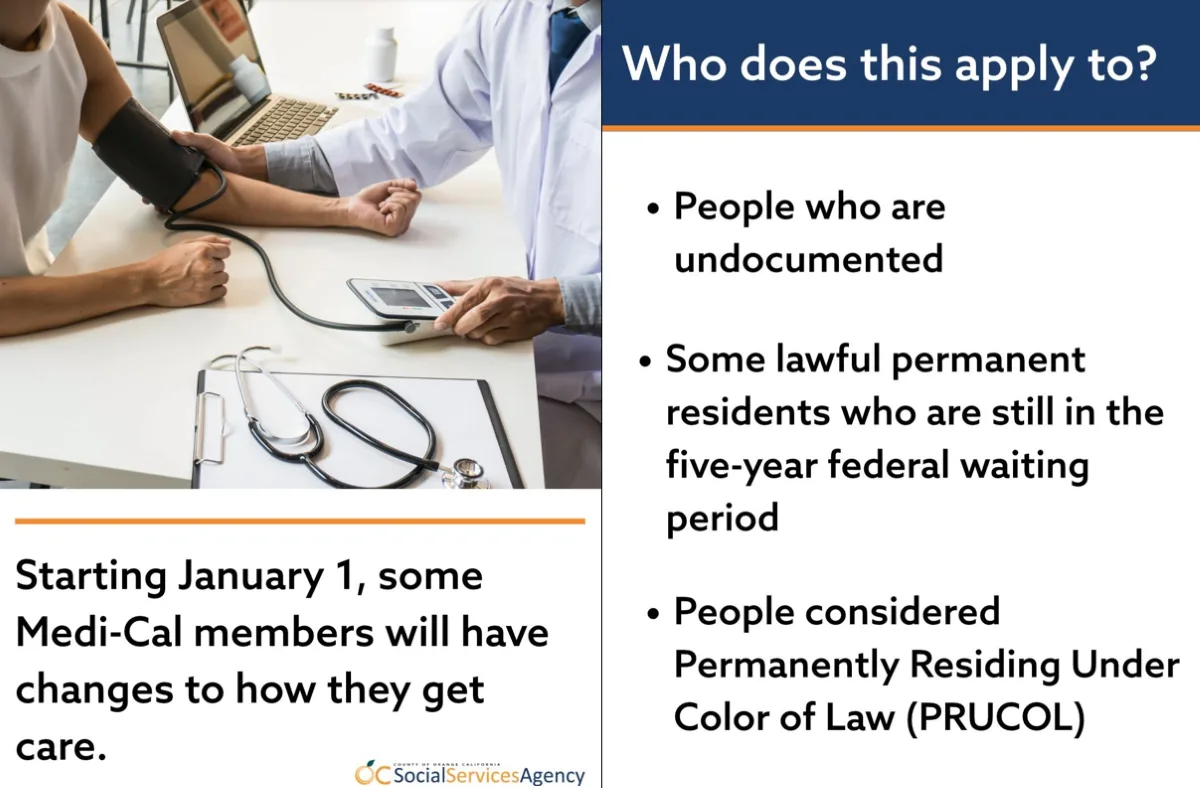
According to the county announcement, the transition applies primarily to:
- Undocumented immigrants who qualify for California’s state-funded Medi-Cal expansion.
- Some lawful permanent residents who are still within the federal five-year waiting period for Medicaid eligibility.
- Individuals classified as Permanently Residing Under Color of Law (PRUCOL), a longstanding immigration category that includes certain non-citizens who are allowed to remain in the United States under specific circumstances.
In practical terms, these are populations whose Medi-Cal benefits are primarily funded by California rather than the federal government.
How Many Orange County Residents Could Be Affected?
Neither the county nor the state has yet released a county-specific estimate.
However, Orange County’s Medi-Cal caseload exceeds 900,000 residents, representing roughly one in four county residents.
Based on statewide enrollment data and Orange County’s large immigrant population, a reasonable estimate is that somewhere between 80,000 and 150,000 Orange County Medi-Cal recipients could potentially fall into the categories identified for the transition.
The actual number may be lower because not every undocumented or PRUCOL recipient currently participates in a managed care plan.
Santa Ana alone has one of the largest concentrations of Medi-Cal recipients in California, due in part to its large low-income and immigrant populations.
Which Orange County Cities Likely Have the Most Medi-Cal Recipients?
While enrollment figures are not routinely published by city, demographic and poverty data strongly suggest the highest concentrations of Medi-Cal users are located in:
- Santa Ana
- Anaheim
- Garden Grove
- Westminster
- Fullerton
Santa Ana is generally considered the county’s largest Medi-Cal enrollment center because of its high poverty rate and large population of lower-income families.
Anaheim follows due to its size and significant working-class population.
Garden Grove and Westminster have substantial immigrant communities and large numbers of residents who qualify for public assistance programs.
Fullerton’s size and mix of lower-income neighborhoods place it among the county’s top Medi-Cal enrollment communities as well.
Why Some Patients May Be Concerned
Although recipients will remain covered, the transition could still create challenges.
Many patients have developed long-term relationships with doctors participating in managed care networks. Not all of those providers accept Fee-For-Service Medi-Cal.
As a result, affected patients may need to:
- Verify whether current physicians will continue seeing them.
- Locate new primary care providers.
- Transfer medical records.
- Learn new referral procedures.
- Update pharmacies and specialists if necessary.
Health care advocates have long noted that finding providers who accept Fee-For-Service Medi-Cal can sometimes be more difficult than finding doctors within managed care networks because reimbursement rates are often lower.
What Recipients Should Do Now
The county is advising potentially affected residents to take several steps before January:
- Ask current doctors and clinics whether they accept Fee-For-Service Medi-Cal.
- Keep Beneficiary Identification Cards (BICs) available for medical appointments.
- Watch for notices from Medi-Cal.
- Complete annual eligibility renewals on time.
- Confirm contact information is current with county social services.
Residents needing assistance finding participating providers can use the state’s provider directory at: https://dhcs.ca.gov/findcare. They may also call the Medi-Cal Help Line at 800-541-5555.
How Large Is Orange County’s Social Services Budget?
The scale of Orange County’s public assistance system helps explain why changes like this affect so many residents.
The Orange County Social Services Agency operates one of the largest county human services systems in California, administering Medi-Cal, CalFresh, CalWORKs, In-Home Supportive Services and numerous child welfare programs.
The agency’s annual budget is generally measured in the billions of dollars, with recent adopted budgets exceeding $4 billion when federal, state and county funding sources are combined.
Medi-Cal administration and eligibility services represent one of the agency’s largest responsibilities, serving hundreds of thousands of county residents every month.
Bottom Line
The upcoming Jan. 1 transition does not eliminate Medi-Cal coverage for affected Orange County recipients. Instead, it changes the way medical services are delivered and paid for.
For many recipients the transition could be little more than a paperwork change. For others, especially those whose doctors do not accept Fee-For-Service Medi-Cal, it may require finding new providers and learning how to navigate a different system.
With potentially tens of thousands of Orange County residents affected, health advocates and county officials will likely be watching closely to see whether the transition causes disruptions in patient care during the first months of 2027.