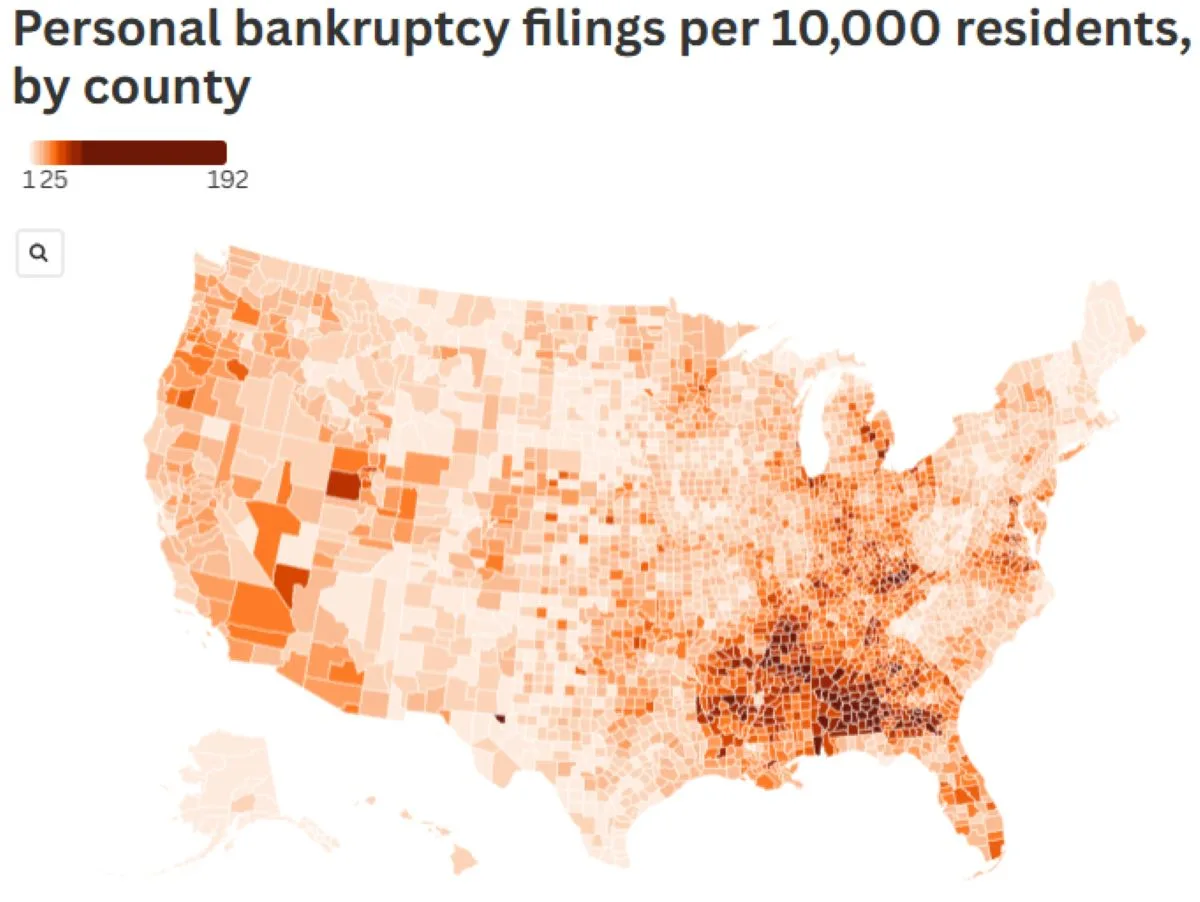
Orange County’s economic warning lights are flashing as bankruptcy filings continue to rise, underscoring the financial strain many local families and businesses are experiencing despite years of headlines touting a strong economy.
According to a new analysis of federal court records by The Kaplan Group, Orange County households and businesses filed 4,037 bankruptcy cases in the 12 months ending Sept. 30, a 7% increase from the 3,765 filings recorded during the previous year. More significantly, bankruptcy filings have now increased for four consecutive years.
The latest figures suggest that many residents are struggling with a combination of high housing costs, inflation, rising insurance premiums, growing consumer debt, and elevated interest rates that continue to squeeze household budgets.
Personal Bankruptcies Drive the Increase
The overwhelming majority of bankruptcy filings in Orange County involved individuals and families rather than businesses.
Personal bankruptcies rose from 3,338 cases to 3,644 during the latest reporting period, accounting for most of the county’s overall increase.
Business bankruptcy filings actually declined slightly, falling from 427 filings to 393. However, experts caution that business distress remains a serious concern, particularly because many companies that never file bankruptcy can still suffer significant financial harm when customers or business partners seek court protection from their debts.
A contractor, for example, may complete a project, pay employees, purchase materials, and cover overhead costs, only to discover that the customer has filed for bankruptcy protection. Collection efforts generally must stop once a bankruptcy case is filed, potentially leaving the contractor waiting months for payment, receiving only a fraction of the amount owed, or receiving nothing at all.
For small and medium-sized businesses operating on tight margins, even one large unpaid invoice can trigger significant financial hardship.
Orange County Business Bankruptcies Outpace State and National Rates
While the raw number of business bankruptcy filings declined year over year, Orange County’s business bankruptcy filing rate remains higher than both the California and national averages.
The county recorded approximately 3.67 business bankruptcy filings per 1,000 businesses, compared to 3.51 statewide and 3.18 nationally.
That statistic suggests Orange County companies continue to face unusually strong financial pressures despite being located in one of California’s most affluent regions.
Nationally, business bankruptcy filings have more than doubled from their low point four years ago and now exceed pre-pandemic levels. Personal bankruptcy filings are also rising across the country, although they remain below where they stood before COVID-19.
A Sign of Broader Economic Anxiety
The steady rise in bankruptcies may help explain some of the voter frustration seen in recent elections throughout California and across the nation.
While economic indicators such as unemployment rates and stock market performance often dominate political discussions, the lived experience of many working families tells a different story. For residents facing higher grocery bills, rising utility costs, expensive insurance premiums, increased rent, and persistent housing affordability challenges, economic conditions often feel far worse than headline statistics suggest.
In Orange County, many middle-class households report feeling financially stretched despite maintaining steady employment. The reality of working full time while falling behind on credit card balances, personal loans, and basic living expenses has created growing dissatisfaction among voters who increasingly question whether economic growth is benefiting average families.
The rising bankruptcy figures serve as another data point suggesting that financial stress remains widespread even in one of Southern California’s wealthier counties.
Why Are Struggling Voters Still Approving Higher Taxes?
One of the more surprising developments in Orange County is that rising financial distress has coincided with continued voter support for tax increases and government spending measures.
In the most recent election, voters across Orange County approved many local tax and bond measures despite growing concerns about inflation, housing costs, consumer debt, and affordability. In Santa Ana, voters approved an extension of the city’s sales tax, preserving what remains one of the highest sales tax rates in Orange County.
At first glance, the trend appears contradictory. If thousands of households are struggling badly enough to consider bankruptcy, why would voters support measures that could increase their tax burden?
Political analysts point to several possible explanations. Many voters may not connect local tax measures to their personal financial challenges, viewing the costs as relatively small compared to benefits such as funding public safety, parks, street repairs, homelessness programs, and city services. Others may support higher taxes because they believe government intervention can help address economic inequality and affordability concerns.
Generational attitudes may also play a role. Younger voters, who have become a larger share of the electorate, generally express greater support for labor unions, government spending, social programs, and public-sector investment than previous generations. While many younger residents face substantial financial pressures themselves, they may still view increased public spending as part of the solution rather than part of the problem.
Critics argue that this creates a troubling cycle. As the cost of living rises, voters often demand additional services and programs. Governments respond by seeking additional revenue through taxes and fees. The result can be an even higher cost of living for residents who are already struggling to balance household budgets.
The growing number of bankruptcy filings in Orange County raises an important question for policymakers and voters alike: at what point does the cumulative impact of sales taxes, fees, insurance increases, housing costs, utility bills, and consumer debt become unsustainable for working families?
Whether one supports or opposes tax increases, the latest bankruptcy figures suggest that a growing number of Orange County residents are approaching that breaking point.
The Holiday Season Could Add More Financial Pressure
The timing of the report is significant as Orange County enters the holiday shopping season.
Many families already carrying credit card balances may be tempted to take on additional debt for gifts, travel, entertainment, and holiday gatherings. Financial experts frequently note that holiday spending can create a cycle in which December purchases become January debt problems, particularly when those purchases are financed with high-interest credit cards.
With bankruptcy filings already trending upward, avoiding unnecessary debt may be more important than ever.
Holiday Money-Saving Tips for Orange County Families
Families looking to reduce financial stress this holiday season may want to consider several practical cost-saving strategies:
- Set a firm holiday budget and pay with cash or debit whenever possible.
- Organize gift exchanges instead of purchasing gifts for every family member.
- Take advantage of local holiday events offered by cities such as Santa Ana, Anaheim, Costa Mesa, and Huntington Beach that provide free entertainment.
- Compare grocery prices between Aldi, Costco, Walmart, Trader Joe’s, Grocery Outlet, and local ethnic markets.
- Purchase holiday decorations after Christmas and save them for next year.
- Take advantage of cashback programs offered through Rakuten, Capital One Shopping, and major credit card rewards programs.
- Review recurring subscriptions and cancel unused streaming services, apps, and memberships.
- Prepare more meals at home rather than relying on restaurant dining and food-delivery services.
- Consider gently used gifts, books, sporting goods, bicycles, and electronics available through Facebook Marketplace, OfferUp, and local thrift stores.
- Delay major discretionary purchases until household finances stabilize.
What the Numbers Show
Orange County bankruptcy filings for the 12 months ending Sept. 30, 2026:
- Total filings: 4,037, up from 3,765 a year earlier
- Personal filings: 3,644, up from 3,338
- Business filings: 393, down from 427
- Business filings counting related-company cases once: 378, up slightly from 376
- Filings have increased every year since 2022
While Orange County’s economy continues to generate jobs and attract investment, the county’s fourth consecutive annual increase in bankruptcy filings suggests that many residents and businesses remain under considerable financial pressure. As families head into the holiday season and policymakers assess voter concerns following recent elections, the growing number of bankruptcies offers a sobering reminder that economic hardship remains a reality for thousands of local households.