A new study reviewed by the law firm Sweet James is shedding light on the devastating impact hit-and-run crashes continue to have on California’s most vulnerable road users. While statewide pedestrian fatalities have recently declined, the research found that drivers who flee the scene remain a major factor in traffic deaths involving people walking and riding bicycles.
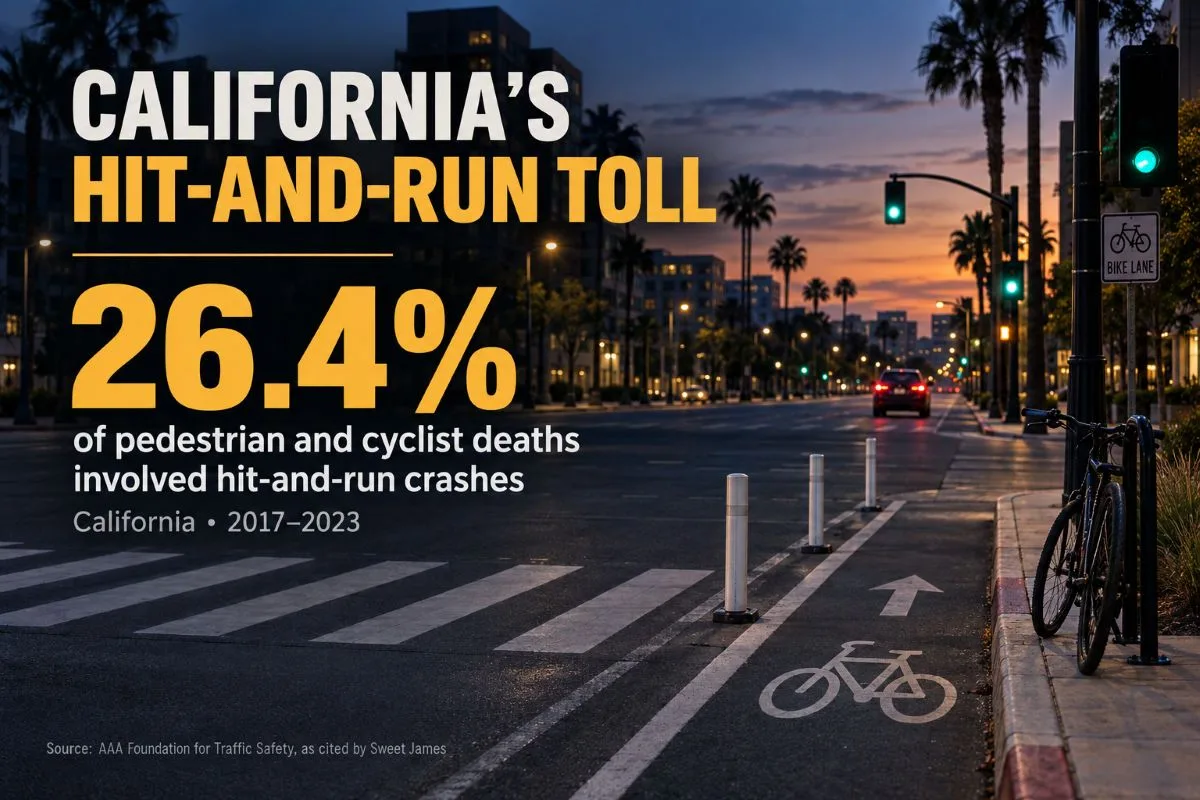
According to the analysis, 10.5% of all traffic fatalities in California between 2017 and 2023 occurred in hit-and-run crashes. The danger is substantially greater for pedestrians and cyclists. During that seven-year period, 8,491 pedestrians and cyclists were killed on California roadways, and 26.4% of those deaths involved a driver who fled the scene. In other words, more than one in four pedestrians and cyclists killed in California were left behind by the motorist who struck them.
Those findings come despite signs of improvement in overall pedestrian safety. The Governors Highway Safety Association reported that California experienced a 22.4% decline in pedestrian deaths in 2025, one of the largest decreases in the nation. Yet the new data suggests hit-and-run collisions remain a persistent and deadly public safety problem.
California’s Hit-and-Run Problem Remains Severe
The AAA Foundation data analyzed by Sweet James shows that of California’s 28,494 total traffic deaths from 2017 through 2023, approximately 2,992 involved hit-and-run crashes.
The risks are especially pronounced for people outside of vehicles. Pedestrians and bicyclists have no protective frame, airbags, or seat belts to shield them during a collision. As a result, a crash that might produce moderate injuries to vehicle occupants can prove fatal to someone walking or cycling.
The California Highway Patrol’s November 2025 report to the Legislature further illustrates the challenge facing investigators. CHP investigated 614 fatal hit-and-run crashes between January 2023 and November 2025. During that same period, California’s Yellow Alert system, which is designed to help locate drivers who flee fatal crashes, was activated only twice and resulted in a single arrest.
The numbers highlight how difficult it can be for law enforcement agencies to identify and locate fleeing drivers, even in the most serious cases.
Poor Driving Behaviors Continue to Fuel Serious Crashes
Traffic safety experts have long identified several behaviors that significantly increase the likelihood of severe pedestrian and bicycle collisions.
Common contributing factors include:
- Distracted driving, particularly texting or cellphone use behind the wheel.
- Excessive speed on city streets.
- Failure to yield at crosswalks and intersections.
- Running red lights and stop signs.
- Impaired driving involving alcohol or drugs.
- Aggressive driving and unsafe lane changes.
- Driving without a valid license.
- Driving uninsured or with suspended driving privileges.
The study found that among known drivers involved in fatal hit-and-run crashes nationwide, approximately 40% did not possess a valid driver’s license. More than half were operating vehicles not registered in their own names, conditions that may create additional incentives to flee after a collision.
California’s High Uninsured Driver Rate Adds Another Layer of Risk
The financial consequences of hit-and-run crashes are magnified by California’s unusually high number of uninsured drivers.
According to a separate Sweet James analysis of Insurance Research Council data, an estimated 20.4% of California drivers were uninsured in 2023, compared to a national average of 15.4%. That means roughly one in five California motorists may be driving without insurance coverage.
The study found California ranks among the states with the highest uninsured driving rates in the country. California’s rate exceeds neighboring states including Oregon, Nevada and Arizona, highlighting a regional disparity that can leave crash victims facing additional financial challenges.
Researchers also noted that 33.4% of U.S. drivers were either uninsured or underinsured in 2023, meaning many motorists may not carry enough coverage to fully compensate victims following a serious collision.
Cost pressures appear to be a major factor. A 2026 survey of licensed drivers found that 56% had delayed a policy renewal or missed a payment during the previous year, while nearly one-third reported canceling coverage altogether to reduce expenses. Rising insurance premiums, housing costs, utility bills and grocery expenses were frequently cited as reasons drivers reduced or dropped coverage.
California officials have attempted to address the problem through the state’s Low Cost Auto Insurance Program. According to a 2026 report to the Legislature, active policies in the program increased by 45% to nearly 67,000 policies in 2025. Even with that growth, however, millions of California motorists remain uninsured or carry only minimal coverage.
For victims of pedestrian, bicycle and vehicle collisions, the numbers underscore an unfortunate reality: even when a driver is located after a crash, there is a significant chance that driver may have little or no insurance available to cover injuries, lost wages and other damages. When a hit-and-run driver is never identified, the financial burden often shifts to the victim’s own insurance company and, ultimately, to the victim.
Hit-and-Run Drivers Can Face Major Insurance Consequences
Beyond potential criminal charges and civil liability, drivers involved in pedestrian and bicycle collisions often face significant consequences from their auto insurance companies. Those consequences can be even more severe when a driver leaves the scene of a crash.
Insurance companies view hit-and-run collisions as a major risk factor because fleeing the scene can indicate reckless, negligent, or unlawful behavior. Even if a driver is later identified and convicted, the long-term financial impact can continue for years.
Potential insurance consequences include:
- Significant premium increases following a conviction or at-fault collision.
- Loss of safe-driver discounts.
- Placement into California’s higher-risk insurance market.
- Policy non-renewal by the driver’s insurer.
- Difficulty obtaining coverage from standard insurance carriers.
- Requirements to file an SR-22 certificate if a license suspension or other court action occurs.
- Increased out-of-pocket costs due to higher deductibles and reduced carrier options.
For drivers convicted of hit-and-run offenses, insurance premiums may remain elevated for three to seven years or longer, depending on the severity of the incident, the driver’s record, and the insurer’s underwriting guidelines.
Crashes involving pedestrians or cyclists can be particularly costly because injuries are often more severe than vehicle-to-vehicle collisions. If a victim suffers catastrophic injuries or wrongful death, insurance policy limits may be exhausted quickly, potentially exposing the driver to personal financial liability through civil lawsuits.
The financial stakes become even higher for uninsured motorists. The Sweet James study notes that California’s uninsured driver rate is estimated at 20.4%, well above the national average. Drivers who cause a serious injury collision while uninsured may face judgments that can lead to wage garnishments, bank levies, and other collection actions if they are found legally responsible for a victim’s losses.
For motorists, the message is straightforward: stopping after a crash, contacting emergency services, cooperating with investigators, and maintaining adequate insurance coverage are not only legal obligations but also critical steps in limiting potentially devastating financial consequences.
Hit-and-Run Victims Often Face Financial Hardship
The consequences extend well beyond the physical injuries suffered by victims.
According to National Safety Council estimates for 2024, the average economic cost of a traffic fatality is approximately $2.05 million. A disabling injury carries an estimated economic cost of $174,000, compared to $45,000 for an evident injury.
Estimated economic costs include:
- Fatal injury: $2,050,000
- Disabling injury: $174,000
- Evident injury: $45,000
- Possible injury: $28,000
For many victims, recovering those losses becomes difficult when the at-fault driver cannot be identified.
Insurance Research Council data cited in the study found that California’s uninsured driver rate reached 20.4%, significantly higher than the national average of 15.4%. Even when victims carry uninsured motorist coverage, limitations and coverage caps may leave them responsible for substantial out-of-pocket expenses.
Cities With the Highest Numbers of Pedestrian and Bicycle Collisions in Orange County
Based on recent collision data trends reported through California’s Statewide Integrated Traffic Records System (SWITRS), the five Orange County cities that consistently report the largest numbers of pedestrian and bicycle collisions are:
- Anaheim
- Santa Ana
- Irvine
- Huntington Beach
- Garden Grove
These cities combine large populations, busy commercial corridors, significant commuting traffic, and high volumes of pedestrian and bicycle activity. Major streets such as Harbor Boulevard, Bristol Street, Beach Boulevard, Katella Avenue, Chapman Avenue, and Westminster Avenue have historically experienced elevated collision activity.
While not every collision is a hit-and-run, heavier traffic volumes increase opportunities for serious crashes involving vulnerable road users.
Safety Tips for Pedestrians
Pedestrians can reduce their risk of becoming involved in a serious collision by taking several precautions:
- Use marked crosswalks whenever possible.
- Obey pedestrian signals and traffic controls.
- Make eye contact with drivers before stepping into a roadway.
- Avoid using phones while crossing streets.
- Wear reflective or brightly colored clothing at night.
- Stay alert around driveways, parking lots, and right-turn lanes.
- Never assume an approaching vehicle will stop.
Safety Tips for Cyclists
Cyclists are encouraged to increase their visibility and ride predictably.
- Always wear a properly fitted helmet.
- Use front and rear lights during darkness or reduced visibility.
- Ride in the direction of traffic.
- Obey all traffic signals and roadway signs.
- Use bike lanes where available.
- Signal turns well in advance.
- Avoid lingering in vehicle blind spots.
- Wear reflective gear when riding at night.
Safety Tips for Drivers
Motorists have the greatest ability to prevent pedestrian and bicycle crashes.
- Put away cell phones and other distractions while driving.
- Slow down in residential neighborhoods and commercial districts.
- Scan intersections carefully before making turns.
- Give cyclists adequate room when passing.
- Watch for pedestrians entering crosswalks.
- Never drive impaired by alcohol, drugs, or medications.
- Exercise extra caution during nighttime hours when visibility is reduced.
- If a collision occurs, stop immediately and remain at the scene as required by law.
A Persistent Challenge Despite Recent Progress
California’s declining pedestrian fatality numbers are encouraging, but the latest data shows that hit-and-run crashes remain a significant public safety concern. More than one-quarter of pedestrians and cyclists killed between 2017 and 2023 died in crashes where the driver fled, leaving victims and families to cope with both devastating injuries and financial uncertainty.
The findings suggest that reducing pedestrian and bicycle deaths will require more than safer road design and enforcement. Addressing distracted driving, speeding, impaired driving, unlicensed driving, and hit-and-run behavior remains critical if communities across Orange County and California hope to continue reducing traffic fatalities in the years ahead.