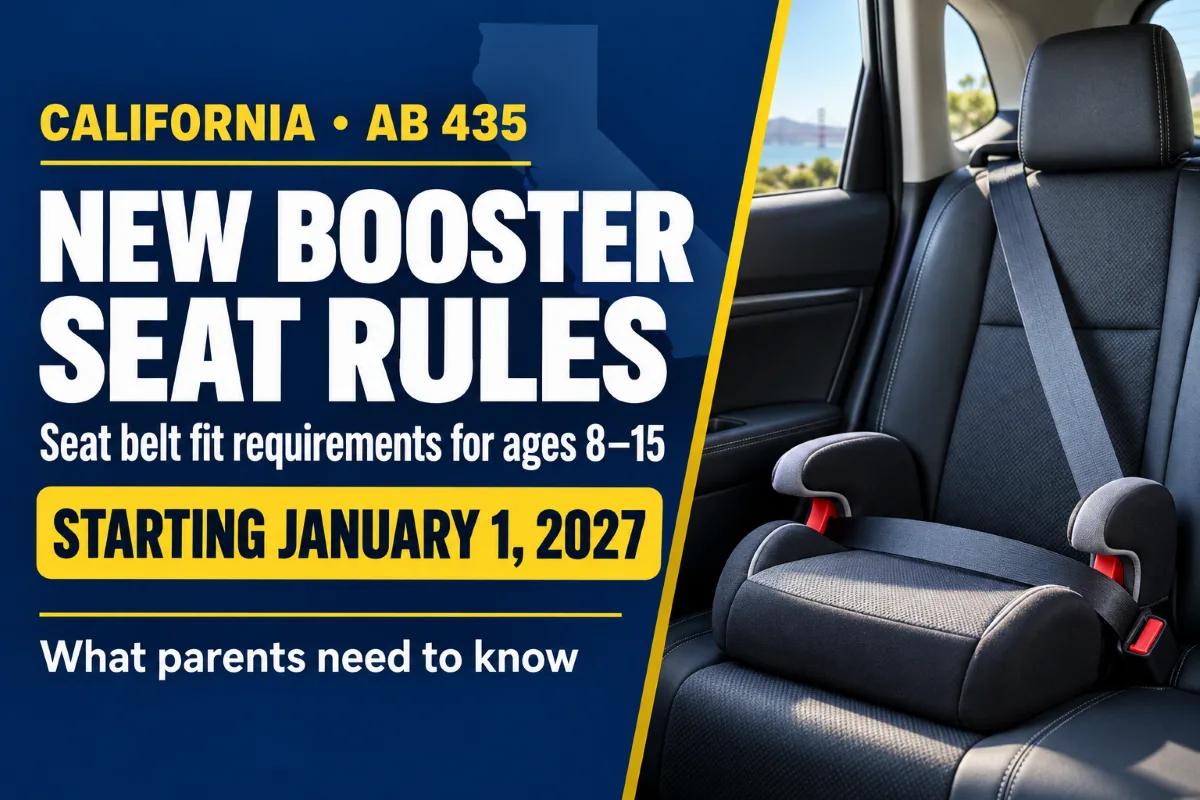
California parents will soon have to pay much closer attention to how their children fit into vehicle seat belts.
Gov. Gavin Newsom signed AB 435, a new law that expands California’s child passenger restraint requirements beginning Jan. 1, 2027. The legislation requires children between the ages of 8 and 15 to pass a newly codified“5-Step Seat Belt Fit Test” before they can legally ride using only a vehicle seat belt. Otherwise, they must continue using a booster seat.

Supporters say the law will improve child passenger safety. Critics argue it creates a new burden for families by requiring booster seats for many children who are already in middle school or high school.
What AB 435 Changes
Current California law generally allows children who are at least 8 years old, or who are at least 4 feet 9 inches tall, to use a regular vehicle seat belt rather than a booster seat.
Starting Jan. 1, 2027, that changes.
Under AB 435, children ages 10 through 13 must continue using an appropriate child passenger restraint system unless they pass the state’s new five-step test. Additionally, children ages 13 through 15 riding in the front seat must also meet the test’s requirements to be considered properly restrained by a seat belt alone.
The law establishes that seat belt fit, rather than age alone, determines whether a child can safely ride without a booster.
The New 5-Step Test
To legally ride with only a seat belt, a child must meet all five of the following requirements:
- The child sits all the way back against the vehicle seat.
- The child’s knees bend comfortably over the edge of the seat.
- The shoulder belt crosses the center of the chest and shoulder, not the neck.
- The lap belt sits low across the thighs and hips, not the stomach.
- The child can remain seated in that position for the entire trip.
If a child fails any one of those tests, a booster seat is required.
Penalties for Violating the Law
Violations of California’s child restraint laws can be expensive.
The statutory fine for a first offense is generally $100, while subsequent violations carry a $250 base fine. However, California’s court assessments and fees can dramatically increase the final amount paid.
Some legal and safety organizations estimate that a first citation can approach $490 or more after fees and assessments are added, while repeat violations can exceed $1,000 in total costs.
Depending on the circumstances, drivers may also face DMV consequences associated with moving violations.
How Parents Can Comply
Parents can prepare now by evaluating how their children fit in family vehicles.
Steps to comply include:
- Perform the five-step test in every vehicle your child regularly rides in.
- Purchase an age- and size-appropriate booster seat if needed.
- Read and follow the booster seat manufacturer’s installation instructions.
- Verify that shoulder and lap belts are positioned correctly.
- Re-test children periodically as they grow.
- Consider professional installation assistance through local child passenger safety programs.
Because seat dimensions vary significantly among vehicles, a child who passes the test in one vehicle might not pass in another.
What Will Compliance Cost?
The financial impact on families will vary.
A basic backless booster seat can cost as little as $25 to $50. High-back booster seats generally range from $60 to $150, while premium models can exceed $200.
For families with multiple children, multiple vehicles, grandparents who transport children, or shared-custody arrangements, compliance costs could easily reach several hundred dollars.
Estimated costs:
- Economy booster seat: $25-$50
- Mid-range booster seat: $60-$100
- Premium booster seat: $100-$200+
- Multiple-car households: $100-$400+
The law may be particularly costly for families whose children are already between 10 and 15 years old and had long ago outgrown what most people traditionally consider car seats.
Why Supporters Backed the Bill
Supporters of AB 435 argue that many children are not physically large enough for adult seat belts to work properly, even when they are older than 8 years old.
Research cited during the legislative process found that seat belt fit depends more on a child’s size and body proportions than age alone. Safety advocates contend that poorly fitting belts can increase injury risk during crashes by placing forces on the abdomen and neck instead of stronger parts of the body.
The law’s backers also note that some safety organizations have recommended booster-seat use beyond age 8 for years.
Who Opposed this Bill?
AB 435 was not unanimous. The bill passed comfortably, but it did face opposition from a number of Republican legislators.
According to the legislative history, the final Assembly vote was 58-14, while the Senate approved it 29-8.
The lawmakers voting“No” in the Assembly included:
- Tom Lackey (R)
- Greg Wallis (R)
- Bill Essayli (R)
- Carl DeMaio (R)
- Heath Flora (R)
- Alexandra Macedo (R)
- Joe Patterson (R)
- James Gallagher (R)
along with several other Republican members.
In the Senate, opposition was likewise primarily Republican.
Is AB 435 Necessary?
That question is likely to remain controversial.
Supporters view the bill as a commonsense update that reflects modern safety research and could help prevent serious injuries.
Critics see it very differently.
Many parents may be surprised to learn that a 13-, 14-, or even 15-year-old could legally require a booster seat under California law. Opponents argue that the state is replacing a relatively straightforward rule with a subjective test that could be difficult for parents and law enforcement officers to interpret consistently.
The law also raises practical questions:
- How will officers determine compliance during traffic stops?
- Will parents be expected to prove that a child passed the test?
- How many teenagers will realistically use booster seats?
- Will safety benefits justify the added costs and inconvenience?
For many Californians, the idea of placing a high-school freshman in a booster seat will be seen as an example of government overreach.
Others will argue that if a properly fitted booster seat reduces injuries, age-based objections should not outweigh safety considerations.
The debate highlights a broader tension in California policymaking: balancing public safety objectives against concerns about regulation, cost, and personal responsibility.
What Happens Next?
AB 435 takes effect on Jan. 1, 2027, giving parents time to assess whether their children meet the new requirements. Until then, California’s existing child restraint laws remain in force.
Families who are uncertain whether a child passes the five-step fit test may want to check now rather than wait until the new rules take effect, especially with potentially costly citations on the line.