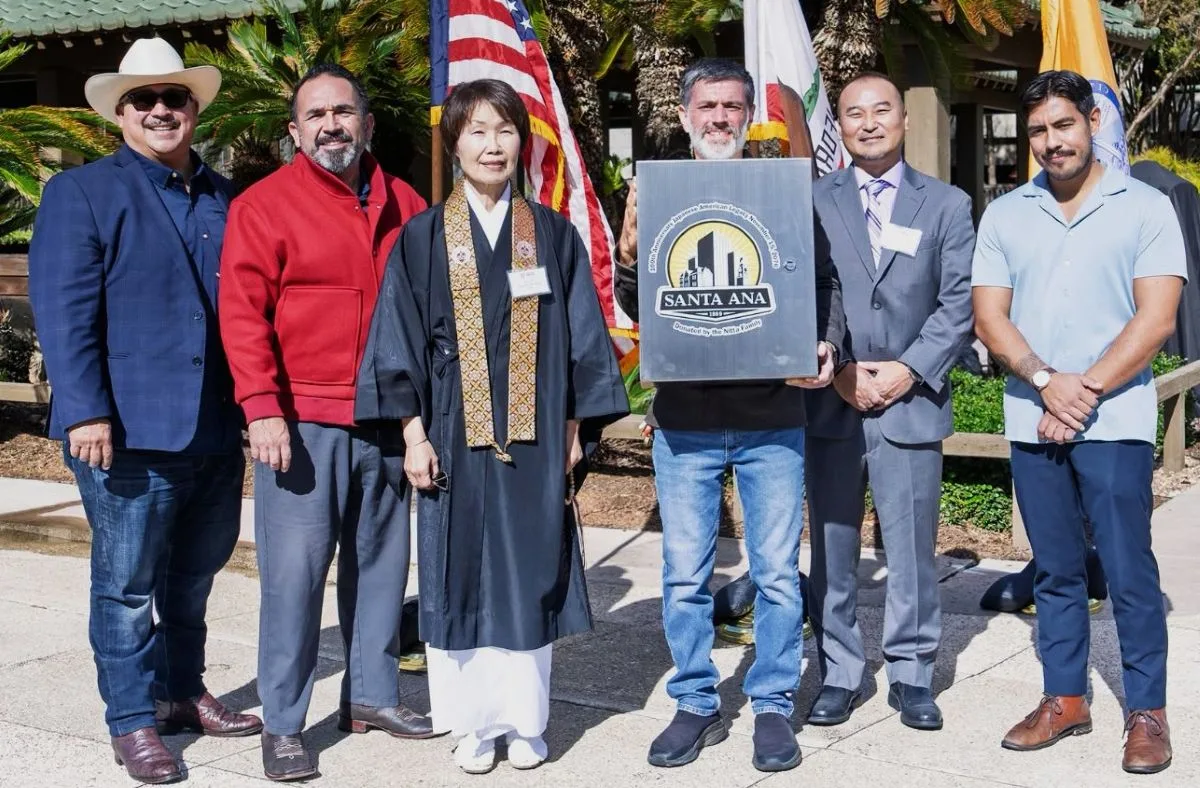
The City of Santa Ana, in partnership with the SELANOCO-Orange County Chapter of the Japanese American Citizens League, recently celebrated the rededication of the Orange County Japanese Garden and Teahouse near Santa Ana City Hall.
The Nov. 14 ceremony commemorated a site originally dedicated in 1970 as a symbol of friendship and remembrance, honoring Japanese Americans who returned to Orange County after being forcibly removed from their homes and incarcerated during World War II.
The event drew approximately 300 members of the Japanese American community and included a blessing of a time capsule donated by the Nitta family. Residents can also learn more about the site’s history through a special exhibition in the Santa Ana Main Library’s History Room running through February 2027.

A Forgotten Chapter of Orange County History
Before World War II, Japanese American families played a major role in Orange County agriculture. Historians estimate that hundreds of Japanese immigrant and Japanese American families were engaged in farming, gardening, flower cultivation, truck farming, berry production, celery farming, chili pepper cultivation and other agricultural enterprises throughout the county.
Japanese farmers often transformed difficult land into highly productive farms, helping supply Southern California with fruits and vegetables. Communities developed in areas including Santa Ana, Garden Grove, Westminster, Fountain Valley, Anaheim, Irvine and surrounding agricultural regions.
Despite facing discriminatory laws that prevented many immigrants from owning land directly, Japanese farming families became some of the most successful agricultural operators in Orange County through hard work, leasing arrangements and family-run businesses.

Executive Order 9066 Changed Everything
Following the Japanese attack on Pearl Harbor in December 1941, fear, wartime hysteria and long-standing anti-Japanese prejudice combined to produce one of the most controversial actions in American history.
In February 1942, President Franklin D. Roosevelt, a Democrat, signed Executive Order 9066, which authorized the removal of Japanese Americans from much of the West Coast. More than 120,000 people of Japanese ancestry were eventually forced into internment camps and relocation centers. Most were American citizens or lawful residents.
Orange County families had little choice. Many were forced to sell farms, homes, equipment, vehicles and businesses on short notice. Others left property with neighbors or friends, only to find it lost, damaged or gone when they returned years later.
The economic losses were staggering. Some families managed to rebuild after the war, but many never recovered the wealth and businesses that had taken decades to create.

Loyalty Proven Through Military Service
One of the most remarkable aspects of this history is that thousands of Japanese Americans answered the nation’s call despite the treatment many of their families were experiencing.
The 442nd Regimental Combat Team, composed primarily of Japanese American soldiers, became one of the most decorated military units in American history for its size and length of service. Many of its members had parents, siblings or other relatives living behind barbed wire in internment camps while they fought overseas for the United States.
Japanese American soldiers served with distinction in Europe and in military intelligence operations in the Pacific Theater. Their record helped dispel false accusations that Japanese Americans were disloyal to the United States.

What About German Americans?
The wartime treatment of Japanese Americans has long been criticized because it was not applied equally to all national groups from countries at war with the United States.
While some German nationals and German Americans, as well as some Italian nationals, faced government restrictions, investigations and internment, the scale was dramatically smaller than what occurred with Japanese Americans. Historians have documented actual German espionage operations inside the United States before and during the early stages of World War II, including the famous German spy rings dismantled by the FBI.
Yet no mass removal program comparable to the incarceration of Japanese Americans was imposed on German American communities.
This disparity has contributed to the modern consensus among historians, legal scholars and civil rights advocates that the wartime incarceration of Japanese Americans was based more on racial prejudice and wartime panic than on evidence of widespread disloyalty.

From Wartime Enemies to Close Allies
The rededication ceremony also highlights one of the most remarkable transformations in modern history.
The United States and Japan fought a brutal war that culminated in the atomic bombings of Hiroshima and Nagasaki, which caused massive civilian casualties along with military and infrastructure losses. Yet in the decades after the war, the two nations developed one of the world’s strongest alliances.
Today Japan is one of America’s closest allies, a major trading partner, and a key strategic partner in the Pacific region.
The Japanese Garden and Teahouse in Santa Ana stands as a local reminder of that journey, as well as the resilience of a community that endured discrimination, forced relocation and the loss of property, yet helped rebuild Orange County after the war.

A Place of Remembrance
More than a ceremonial space, the Orange County Japanese Garden and Teahouse serves as a living reminder of the contributions Japanese Americans made to Orange County’s agricultural heritage and civic life.
For many descendants of those farming families, the garden represents both the pain of wartime incarceration and the perseverance that followed. The rededication ceremony honored not only a physical landmark but also a generation of residents whose sacrifices and contributions helped shape modern Orange County.
Residents interested in learning more can visit the exhibition at the Santa Ana Main Library History Room through February 2027, where additional artifacts and historical information help tell the story of Orange County’s Japanese American community and its enduring legacy.