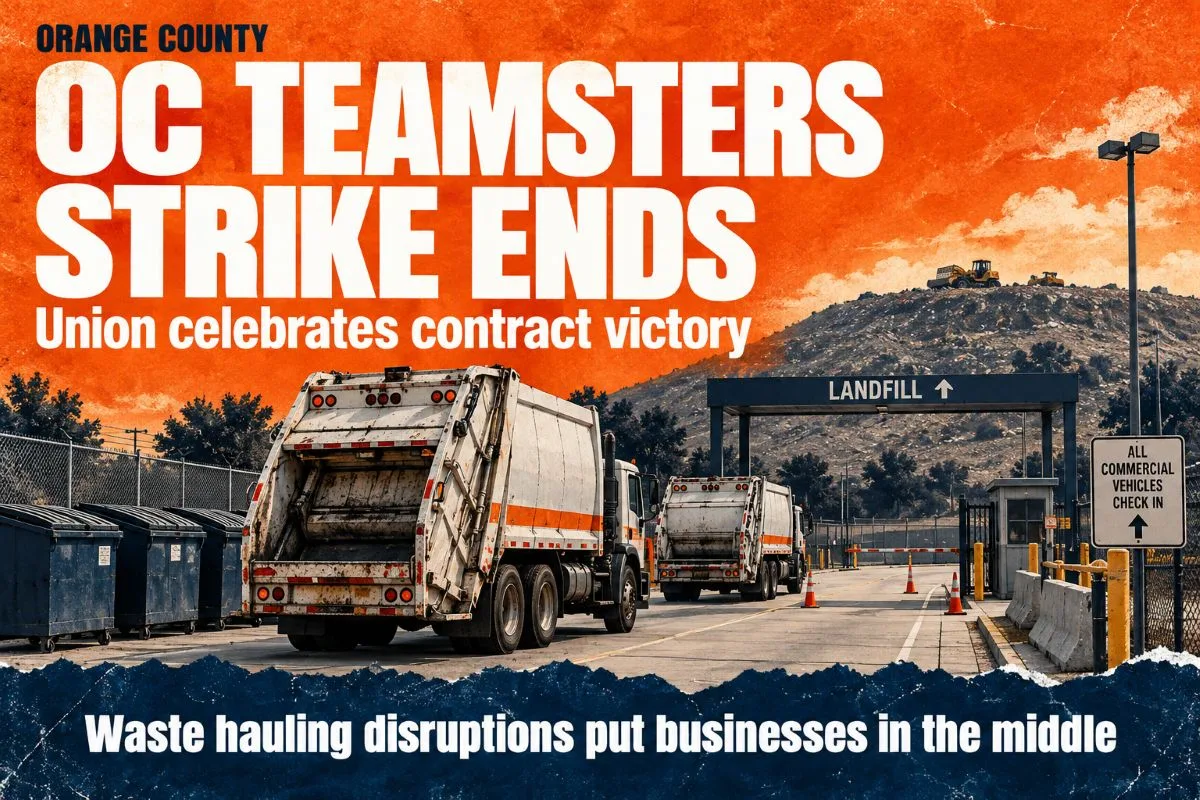
Teamsters Local 952 is celebrating the end of a 24-day strike involving approximately 465 Orange County employees after union members overwhelmingly ratified a new two-year contract with the County of Orange.
The union announced the victory Monday, describing the labor action as one of the longest strikes in Orange County history and praising workers for standing together in pursuit of higher wages and improved working conditions.
The strike affected employees working in OC Public Works, OC Waste and Recycling, OC Community Resources, Orange County Animal Care, and other county operations. The dispute began October 13 after months of negotiations failed to produce a contract acceptable to both sides.
According to Teamsters Local 952, workers secured a stronger agreement than the county’s initial offer. Reports indicate the ratified contract includes a 4% pay increase in the first year, a 4.25% increase in the second year, and a $1,000 signing bonus. More than 90% of voting members reportedly approved the deal.

Teamsters Celebrate Historic Win
In announcing the agreement, union leaders framed the contract as proof of the power of organized labor. Teamsters Local 952 told supporters that workers endured uncertainty and sacrifice to achieve what the union described as a landmark victory.
The slogan highlighted in the union’s announcement, “United We Bargain. Divided We Beg,” reflected the message union leaders emphasized throughout the dispute: collective action produced results that individual employees could not have achieved on their own.
From the union’s perspective, the strike demonstrated solidarity, bargaining strength, and a willingness by members to endure lost paychecks in order to secure a better contract.
Businesses, Residents, and Taxpayers Bore Much of the Burden
While union leaders are celebrating, many Orange County residents and businesses experienced a different side of the strike.
From the beginning, Teamsters officials openly acknowledged that a walkout would disrupt critical county services. The union itself warned of impacts to:
- Landfill operations
- Road maintenance
- Flood control channel work
- Beach and park maintenance
- County vehicle repairs
- Public works projects
Those warnings ultimately proved accurate.
Waste haulers, construction contractors, landscapers, demolition companies, and other businesses that rely on county landfill facilities faced significant uncertainty throughout the dispute. Delays at disposal facilities can quickly ripple through the local economy, increasing costs for private businesses and, ultimately, consumers.
For many companies, the strike arrived at a particularly difficult time. Contractors working on fixed-price projects generally cannot recover every unexpected expense caused by operational disruptions. Extra hauling time, delayed dumping schedules, longer truck routes, and lost productivity often come directly out of a company’s bottom line.
Unlike the county and the union, which were engaged in formal negotiations, private businesses had little influence over the outcome while still absorbing many of the economic consequences.
Picketing Tactics Became Part of the Controversy
As the strike stretched into its third week, tensions escalated.
County officials accused striking workers of engaging in unlawful conduct at landfill facilities, including forming human chains, blocking traffic, and telling customers that facilities were closed when they remained open. The county filed a complaint with the Public Employment Relations Board.
Union leaders strongly denied the allegations and accused county officials of unfair labor practices and bad-faith bargaining.
Regardless of who ultimately prevails in those disputes, the controversy highlighted the pressure tactics frequently employed during prolonged labor actions. The goal of a strike is not merely to stop work. It is to create enough disruption that management feels compelled to reach a settlement.
In this case, that disruption extended well beyond county offices and into the broader Orange County economy.
County Services Were Significantly Affected
The strike involved workers responsible for maintaining many of the county’s basic operational functions.
Affected departments included:
- OC Public Works
- OC Waste and Recycling
- OC Community Resources
- Orange County Animal Care
Those agencies provide services relied upon by more than three million residents and thousands of businesses.
Public works maintenance, waste disposal operations, equipment repair functions, and other daily services are often taken for granted until a labor dispute interrupts them.
The 24-day strike served as a reminder of just how dependent Orange County’s infrastructure is on skilled county employees.
Who Actually Won?
The answer depends on perspective.
The union clearly achieved a contract that members believed was worth approving after nearly a month on strike. Teamsters leaders are understandably declaring victory, and the ratification vote suggests members agree.
County officials succeeded in restoring operations and avoiding an even longer labor dispute, but they also agreed to compensation increases beyond their original proposal.
Lost in the celebration, however, are the businesses, residents, contractors, and taxpayers who endured weeks of service disruptions with no seat at the bargaining table. Many of those stakeholders absorbed increased costs, project delays, and operational headaches while labor and management battled over contract terms.
The Teamsters may view the outcome as a historic victory. For much of Orange County’s business community, the strike was a costly reminder that when labor disputes drag on, the collateral damage often extends far beyond the negotiating room.