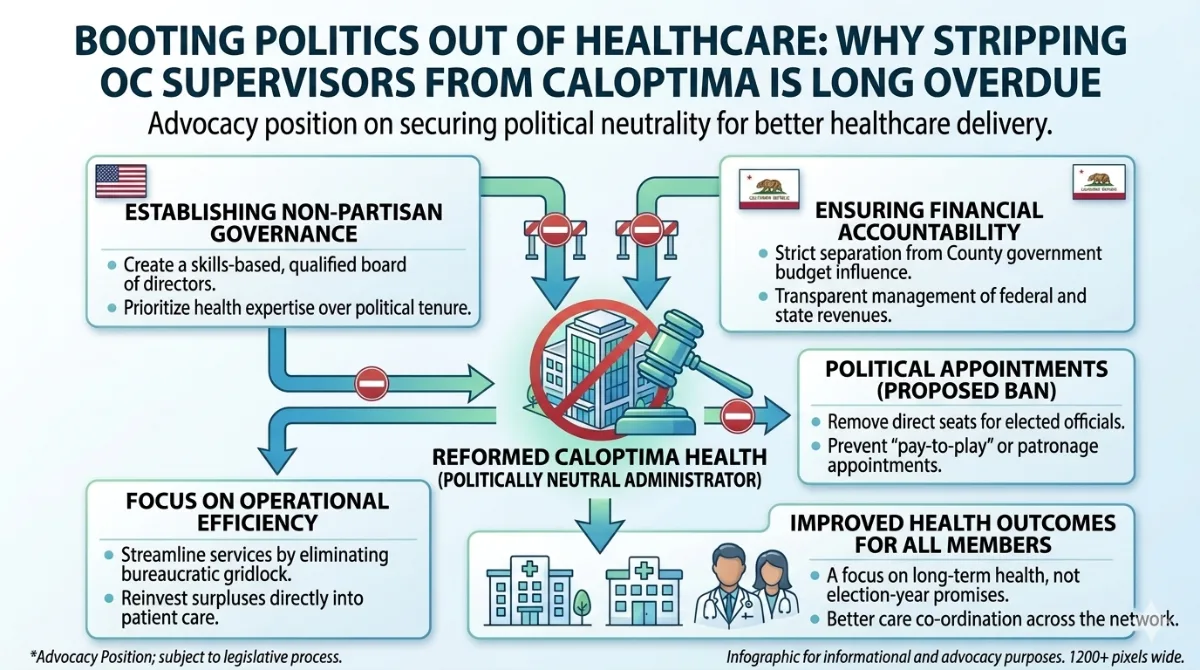
State Assemblymember Avelino Valencia has introduced a crucial amendment to Assembly Bill 2194 to remove Orange County supervisors from the CalOptima Health board. The bold legislative move aims to completely depoliticize the agency by stripping county supervisors of their automatic board seats and removing their power to appoint other directors. For years, local politicians have treated the massive public health plan as a personal sandbox for political games and influence. Evicting politicians from medical governance is a massive win for Orange County’s most vulnerable residents.

CalOptima Health receives its funding entirely from state and federal revenues. Contrary to what many assume given its name and oversight structure, CalOptima does not receive any of its funding from the County of Orange.
Understanding CalOptima and the Need for Change
To understand why this bill is so necessary, it helps to understand what CalOptima Health actually does. It is a massive, $4.7 billion county-structured public health plan tasked with providing health insurance and administering Medi-Cal services to low-income individuals, children, seniors, and people with disabilities. It covers roughly one-third of Orange County’s entire population. Because it controls such a staggering budget, the agency should be run strictly by medical professionals and public health experts who prioritize member needs over political survival. Instead, the board has long been plagued by local political interference.
A History of Political Misbehavior: From Andrew Do to Janet Nguyen
The historical misbehavior of Orange County supervisors on the CalOptima board proves they cannot be trusted with neutral oversight. Take former supervisor Andrew Do, who was hit with a $12,000 fine by the state Fair Political Practices Commission in 2022 for blatant “pay-to-play” activities during his time on the CalOptima board. Do used his position to steer lucrative contracts and decisions, treating healthcare funds like political capital.
The pattern of treating the agency like a political tool continues with current supervisor Janet Nguyen. While Nguyen claims that supervisors act as essential “watchdogs,” critics point out that having active politicians on the board creates a massive conflict of interest. Politicians routinely use public boards to grandstand, reward political allies, and punish adversaries rather than making objective decisions based on healthcare metrics. Concentrating this kind of financial and political power in the hands of elected county officials has repeatedly backfired on taxpayers and patients.
How AB 2194 Protects Patients
Assemblymember Valencia’s rewritten version of Assembly Bill 2194 fixes this toxic structure by replacing the two county supervisor seats with the head of the Orange County Health Care Agency and the director of county social services. This guarantees that qualified, career public health administrators—not politicians looking for their next election cycle—will fill those critical seats. Furthermore, future board selections will be handled by a specialized committee consisting of state and federal legislators representing the highest concentrations of Medi-Cal beneficiaries, alongside healthcare leaders, legal specialists, and a CalOptima member.
This restructuring will be a massive net positive for CalOptima users. When decisions are made based on medical expertise rather than political posturing, patients get better access to care, shorter wait times, and improved provider networks. Every single dollar in CalOptima’s multi-billion dollar budget will finally be forced to deliver direct value to patients, rather than funding political agendas.
Valencia’s Next Steps
This legislation arrives at a pivotal moment for its author. Valencia, a Democrat representing Anaheim, recently advanced from the June primaries and is officially on the ballot as a candidate for the California State Senate in the upcoming November 3, 2026, general election. Pushing this aggressive reform highlights his campaign focus on fighting local government corruption and protecting public funds. The bill is officially scheduled to face its next big hurdle before the State Senate Health Committee on June 24, 2026.
Here is a recent press release from Valencia regarding this bill:
SACRAMENTO, CA – Assemblymember Valencia (D-Anaheim) announced amendments to Assembly Bill 2194 that would establish an independent nominating committee that would select seven members of the CalOptima Health Board of Directors to strengthen oversight of the agency serving nearly 900,000 low-income Orange County residents.
“Today, the same body that appoints the CalOptima board also holds seats on it, concentrating political power over an agency whose decisions should focus on member needs and medical expertise,” said Assemblymember Valencia. “Removing the supervisors and placing selection in independent hands de-politicizes the board and keeps its governance separate from politics.”
“Every dollar CalOptima manages has to deliver full value for members, and strong, independent oversight is how we make sure it does,” said Assemblymember Valencia. “These good governance reforms keep the board focused on one job, looking out for the people CalOptima serves.”
CalOptima is Orange County’s single largest health plan, covering nearly one in three county residents, including children, seniors, families, and people with disabilities, with an annual budget of $4.7 billion. The amendments to AB 2194 would create an independent, qualifications-based path to board service and dedicate the board’s full attention to the people CalOptima serves.
The pressure has only grown. Federal legislation enacted last year imposed the largest funding cut in Medicaid’s 60-year history. Up to 3.4 million Californians could lose Medi-Cal coverage and the state stands to lose roughly $30 billion in federal funding every year. Orange County is already feeling the impact, nearly 27,000 CalOptima members disenrolled in just two months, and beginning in July, members will pay $30 a month to keep full coverage.
Under current law, the Orange County Board of Supervisors appoints the CalOptima board, and two supervisors hold seats on it. AB 2194 would remove the two supervisors from the board and create an independent nominating committee to fill seven of its seats, de-politicizing the board so its work stays focused on members.
AB 2194 builds on Assemblymember Valencia’s record of strengthening accountability in Orange County government. As an Anaheim City Councilmember, he was an early voice against the corruption that led to the resignation and federal conviction of former Mayor Harry Sidhu, calling for transparency and reform as the scandal unfolded. In the Legislature, he authored AB 34 (Ch. 315, Statutes of 2023), which created an independent redistricting commission to draw the county’s supervisorial districts, AB 2946 (Ch. 249, Statutes of 2024) which requires Board of Supervisors approval and public disclosure before supervisors award district discretionary funds, and AB 2803 (Ch. 576, Statutes of 2024), which prohibits the use of campaign funds to pay legal costs for public corruption or fraud and requires reimbursement if an official is convicted. He also secured a state audit of the City of Anaheim’s public payments to the Anaheim Chamber of Commerce and Visit Anaheim, which found the city had failed to properly oversee its contracts, resulting in millions in improper spending.