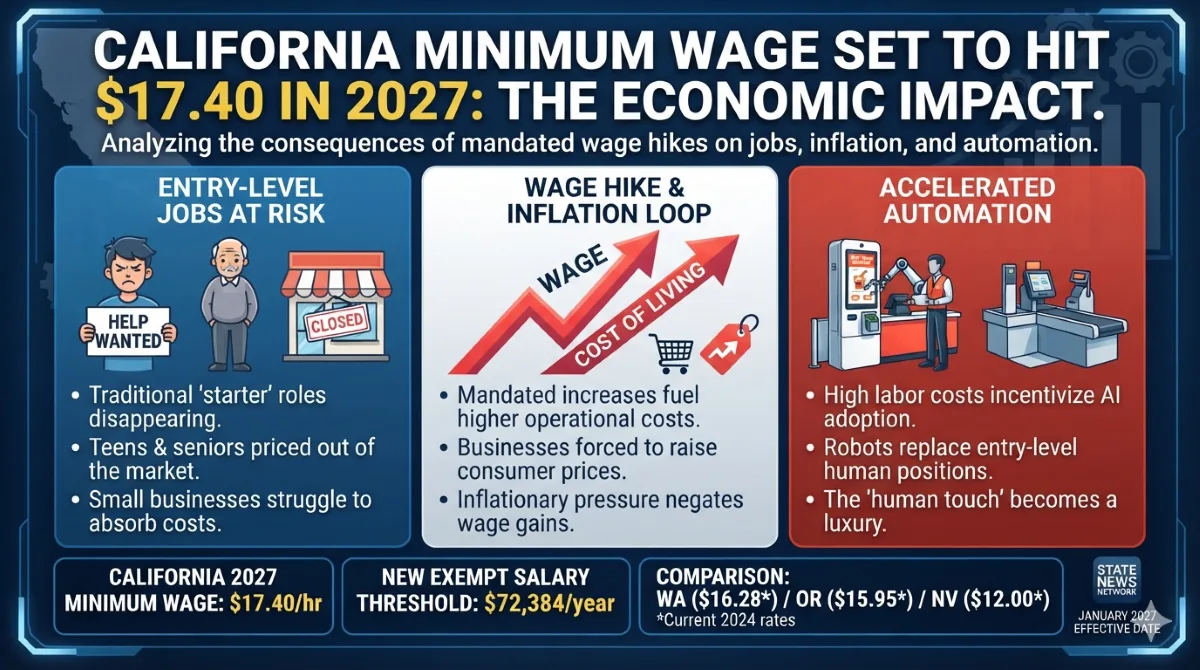
The California Labor Commissioner’s Office recently announced that the state’s minimum wage will climb to $17.40 per hour on January 1, 2027.

While Sacramento pitches this annual inflation-adjusted increase as economic support for workers, the reality on the ground tells a much different story. These unsustainable government-mandated wage hikes are actively backfiring. Instead of helping the economy, they are fueling the inflation fire, crushing small businesses, and permanently eliminating entry-level jobs.
Historically, entry-level, minimum-wage positions served a specific purpose in our economy. They were designed for high school and college students gaining first-time work experience, or for seniors looking to make ends meet during retirement. By forcing artificially high wages onto these roles, the state has priced vulnerable workers out of the market. Small businesses simply cannot afford to pay teenagers or part-time retirees nearly $18 an hour for baseline tasks, destroying the traditional stepping stones to financial independence.
This aggressive wage push puts California at a severe competitive disadvantage compared to its neighbors. When you examine the minimum wage landscapes of other Western U.S. states, the stark contrast highlights how extreme California’s policies have become:
- California: $17.40 per hour (Effective Jan 1, 2027)
- Washington: $16.28 per hour (Current 2024 baseline, adjusted annually)
- Oregon: $14.20 to $15.95 per hour (Tiered by region)
- Arizona: $14.35 per hour (Adjusted annually for inflation)
- Nevada: $12.00 per hour (Uniform rate across all employers)
- Idaho and Utah: $7.25 per hour (Adhering to the federal baseline)
As California outpaces the rest of the West, businesses are forced to adapt to survive the mandates. To offset these soaring labor costs, companies have no choice but to raise prices on goods and services, directly worsening the inflation that hurts every everyday consumer. Furthermore, this hike triggers a massive spike in the minimum salary threshold for exempt white-collar employees, pushing it to a staggering $72,384 annually starting in 2027.
The ultimate tragedy of this policy is the permanent destruction of employment opportunities. To stay afloat, employers are aggressively accelerating their transition to technology. California’s unsustainable wage mandates are guaranteeing that artificial intelligence, self-service kiosks, and automated robots will take over what few entry-level jobs are left. By forcing employers to pay premium rates for starter roles, the state is effectively replacing human workers with algorithms and machinery, leaving the very people the law was meant to protect with fewer places to turn.
One Party Rule is Ruining California’s Economy
The economic fallout of the $17.40 minimum wage is the predictable byproduct of California’s absolute one-party rule, which has completely dismantled the checks and balances necessary for a healthy, balanced state economy. With a legislative supermajority unchecked by political competition, Sacramento lawmakers consistently prioritize heavy-handed government mandates over free-market realities. This environment silences the warnings of independent business owners, leading to a regulatory climate characterized by runaway spending, steep corporate taxes, and restrictive labor laws.
By enacting policies shaped by singular political ideologies rather than pragmatic economic consensus, the state continues to drive out major employers, kill small businesses, and steadily erode the financial stability of the very communities it claims to support.
nice curmudgeonly rant, didn’t reagan already prove this trickle down affect you fear will never materialize
The impact of Governor Gavin Newsom’s $20 fast-food minimum wage law (AB 1228) on California restaurant jobs remains highly contested, with independent and conservative studies estimating between 16,000 and 36,000 jobs lost.
Fast Food and Starbucks barista were never intended to be living wage jobs. The real problem is there aren’t enough living wage jobs. But our politicians find tackling that problem far too difficult, so they’ve built a strong and reliable campaign base on empty promises of upward mobility to minimum wage workers, all the while the most powerful economic engine the world has ever seen invests trillions of dollars into making human capital obsolete. The system is broken.