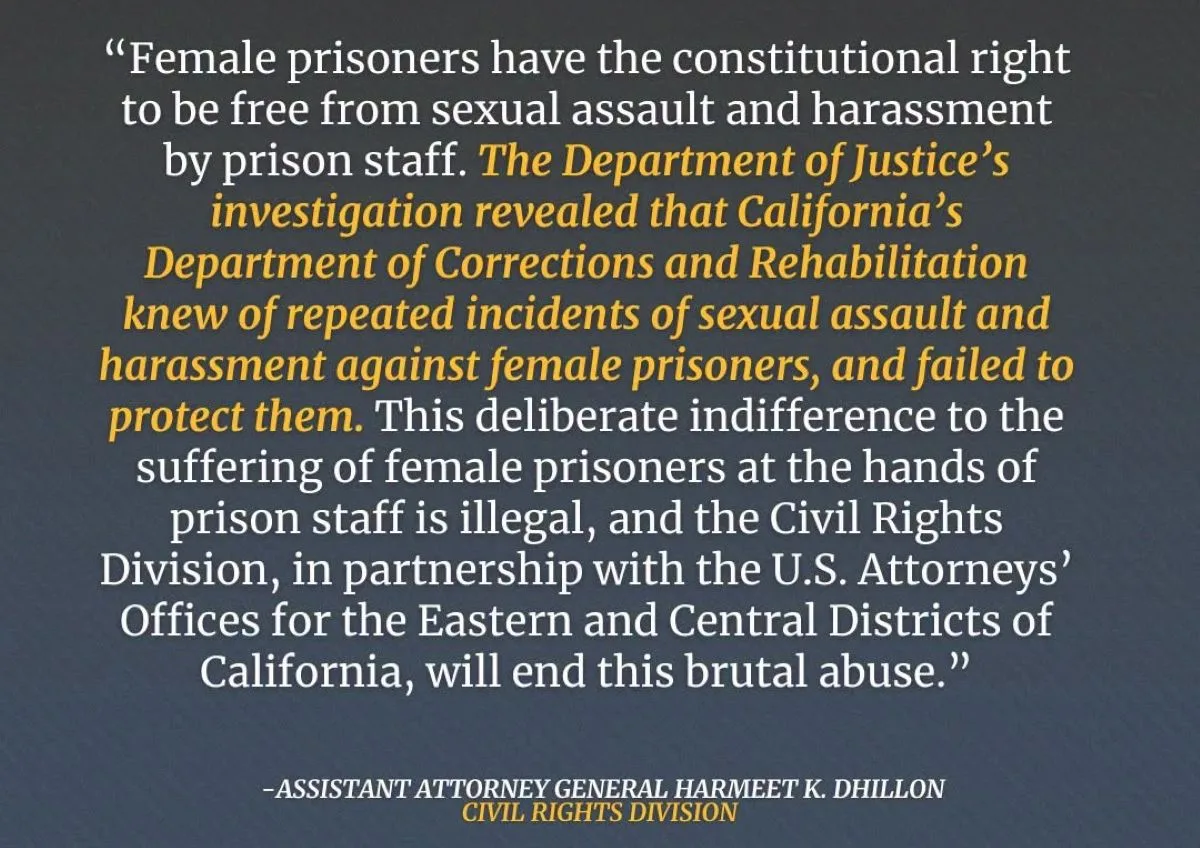
The U.S. Department of Justice (DOJ) has found that California women’s prisons are systematically violating the U.S. Constitution by failing to protect incarcerated individuals from rampant sexual abuse and harassment by correctional staff.

Released on August 13, 2026, the explosive federal findings report concluded that the California Department of Corrections and Rehabilitation (CDCR) operates with “deliberate indifference” to inmate safety. The multi-year investigation focused primarily on the Central California Women’s Facility (CCWF) in Chowchilla and the California Institution for Women (CIW) in Chino. Investigators described an “unbroken pattern” of abuse, documenting decades of trauma ranging from explicit verbal harassment and mock gestures to trading contraband for sexual favors and rape.
Federal investigators revealed that California prison leadership knew about repeated incidents of assault but consciously allowed them to persist. The breakdowns heavily violate inmates’ rights under the Eighth and Fourteenth Amendments, alongside severe failures to implement the Prison Rape Elimination Act (PREA). The state has been handed a 49-day ultimatum to implement mandatory remedial measures—including extensive camera installations, confidential reporting loops, and independent investigative protocols—or face a massive federal civil rights lawsuit from the U.S. Attorney General.
Political Fallout for Governor Newsom and the CA Democratic Legislature Majority
This scathing federal intervention deals a severe political blow to Governor Gavin Newsom and California’s supermajority Democratic legislature, sparking intense scrutiny over their oversight of the state’s carceral system.
Despite running on a platform of progressive criminal justice reform and human rights, the Newsom administration has faced growing criticism for failing to rein in the powerful correctional officers’ union or clean up systemic state-run corruption.
Critics argue that while Sacramento lawmakers frequently target federal immigration detention or private prisons, they have turned a blind eye to the horrific conditions within their own state-managed facilities, allowing these constitutional violations to compound for years.
With federal prosecutors now forcing the state’s hand under threat of immediate litigation, local policy experts note that the report exposes a massive gap between California’s progressive rhetoric and the grim, unchecked reality of its state infrastructure.
Media Disclosures: A Culture of Retaliation and Abusive Inversions
While the official DOJ press release highlights high-level oversight breakdowns, broader media reports paint a far more horrific reality inside the walls of CCWF and CIW. According to media disclosures from KQED and AP News, the very internal systems built to protect inmates were weaponized against them.
- Abusers Investigating Abuse: The federal probe revealed that internal staff members tasked with investigating sexual misconduct allegations were frequently accused of sexual abuse or harassment themselves.
- Severe Victim Retaliation: Victims who attempted to report abuse faced swift and severe retaliation from guards, trapping incarcerated women in an environment of total silence.
- Systemic Blind Spots: Despite recent updates claiming body-worn cameras have begun dropping complaint numbers, the report outlines decades where “blind spots” were intentionally used by staff to execute assaults.
- Mass Litigation Forewarning: The DOJ investigation was heavily propelled by a landmark 2024 lawsuit brought forward by more than 130 formerly incarcerated women who detailed the horrific environment of abuse they survived.
Prison Worker Prosecutions and Convictions
The DOJ report emphasizes that this crisis is not the result of a few “bad apples,” but rather deep institutional rot. Over the years, several horrific individual cases have successfully broken through state protection to reach criminal prosecution:
- The 224-Year Sentence: Media reports highlight at least one extreme case where a California prison guard was convicted of executing a decade-long campaign of rampant sexual violence against inmates, resulting in a 224-year prison sentence.
- Investigator Pled Guilty to Child Exploitation: According to Assistant Attorney General Harmeet K. Dhillon, a correctional sergeant at Chowchilla who was actively trusted to investigate internal PREA violations was caught, prosecuted, and sentenced to 15 years in prison after pleading guilty to receiving child sexual abuse materials while on active duty.
- Contraband Schemes: In May 2024, internal investigations sustained multiple allegations against a CIW sergeant who was caught running a scheme trading outside contraband to female inmates in exchange for forced sexual favors.
- Gynecologist Sexual Battery: Civil and criminal scrutiny has also targeted contracted medical staff. A major lawsuit was filed by inmates against a CIW gynecologist, accusing him of sexually abusing patients under the guise of routine medical treatment for nearly seven years while the prison failed to intervene.
Identical Crises Across Other California Facilities
The rot in California’s carceral landscape extends far beyond state-run facilities, mirroring a broader crisis of sexual misconduct across the region.
- FCI Dublin’s “Club Fed” Scandal: The crisis heavily mirrors the total collapse of the Federal Correctional Institution (FCI) Dublin, a federal women’s prison in Northern California. FCI Dublin was forced to shut down entirely after a systemic wave of sexual abuse by guards—including the prison warden himself—led to multiple successful criminal prosecutions and a determination that the facility was entirely beyond repair.
- Statewide Civil Filings: According to data tracking organizations, nearly 500 active civil cases alleging prison inmate abuse and sexual violence have been filed statewide against various CDCR entities, illustrating that the crisis spans the entire geographical infrastructure of California’s correctional system.
How Families of Incarcerated Individuals Can Fight Back
With federal authorities confirming that internal prison reporting mechanisms are fundamentally broken, families of inmates must bypass internal channels to safely protect their loved ones.
- Submit Direct Tips to the DOJ: The Justice Department’s Civil Rights Division has explicitly bypassed the CDCR by opening direct contact lines. Families can securely report active staff misconduct, retributive actions, or past abuse by calling 1-888-392-9490 or emailing Community.CAWomensPrisons@usdoj.gov.
- Involve the Office of the Inspector General (OIG): Families can file independent complaints directly with the California Office of the Inspector General, which provides public oversight of CDCR and monitors how sexual abuse investigations are handled outside of the prison’s immediate hierarchy.
- Document Everything Digitally: Keep meticulous records of all communications. Note the exact dates, times, names of guards, and locations mentioned by your loved one. Use legal mail channels to communicate when possible, as standard phone lines and emails are heavily monitored by the correctional staff accused of these violations.
- Partner with Specialized Legal Coalitions: Reach out to prisoner advocacy groups and civil rights firms experienced in handling California Prison Abuse Lawsuits. Groups like the California Coalition for Women Prisoners (CCWP) provide rapid-response support and legal avenues to protect inmates from immediate physical retaliation.