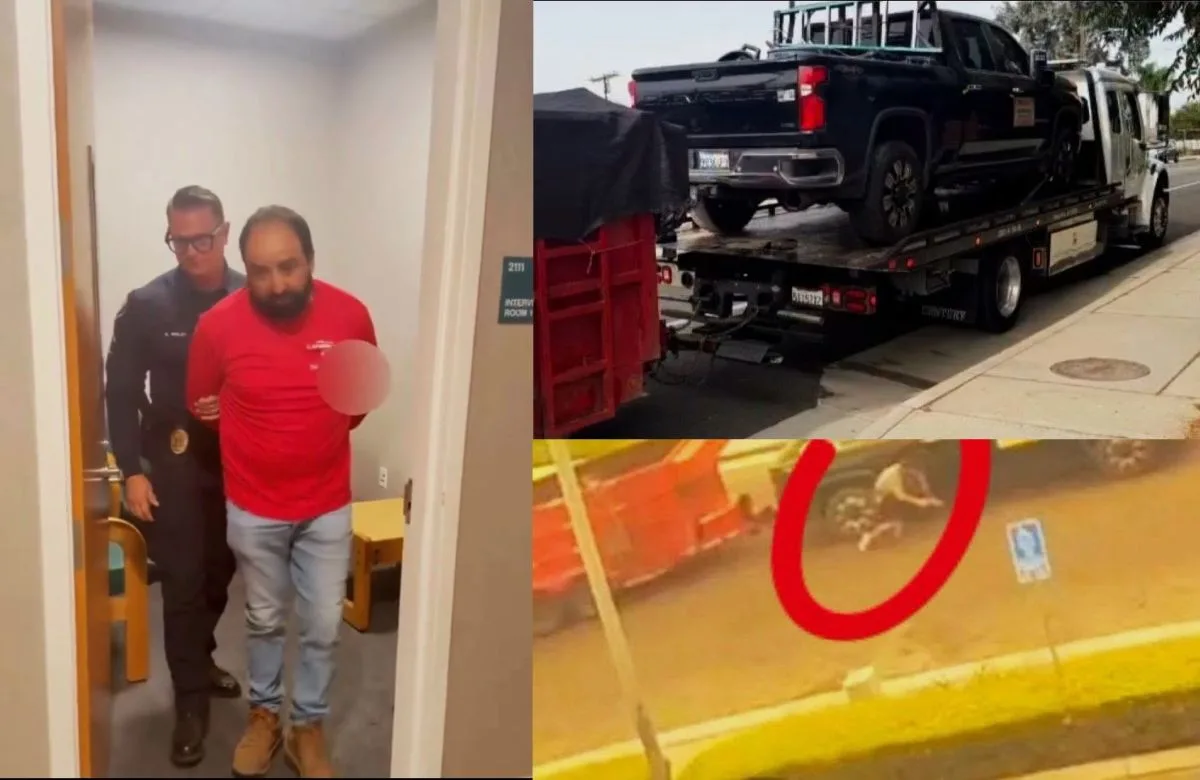
Rigoberto Martinez Villalpando, a 43-year-old resident of Moreno Valley, has been arrested following a weeks-long investigation into a severe hit-and-run collision that left a pedestrian with major injuries in Santa Ana, California.

The incident took place on July 27, 2026, at approximately 7:23 a.m. near the intersection of Auto Mall Drive and Edinger Avenue. Surveillance footage captured a black pickup truck towing a red utility trailer stacked with landscaping tools striking the pedestrian before speeding away from the scene.
Following an extensive probe, detectives from the Santa Ana Police Department’s Collision Investigation Unit located the suspect’s vehicle in Moreno Valley. Officers subsequently executed a search warrant at Villalpando’s residence on August 13, 2026, where they impounded the black Chevrolet truck and booked the suspect into the Santa Ana Jail.
Potential Criminal Charges and Penalties
Under California law, leaving the scene of an accident that causes severe injury or death is prosecuted aggressively. Villalpando faces a felony charge under California Vehicle Code 20001(a), commonly known as felony hit-and-run causing injury. If convicted, the penalties are severe:
- Incarceration: A felony conviction carries a sentence of two, three, or four years in California state prison, or up to one year in a county jail.
- Financial Penalties: Courts can impose criminal fines ranging between $1,000 and $10,000.
- Driver’s License Revocation: The California Department of Motor Vehicles will mandate a swift revocation of the offender’s driving privileges for multiple years.
- Restitution: The defendant can be ordered to pay direct restitution to the victim to cover medical expenses, lost wages, and rehabilitation costs.
Impact on Auto Insurance
A felony hit-and-run arrest carries immediate and devastating financial implications for a motorist’s insurance policy. Upon conviction or structural review of the police report, the policyholder’s premium is projected to increase by 100% to 300%, effectively making standard coverage unaffordable.
Furthermore, because a hit-and-run is categorized as a major violation, most traditional auto insurers will immediately cancel or non-renew the policy. The driver will be forced to seek high-risk SR-22 insurance through specialized non-standard carriers.
Additionally, while the insurer will typically pay out third-party liability claims up to policy limits to compensate the injured pedestrian, they may permanently drop the client afterward or refuse to cover any first-party damages sustained by the suspect’s vehicle.
Hit-and-Run Trends in Orange County
This arrest unfolds amidst a visible surge in critical traffic collisions involving vulnerable road users across Orange County. Local authorities are dealing with an alarming pattern of hit-and-runs in the immediate area.
Just days prior to Villalpando’s arrest, an e-bike rider was violently struck by a hit-and-run driver on August 10, 2026, at the intersection of Warner Avenue and Raitt Street in Santa Ana.
Merely 24 hours later, a second e-bike crash turned deadly in the city, underscoring a regional safety crisis.
Earlier in the year, a fatal hit-and-run on January 9, 2026, claimed the life of a pedestrian on North Grand Avenue, where the driver abandoned their vehicle shortly after impact.
Statistical reports from local traffic bureaus indicate that pedestrian and cyclist involvements comprise a disproportionate percentage of severe injuries and fatalities in urban Orange County corridors.
Pedestrian Safety Tips in High-Traffic Zones
Navigating busy commercial corridors like the Santa Ana Auto Mall zone requires proactive situational awareness. Pedestrians can minimize their risks by implementing these vital safety practices:
- Utilize Crosswalks: Always cross at designated intersections or marked crosswalks, keeping in mind that turning trucks often have restricted blind spots.
- Maintain Visual Contact: Never assume a driver sees you because you see them; look directly at the operator before stepping off the curb.
- Avoid Mobile Distractions: Keep your eyes off your smartphone screen and remove headphones while crossing active roadways.
- Wear Reflective or Bright Clothing: Enhance your personal visibility, particularly during early morning hours or twilight periods when ambient glare distorts a driver’s line of sight.
- Walk Against Traffic: If walking in an area without functional sidewalks, always face oncoming traffic to maximize your reaction time.