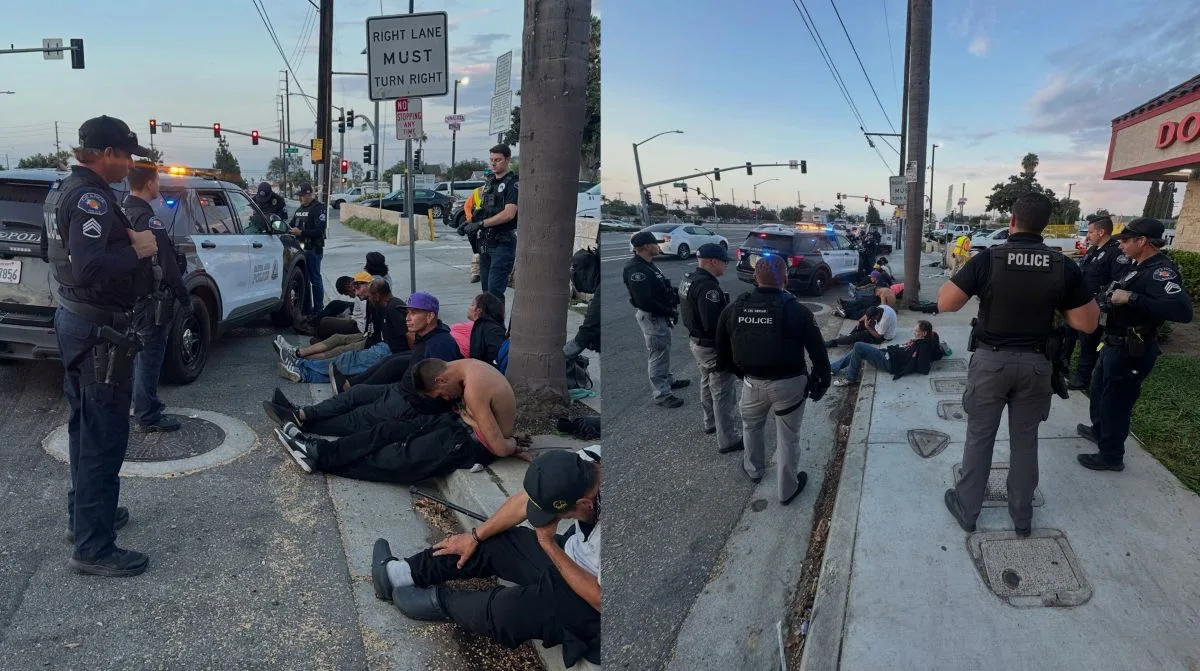
A coordinated law enforcement surge aimed at improving regional quality of life resulted in the arrest of 69 individuals along the municipal borders of Orange and Santa Ana.

The strategic operation, spearheaded by the Orange Police Department Bike Team in partnership with the Santa Ana Police Department, focused heavily on ongoing public nuisances and illegal encampments near Hart Park and the Santiago Creek bed. In addition to dismantling entrenched encampments, the multi-agency task force secured 16 felony arrests and 53 misdemeanor citations, while simultaneously extending 10 outreach and resource referrals to unhoused individuals willing to accept assistance.
Following the initial sweep, specialized teams immediately moved into the Santiago Creek bed to clear hazardous debris, restore public access, and eliminate deep-seated environmental contamination left by illegal municipal squatting.
Severe Legal Consequences and Criminal Penalties
The individuals detained during this high-visibility sweep face a range of local and state charges carrying severe statutory penalties.
Misdemeanor offenses, which constitute the bulk of the citations, typically involve public intoxication, illegal camping, trespassing, and petty theft. Under current municipal frameworks and revised state codes, these misdemeanors carry penalties of up to six months in county jail and fines reaching $1,000.
The 16 felony charges—frequently involving grand theft, active felony warrants, and the possession of narcotics for sale—carry significantly heavier consequences.
Following the passage of California’s strict street crime initiatives like Proposition 36, repeat theft offenses and specific illicit drug violations have been elevated back to felonies, exposing convicted offenders to multi-year sentences in state prison or extended periods in county correctional facilities.
Rising Trend of Transient Crime Across the County
This sweeping joint operation mirrors a broader, more aggressive trend across Orange County as local municipalities grapple with rising crime rates tied directly to transient communities.
According to regional public safety data, transient-related criminal activity is heavily concentrated within property crime sectors, including commercial shoplifting, vandalism, auto theft, and residential burglaries.
Law enforcement data reveals that property crimes account for roughly 66% of all reported offenses across the county, with municipalities like Santa Ana and Anaheim recording thousands of property violations annually.
Beyond property loss, unhoused populations are disproportionately vulnerable to, and involved in, violent altercations, narcotics trafficking, and weapons violations.
This central corridor crackdown marks the third massive quality-of-life operation executed regionally this season, trailing closely behind similar large-scale multi-agency sweeps conducted by the Santa Ana Police Department Quality of Life Team that netted 85 and 74 arrests respectively.
Severe Environmental Impacts and Astronomical Taxpayer Costs
Beyond the direct threat to public safety, illegal transient encampments cause severe, long-term degradation to the local environment and place an immense financial burden on taxpayers.
Encampments established along natural sensitive pathways like the Santiago Creek bed disrupt local wildlife, accelerate soil erosion, and introduce high concentrations of hazardous waste directly into municipal watersheds.
Decontamination teams routinely encounter severe biohazards including human feces, urine, contaminated hypodermic needles, and toxic chemical run-off from illegal fires and hidden cooking setups.
Remediating these locations requires specialized private contractors and heavy machinery, pushing public spending to extraordinary heights. Single encampment cleanups can easily cost municipal governments upwards of $22,000 to $300,000 depending on the size and accumulation of hazardous material.
Cumulatively, Orange County cities, public hospitals, and municipal law enforcement agencies spend nearly $300 million annually managing the immediate fallout of the homelessness crisis, with millions specifically carved out for sanitation, environmental restoration, and park maintenance.
Orange County Cities Shift to Aggressive Enforcement Strategies
The operational landscape for managing unhoused populations shifted fundamentally following the landmark U.S. Supreme Court ruling in Grants Pass v. Johnson, which restored the legal authority of local municipalities to enforce anti-camping ordinances regardless of local shelter availability.
Cities across Orange County have aggressively capitalized on this legal clarity to reclaim public parks and walkways.
The Orange County Board of Supervisors recently passed a sweeping ordinance granting the Orange County Sheriff’s Department explicit authority to fine and arrest individuals camping within county parks, flood control channels, and unincorporated zones. Cities like Anaheim, Irvine, Garden Grove, and Newport Beach have quickly modified their municipal codes to institute zero-tolerance policies regarding public encampments.
By removing previous legal roadblocks, local leaders are utilizing targeted law enforcement sweeps to systematically dismantle camps, compel compliance with local laws, and incentivize resistant individuals to accept dedicated county shelter beds and mental health services.
The Santa Ana City Council Members who Consistently Vote Against Arresting Transients
Councilmembers Johnathan Hernandez and Jessie Lopez consistently oppose punitive measures and arrests of the unhoused in Santa Ana, pushing back against the council majority’s enforcement-heavy approach.
Hernandez argues that criminalizing homelessness strains police resources and ignores shelter shortages, while Lopez champions a resource-first model that led to a targeted recall effort.
Regionally, former Mayor and Supervisor Vicente Sarmiento shares this opposition, criticizing anti-camping laws for using jails instead of solving the housing crisis.
Council Member Lopez will Continue to Hurt Law Enforcement if she gets Elected to the State Assembly
As Jessie Lopez campaigns for a seat in the California State Assembly, her platform is a subject of debate. Law enforcement advocates have expressed concerns that her progressive legislative priorities could impact public safety and police operations. These critics point to her record on certain police measures and past statements regarding police funding. They argue that her potential policies could lead to reduced police budgets, increased oversight, and changes in accountability for criminal behavior.
In contrast, Lopez and her supporters describe her platform as an effort to promote accountability and transparency, aiming to redirect resources towards areas such as affordable housing and mental health care.
Resident Action Guide: How to Spot and Report Illegal Encampments
Community vigilance remains a crucial component in assisting local law enforcement to maintain clean public spaces and curb transient-related crime. Residents are urged to monitor municipal areas closely and report indicators of illegal encampment setups, including the accumulation of shopping carts, makeshift tarps, structural tents, open fires in unauthorized areas, and visible blocking of public sidewalks.
To report active property damage, public intoxication, or illegal trespassing, residents can contact their local police non-emergency dispatch lines or utilize dedicated municipal reporting apps, such as the MySantaAna application or the Orange County Public Works Encampment Mitigation Portal.
For any ongoing criminal behavior, violent altercations, or immediate threats to public safety, community members should immediately dial 911.