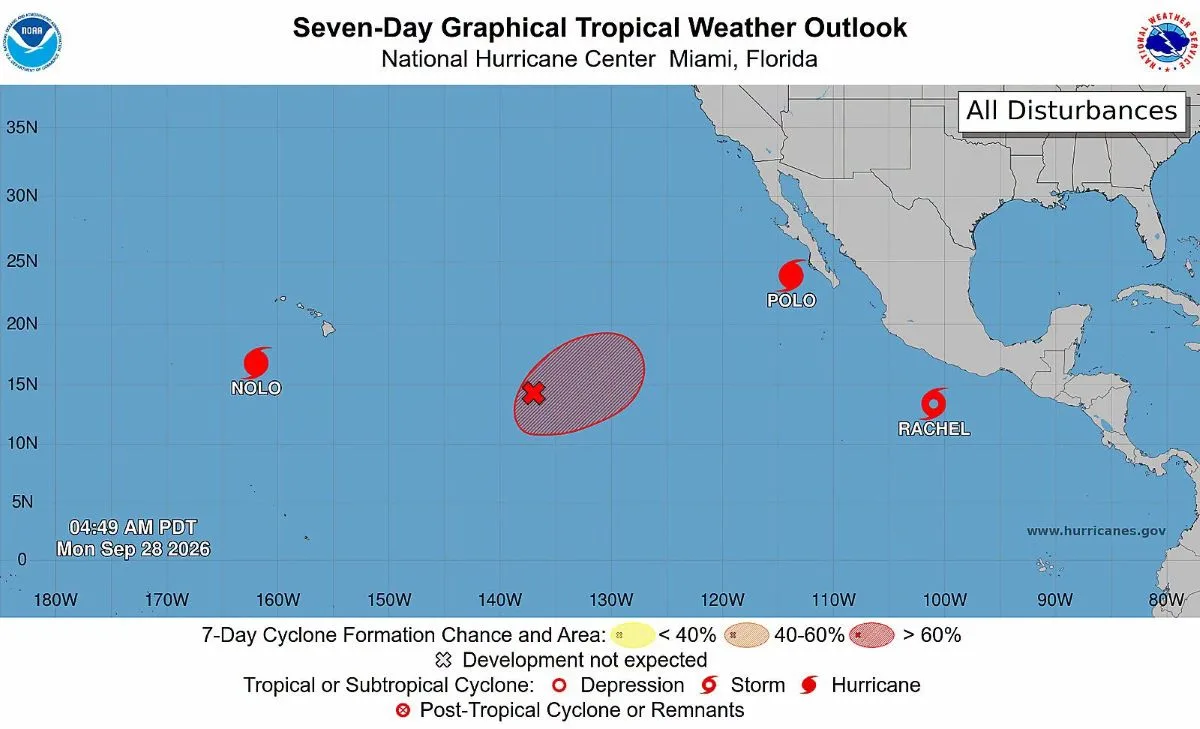
A major hurricane spinning off Mexico’s Pacific coast is sending powerful swells toward Southern California, and Orange County is expected to feel the impact through mid‑week. While Hurricane Polo will not make landfall in California, its circulation over unusually warm ocean waters is already generating long‑period waves, elevated tides, dangerous rip currents, and the potential for coastal flooding in Huntington Beach, Newport Beach, Laguna Beach, Seal Beach, and Dana Point.

Meteorologists say the storm’s intensity is being fueled by record‑warm Pacific waters linked to El Niño conditions. As the hurricane tracks northwest, its swell field will push directly into south‑facing beaches across Orange County. Lifeguards are preparing for heavy surf, with waves building Sunday and peaking Monday into Tuesday. High tides near seven feet may combine with the incoming surf to cause erosion and minor flooding in low‑lying coastal areas.
What Orange County Can Expect
- High surf warnings — Long‑period swells will create large, powerful waves capable of damaging piers, jetties, and beach infrastructure.
- Rip current dangers — Strong currents will pose significant risks to swimmers and surfers, prompting likely lifeguard advisories.
- Coastal flooding — High tides combined with surf may flood beach parking lots, boardwalks, and low‑lying neighborhoods.
- Beach erosion — Heavy wave action may erode sand berms and narrow beach areas, especially in Laguna and Newport.
- Tropical humidity — Moisture from the storm will push muggy conditions into Southern California.
County of Orange Emergency Status
Orange County already has a local state of emergency active due to severe coastal erosion, high surf, and damage from Hurricane Marie, declared on September 17, 2026. This emergency remains in effect and directly overlaps with the hazards now being triggered by Hurricane Polo.
Key points:
- The County declared a local state of emergency for coastal erosion, high surf, and infrastructure damage.
- The declaration was made after Laguna Beach, San Clemente, and Dana Point issued their own local emergencies.
- The County’s Operational Area Emergency Operations Center (OA EOC) is activated at a low level and remains staffed.
- This emergency declaration supports requests for state and federal assistance, including damage assessments, expedited permits, and shoreline protection.
Important: This emergency was not issued for Hurricane Polo, but it covers the same coastal vulnerabilities Polo is now aggravating.
Governor Newsom’s Actions
Governor Gavin Newsom has not issued a Polo‑specific emergency order, but he did declare a statewide emergency on Monday in anticipation of a potentially historic El Niño season, citing severe storms, coastal flooding, and weather‑related hazards.
Additionally:
- Orange County officials — including Vice Chair Katrina Foley — have formally requested that Newsom declare a State of Emergency for Orange County’s coastal communities to support recovery from Hurricane Marie and prepare for winter storms.
- Newsom has not yet issued that OC‑specific emergency declaration.
Current Polo‑Related Advisories
While no new emergency orders have been issued, the National Weather Service has activated a Coastal Flood Advisory and High Surf Advisory for Orange County due to Hurricane Polo.
These advisories:
- Began 5 a.m. Monday
- Remain in effect until 5 p.m. Tuesday
- Warn of 4–7 foot waves, dangerous rip currents, moderate flooding, and significant beach erosion
These are weather advisories, not government emergency proclamations.
Why This Storm Matters
Pacific hurricanes rarely affect Southern California directly, but their offshore strength can still create dangerous conditions along the coast. With ocean temperatures running 5 to 10 degrees above normal, storms like Polo can maintain intensity farther north than usual. This increases the likelihood of large surf events, coastal flooding, and erosion — all of which are significant public‑safety concerns for Orange County residents and visitors.
A History of Pacific Hurricanes That Impacted Southern California
Southern California has experienced several notable tropical systems over the past century. While direct landfalls are extremely rare, offshore hurricanes and tropical storms have produced significant coastal impacts.
- 1939 Long Beach Tropical Storm — The only documented tropical storm to make landfall in California. It caused flooding, 45 deaths, and widespread damage across Los Angeles and Orange County.
- Hurricane Kathleen (1976) — Made landfall in Baja California and moved north, bringing heavy rain and flooding to inland Southern California.
- Hurricane Nora (1997) — Tracked into Arizona and Southern California as a weakening system, causing flooding and wind damage.
- Hurricane Marie (2014) — Generated massive surf that damaged piers in Seal Beach and Malibu, flooded coastal roads, and caused significant erosion.
- Hurricane Hilary (2023) — Made landfall in Baja and moved north as a tropical storm, bringing widespread flooding, landslides, and nearly $900 million in damage across Southern California.
- Hurricane Kay (2022) — Stayed offshore but brought heavy surf, strong winds, and coastal flooding to Southern California beaches.
These events show how Pacific storms — even without direct landfall — can disrupt coastal communities, damage infrastructure, and create dangerous conditions for beachgoers.