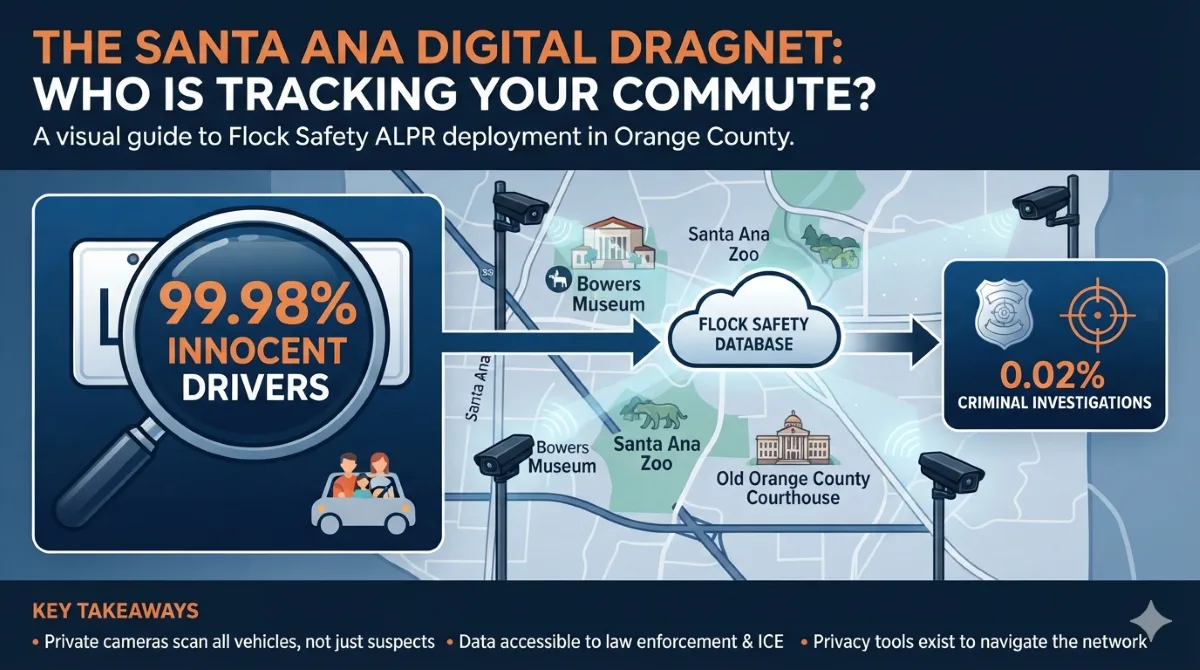
Maintaining your privacy in Orange County requires understanding and actively navigating the rapidly growing network of Flock Safety automated license plate readers (ALPRs), particularly in central hubs like Santa Ana. If you have driven down a major intersection or passed a gated community in Southern California recently, you have likely passed a shoebox-sized black camera mounted on a pole. These are not standard city traffic cameras. Built by private surveillance giant Flock Safety, this hardware acts as a passive surveillance dragnet.

Instead of just recording video, Flock cameras use artificial intelligence to scan vehicles in real-time, capturing license plates, vehicle color, make, model, roof racks, bumper stickers, and even distinct body damage. This data is uploaded into a searchable cloud database. It allows law enforcement to instantly track when, where, and how often a vehicle passes a specific node. For Orange County residents, this means a private, for-profit firm is logging your daily commutes, doctor visits, and grocery runs.
The Privacy Controversy and Law Enforcement Abuse
The massive expansion of Flock’s database has triggered major backlash from civil liberties groups like the American Civil Liberties Union (ACLU). Critics point out that tracking every driver to catch a few bad actors creates a warrantless historical database of entirely innocent citizens.
Local data shows this mass surveillance indiscriminately tracks law-abiding residents almost exclusively. For instance, statistics provided by the Santa Ana Police Department revealed that a mere 0.02% of total camera scans within a one-week period actually resulted in a connection to a criminal investigation. The other 99.98% of drivers scanned were innocent citizens whose daily patterns were logged into a private database anyway.
The primary concern is not just over-collection, but also real-world abuse by rogue law enforcement officers. A recent investigation revealed that at least 50 law enforcement officers nationwide have been charged or accused of abusing automated license plate reader data. In dozens of these cases, officers used the network for intimate surveillance—illegally stalking ex-wives, girlfriends, and other women without their consent. Right here in our backyard, a former Costa Mesa Police Department officer was charged with using ALPR systems to improperly track his ex-wife and girlfriend.
Furthermore, for immigrant communities in central Orange County, the stakes are exceptionally high. Advocacy groups have raised alarms over data-sharing practices that allow federal agencies to access local data. Local immigrant rights lawyers have documented cases where Immigration and Customs Enforcement (ICE) accessed license plate logs from local retail parking lots to track down and deport otherwise law-abiding community members.
Orange County’s Surveillance Landscape: Where the Cameras Are
Surveillance deployment varies heavily by neighborhood across Orange County. Local immigrant rights groups and privacy advocates have pushed back fiercely, mobilizing campaigns like “Get the Flock out of Costa Mesa”. Despite public outcries regarding unwarranted surveillance and data leaks, cities continue to expand these networks.
- Santa Ana: Operating as a central focus of mass surveillance, the city implemented a major rollout featuring approximately 57 active cameras purchased from private firms like Flock Safety and Motorola. The council entered these contracts despite heavy community pushback demanding investments in safer parks and sidewalks instead of automated tracking systems.
- Costa Mesa: Remains a heavily monitored hub with 46 active Flock cameras placed at major thoroughfares.
- Anaheim: Approved a major rollout including 20 cameras based on city crime trends, plus an additional 11 dedicated entirely to the resort and theme park area.
- Unincorporated Orange County: The Orange County Sheriff’s Department paused expansive funding plans due to vocal pushback from residents demanding budget accountability and strict data-sharing safeguards.
The Legal Side: How Flock is Used to Fight Crime
Law enforcement agencies strongly defend the technology, emphasizing that Flock cameras are incredibly effective when used legally. Legally, because license plates are exposed to the public road, courts have largely ruled that capturing them does not violate the Fourth Amendment. The Santa Ana Police Department notes that the system does not use facial recognition and is restricted to legitimate law enforcement purposes. Police utilize the system to:
- Instantly flag vehicles associated with active Amber Alerts for abducted children.
- Match passing plates against a “Hot List” of stolen vehicles or cars tied to active felony warrants.
- Solve hit-and-run accidents and track down fleeing suspects using specific vehicle signatures.
Websites to Help You Avoid Flock Cameras and Maintain Privacy
As the digital dragnet expands, privacy advocates have built open-source tools to help citizens look up, map, and legally bypass these surveillance networks. If you want to protect your privacy on the road, use these specialized websites:
- DeFlock: Use the crowdsourced mapping directory on DeFlock to view verified locations of over 100,000 ALPR cameras across the United States. It allows you to inspect your Santa Ana neighborhood or workplace commute to see exactly which intersections host active devices.
- FlockHopper: To completely reclaim your privacy during a drive, use FlockHopper. This interactive tool allows you to type in a starting location and destination. It analyzes known camera coordinates and automatically generates an alternative, private route that steers clear of active Flock nodes. You can easily export these private routes to secure offline navigation apps like Organic Maps.
- Have I Been Flocked: If you want to find out if your movements have already been tracked, check Have I Been Flocked. This site utilizes public records requests and law enforcement audit logs to let drivers see if their license plate has been searched by police agencies.
- HOA Portal Opt-Outs: If your specific gated community or Homeowners Association utilizes Flock Safety, you can often legally opt out. Look up your neighborhood’s specific Flock Safety transparency portal online, register your vehicle details, and check the official “Safe List” or opt-out box to remove your vehicle’s history from searchable footage logs.
- Flock Alert: Available on platforms like the Apple App Store, this standalone tracker runs silently in the background while you drive. It sends a push notification to your phone the exact moment you approach an active license plate reader grid.
- GPX Data Exporting: While Google Maps won’t build a camera-free route for you, advanced privacy software allows you to map out your route securely on open-source platforms like DeFlock or FlockHopper, then export the file directly into secure, offline navigation engines like Organic Maps.
Staying informed and utilizing open-source mapping networks are your best lines of defense for maintaining personal privacy on the public roads of Southern California.
There are No Legal Ways to Obsure Your License Plate
There are no legal ways to physically hide, alter, or obscure your license plate from these cameras while driving on public roads in California.
The law is very strict regarding license plate visibility. Under California Vehicle Code (CVC) § 5201 and CVC § 4464, any product or action that intentionally impairs the readability of a license plate is illegal.
The legal realities regarding common masking methods include:
- Clear, Tinted, or Smoked Covers: It is completely illegal to place any cover over your license plate, even if it is completely transparent. CVC § 5201.1(c) explicitly prohibits any casing, shield, or frame that impacts the electronic reading or recognition of the plate by automated systems.
- Reflective Sprays and Nanofilms: Specialized sprays or stealth nanofilms designed to reflect camera infrared flashes (making the plate appear blank on camera) are illegal. Manufacturing, selling, or installing devices specifically meant to obstruct ALPR reading can trigger severe fines under proposed legislation like Assembly Bill 1085.
- Vinyl Wraps and Alterations: Customizing plates with vinyl “skins” or wraps to change the color scheme or hide characters violates CVC § 4464, which explicitly bans altering a plate’s original design or reflectivity.
- Physical Obstructions: Allowing bike racks, tow hitches, frames, or even dried mud to block the view of your plate can result in a law enforcement stop and an obstruction citation.
Penalties for Modifying or Hiding Your Plate
If you are caught using physical covers, reflective sprays, or altered plates in California, you face:
- A traffic citation (fix-it ticket) or an infraction fine usually totaling around $200.
- Potential escalation to a misdemeanor charge if an officer determines you intentionally altered the plate to evade law enforcement or toll systems.
- Increased auto insurance rates due to point accumulation on your DMV driving record.
Legal Ways to Protect Your Privacy
Because physically blocking the camera is illegal, the only lawful ways to protect your travel privacy include:
- Route Planning: Using mapping tools like DeFlock or FlockHopper to legally drive on alternative public streets that do not have cameras installed.
- Opting Out of Private Databases: Checking if your local Homeowners Association (HOA) or apartment complex uses Flock and submitting a formal request to place your plate on their “Safe List” or opt-out registry to block historical tracking logs.