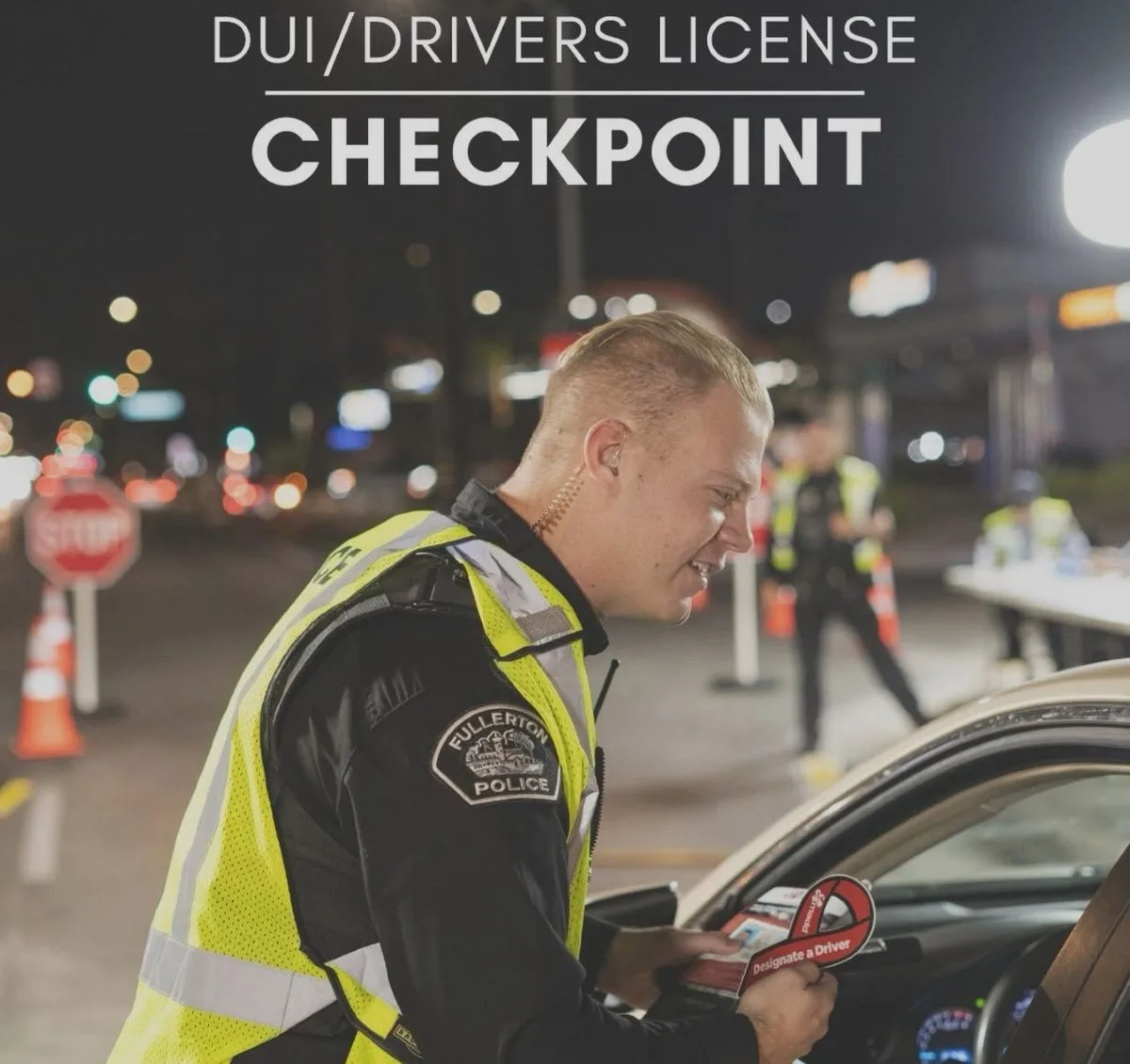
The Fullerton Police Department will host a driving under the influence (DUI) and driver’s license checkpoint on August 21st, 2026, from 8:00 p.m. to 1:00 a.m. In accordance with standard public safety protocols, law enforcement officials have chosen an undisclosed location for the operation.

The deployment area is carefully chosen using statistical data regarding local impaired driving-related crashes and prior DUI arrests. The primary objective of the operation is to maximize public safety by actively removing impaired drivers from public roadways.
Orange County drivers should keep in mind that dangerous driving impairment extends far beyond alcohol usage. Over-the-counter medications and regular prescription drugs can severely hinder your physical and mental ability to drive safely. Furthermore, while both medicinal and recreational marijuana are completely legal in California, driving while under the influence of cannabis remains strictly illegal. Specially trained officers will remain on-site at the checkpoint to evaluate motorists suspected of drug-impaired driving, a rising variable in regional traffic collisions. This checkpoint program is funded via a traffic safety grant provided by the California Office of Traffic Safety through the National Highway Traffic Safety Administration.
Historical Fullerton Checkpoint Locations
Because local authorities do not publicly release the exact coordinate address beforehand, motorists should note that the Fullerton Police Department frequently utilizes specific high-traffic corridors for safety checkpoints. Past checkpoint locations used often in the city include:
- Harbor Boulevard: Southbound lanes positioned between Orangethorpe Avenue and Houston Avenue.
- Orangethorpe Avenue: Major intersections near the freeway bottlenecks or commercial sectors.
- Commonwealth Avenue: High-visibility zones located near the central downtown corridor.
- Chapman Avenue: Stretches passing near the university or surrounding entertainment districts.
Criminal Charges, Impound Fees, and Penalties
Motorists caught driving while impaired face immediate arrests and harsh legal penalties. A first-time DUI conviction in California carries an average total economic impact of $13,500 in combined fines, penalties, court costs, and mandatory insurance hikes. The specific penalties and charges drivers may face include:
- Criminal Charges: Motorists are typically prosecuted under California Vehicle Code 23152, which includes driving under the influence of alcohol, drugs, or a combined total of both. Most initial offenses are handled as misdemeanors, but aggravating factors like causing an injury can elevate the offense to a felony.
- Vehicle Impound Fees: According to the official City of Fullerton Fee Schedule, the department enforces a mandatory $285.00 administrative impound fee for any DUI-related incident. This cost does not include private towing company collection rates or daily storage fees, which regularly add an extra $150 to $350 initial tow cost and $20 to $60 for each day the vehicle is held.
- License Suspensions: Drivers will have their driver’s license suspended by the California DMV. Reinstatement demands a $125 administrative fee along with an SR-22 high-risk insurance certificate.
- Ignition Interlock Devices: Convicted drivers are often forced to pay out-of-pocket to install an Ignition Interlock Device (IID) inside their personal vehicle to resume restricted driving privileges.
Impact of DUI Charges on Your Auto Insurance
A DUI arrest or conviction will trigger a severe and immediate financial impact on your auto insurance policy. In California, an impaired driving charge permanently alters your risk profile in the eyes of insurance providers.
- Immediate Policy Cancellation or Non-Renewal: California law permits insurance companies to cancel your policy or refuse to renew it once they discover a DUI conviction or an administrative driver’s license suspension. Many standard, preferred insurance providers will completely drop your coverage, classifying you as a high-risk driver.
- Loss of the Good Driver Discount: Under California Proposition 103, drivers with a clean record are entitled to a mandatory 20% Good Driver discount. A DUI conviction automatically disqualifies you from this discount for 10 consecutive years from the date of the violation. Losing this discount alone causes premiums to spike drastically.
- Mandatory SR-22 Requirement: To get your driving privileges reinstated after a DUI suspension, the California DMV requires you to file an SR-22 Certificate of Financial Responsibility. This form is not insurance itself; rather, it is a document your insurance company must file with the state to prove you carry the mandatory minimum liability coverage. Filing an SR-22 instantly alerts your insurer to the DUI, prompting a rate recalculation.
- Massive Premium Increases: If your insurance company chooses to retain your policy, or if you are forced to switch to a specialized high-risk (non-standard) insurance provider, your annual premiums will skyrocket. On average, California drivers see their auto insurance rates increase by 150% to 300% following a DUI. This premium hike typically persists for 3 to 7 years, adding thousands of dollars in cumulative costs.
Orange County DUI Arrest and Collision Data
The enforcement of checkpoints remains a primary tool because drunk and drugged driving continues to be a severe public hazard across Southern California.
- DUI Collisions: According to data tracked by the California Office of Traffic Safety, Orange County records well over 1,200 alcohol-involved injuries and fatalities on its roadways in a standard statistical year. Heatmaps from recent years confirm that cities like Santa Ana, Anaheim, Huntington Beach, and Costa Mesa remain severe regional hotspots for drunk driving accidents.
- DUI Arrests: Local agencies combine forces to execute thousands of annual misdemeanor and felony DUI arrests across the county. Highly trafficked nightlife areas or coastal regions consistently record some of the highest per-capita DUI arrest numbers in the state.
California Blood Alcohol and Marijuana Limits
Understanding California’s strict legal boundaries is essential for every driver sharing the road:
- Blood Alcohol Concentration (BAC): The legal limit is 0.08% for adult drivers aged 21 or older operating a standard passenger vehicle. For commercial drivers, the limit is strictly 0.04%. California also enforces a “Zero Tolerance” law for drivers under 21, meaning any measurable BAC of 0.01% or higher results in an immediate suspension.
- Marijuana and Cannabis: Unlike alcohol, California does not have a set legal numerical limit (such as a specific nanogram level in blood) for cannabis. Instead, the state relies on a standard of proof regarding actual impairment. If marijuana affects your mental or physical abilities to the point that you can no longer drive with the caution of a sober person, you can be legally convicted of a drug DUI regardless of the amount consumed.
Checkpoint Safety and Troubleshooting Tips
Navigating a checkpoint smoothly requires understanding your legal rights and practicing proper road safety:
- Do Not Panic: Maintain a calm, polite demeanor. Prepare your required documents early to avoid unnecessary delays.
- Have Documents Ready: Officers will momentarily look for signs of impairment and check for a valid driver’s license, proof of insurance, and vehicle registration.
- Turn Around Safely: It is entirely legal to avoid a DUI checkpoint by turning around or taking an alternative path, provided you do so safely and legally. However, making illegal U-turns or driving erratically will give watching patrol officers immediate probable cause to pull your vehicle over.
- Roll Down the Window: You are legally required to stop and provide your basic identification documents once you have entered the designated checkpoint lane.
- Plan a Sober Ride: The absolute best way to avoid a costly $13,500 legal penalty is to plan your night ahead. Designate a completely sober driver, use a commercial rideshare app, or take public transit if you intend to consume any alcohol or cannabis.
Understanding Your Rights: Navigating Breathalyzer and Chemical Tests During a Traffic Stop
When pulled over under suspicion of driving under the influence (DUI), knowing the distinct legal differences between a roadside test and a post-arrest test is critical. Many motorists operate under severe legal misconceptions that can result in immediate, mandatory penalties.
The Roadside Investigation vs. Post-Arrest Testing
The legal requirements for testing change drastically depending on whether you have been formally placed under arrest:
- Preliminary Roadside Tests (Voluntary): Standardized Field Sobriety Tests (FSTs)—such as walking a straight line or balancing on one foot—and the preliminary alcohol screening (PAS) roadside breathalyzer are strictly voluntary. You have the legal right to politely decline these initial field assessments without triggering automatic license penalties.
- Post-Arrest Evidentiary Tests (Mandatory): Once an officer establishes probable cause and formally places you under arrest, the legal framework completely shifts. Under California’s Implied Consent Law, by obtaining a driver’s license and operating a vehicle, you have already consented in advance to a post-arrest chemical test.
- Your Choices After Arrest: Law enforcement will typically require an evidentiary breath test or a blood test. A urine test is generally only permitted or offered if both breath and blood tests are unavailable, or if the officer specifically suspects drug impairment and a blood draw cannot be performed.
The Tony Romo Cautionary Tale: Don’t Make This Mistake
A clear real-world example of how these testing laws are commonly misunderstood occurred during the July 2026 operating while intoxicated (OWI) arrest of former Dallas Cowboys quarterback Tony Romo in Milwaukee. According to released law enforcement bodycam footage, Romo attempted to halt the investigation by repeatedly asking to call his attorney before stepping out of the vehicle. The deputy correctly informed him that he did not have the right to pause an active investigative traffic stop to speak with a lawyer.
Romo went on to perform poorly on physical field assessments and subsequently refused to submit to the post-arrest evidentiary breath test, explicitly stating that lawyers generally advise against taking them. This was a severe miscalculation. Because he refused the mandatory post-arrest test, authorities quickly secured a judicial search warrant to perform a forced blood draw anyway. Consequently, Romo gave up the chance to keep chemical data out of the investigation while getting hit with a fourth citation for unlawful refusal—triggering severe, automatic administrative penalties independent of the underlying OWI charge.
Consequences of Refusing a Post-Arrest Chemical Test
Refusing to submit to a breath, blood, or urine test after a formal DUI arrest triggers immediate administrative and criminal consequences:
- Automatic License Suspension: Under implied consent regulations, the DMV will automatically suspend or revoke your driving privileges. For a first-time refusal, this is a mandatory one-year suspension with no option for a restricted hardship license.
- Enhanced Criminal Penalties: If you are subsequently convicted of a DUI in court, the refusal acts as a sentence enhancement. It adds mandatory jail time, higher court fines, and lengthier mandatory alcohol education programs to your sentence.
- Consciousness of Guilt: In a courtroom trial, prosecutors are legally allowed to present your refusal to the jury as physical evidence of a “consciousness of guilt,” arguing that you refused the test because you knew you were impaired.
- Warrants for Forced Blood Draws: Refusing the test will not stop the police from gathering biological data. As seen in the Romo arrest, officers can easily contact an on-duty judge to secure an expedited electronic search warrant, allowing medical staff to draw your blood by force.
Key Legal Takeaways
If you are stopped by law enforcement, remember these three main rules to protect yourself legally:
- Answer Questions with Discretion: You are required to provide your license, registration, and insurance. However, you do not have to answer incriminating questions regarding how much you have had to drink.
- Decline Roadside FSTs Politely: You can exercise your right to decline the roadside balancing acts and the preliminary handheld breath test.
- Always Submit Post-Arrest: If the officer places you in handcuffs and transports you to a station or hospital, do not refuse the evidentiary chemical test. Refusal will only compound your legal troubles, cost you your license instantly, and fail to prevent the state from obtaining your blood sample anyway.