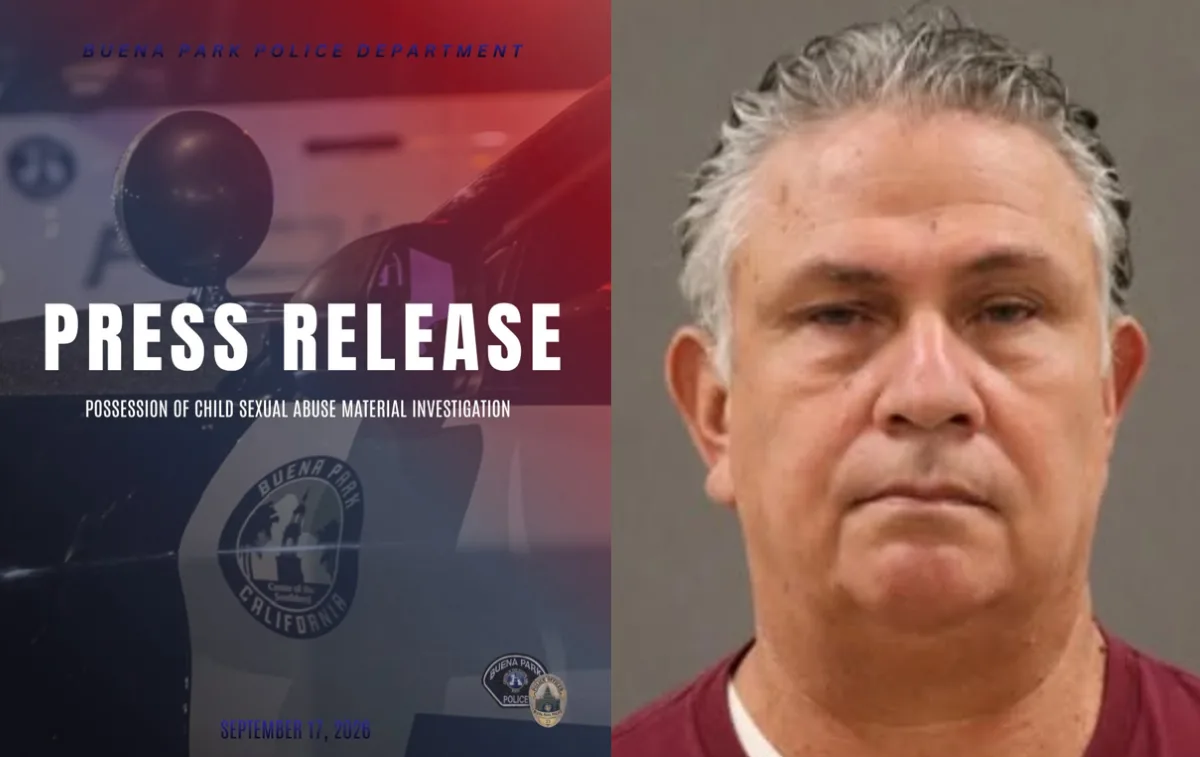
The Buena Park Police Department has arrested Moises Garcia, 56, a teacher at Paramount High School, after detectives served search warrants at his home and workplace and located child sexual abuse material (CSAM).

According to the department’s release, Garcia was taken into custody on September 17, 2026, and the investigation remains ongoing.
Criminal Charges and Potential Penalties
Under California Penal Code §§311.1–311.11, possession of CSAM is a felony that can carry multi‑year prison terms, mandatory sex‑offender registration, and additional sentencing enhancements when the material involves prepubescent children or large volumes of files. Federal charges may also apply, as federal law prohibits possession, receipt, distribution, and attempted purchase of CSAM, with penalties ranging from 5 to 20 years per count depending on aggravating factors. justice.govjustice.gov. Child Sexual Abuse Material – United States Department of Justice
If prosecutors determine Garcia possessed, downloaded, or attempted to purchase CSAM, he could face:
- Felony CSAM possession — typically 2–6 years in state prison.
- Felony distribution or attempted purchase — significantly higher exposure under federal statutes.
- Mandatory lifetime sex‑offender registration under California law.
- Loss of teaching credential — the California Commission on Teacher Credentialing revokes credentials for CSAM‑related convictions.
Impact on His Career
A CSAM arrest is effectively career‑ending for any educator. School districts immediately place employees on leave, revoke access to campus, and initiate termination proceedings. Credential revocation is automatic upon conviction for CSAM offenses. Even without a conviction, districts rarely reinstate teachers arrested for crimes involving child exploitation because of liability exposure and mandatory reporting laws.
Why Some Teachers Engage in This Behavior
Experts note that offenders in child‑serving professions often exploit access, trust, and routine proximity to minors. According to federal CSAM research, offenders frequently use everyday technology—phones, cloud storage, social media—to hide illicit material and communicate anonymously. Some educators who offend do so because:
- They believe digital anonymity shields them from detection.
- They have pre‑existing sexual interest in minors and seek material online.
- They rationalize their behavior as “private” consumption, ignoring the real victims depicted.
- They underestimate the sophistication of modern digital forensics.
California’s Expanded Civil Liability for Schools
California lawmakers have recently expanded the ability of survivors to sue school districts for historical child‑sexual‑abuse cases, including those involving CSAM. These reforms extend statutes of limitation and allow civil claims even decades after the abuse occurred. This means districts face significant financial and reputational risk when employees engage in CSAM‑related crimes, further ensuring that accused educators are swiftly removed from classrooms.
How Schools Are Working to Prevent Abuse
Schools today employ multiple layers of prevention:
- Mandatory background checks and fingerprinting.
- Digital‑device monitoring on district networks.
- Mandatory reporter training for all staff.
- Anonymous reporting systems for students.
- Regular audits of employee conduct and campus access.
Districts also partner with law enforcement and the National Center for Missing & Exploited Children (NCMEC) to detect suspicious online activity.
Long‑Term Trauma for Child Victims
CSAM survivors often experience lifelong trauma. According to NCMEC, 67% of survivors report that the ongoing distribution of their images causes unique, enduring harm because the exploitation never truly ends. Victims may suffer:
- Chronic anxiety and depression
- Fear of images resurfacing
- Difficulty forming relationships
- Long‑term PTSD
- Re‑victimization each time the material is viewed or shared
Data on CSAM Trends
CSAM cases have surged nationwide. NCMEC’s CyberTipline received nearly 30 million reports in 2021, up from 500,000 in 2013. Law enforcement also reports:
- Over 195 million CSAM‑related reports since CyberTipline’s inception.
- More than 425 million images and videos reviewed by analysts.
- Over 30,000 identified victims worldwide.
How Police Catch CSAM Offenders
Modern CSAM investigations rely on:
- Search warrants for homes, workplaces, and digital devices.
- Digital forensics labs capable of recovering deleted files.
- CyberTipline reports from tech companies detecting illegal uploads.
- Cross‑agency cooperation between local police, DOJ, FBI, and specialized computer‑crimes units.
- IP‑address tracing, metadata analysis, and encrypted‑device cracking.
These tools allow investigators to identify offenders even when they attempt to hide behind anonymizing technology.