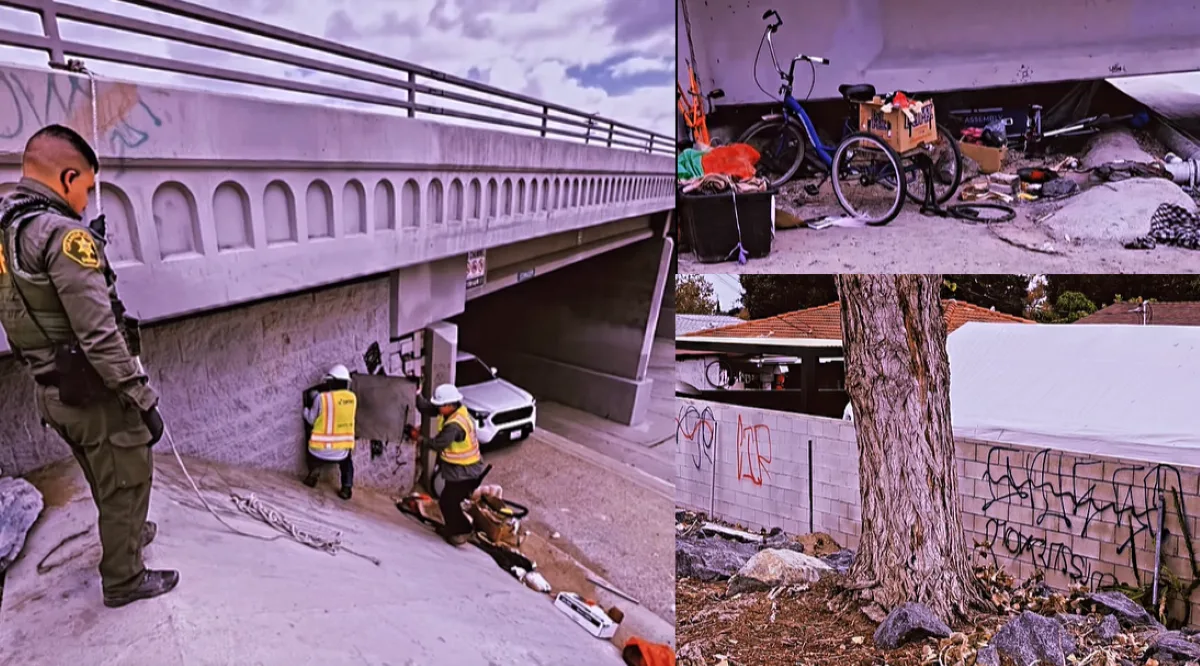
Law enforcement operations along the Santa Ana River have intensified following a major joint operation spearheaded by the Orange County Sheriff’s Department North Patrol.

Partnering with a diverse network of county agencies, deputies executed a sweeps-and-service strategy aimed at dismantling illegal infrastructure and addressing rising crime rates:
- Behavioral Health Bureau (BHB): Deployed specialized staff to evaluate psychiatric and substance needs on-site.
- Stanton Police Services: Provided localized tactical support and regional enforcement assets.
- Orange County Public Works: Spearheaded heavy debris removal and environmental cleanup machinery.
- County Outreach & Engagement Team: Offered immediate placement, shelter coordination, and medical service referrals.
The targeted sweep along the critical flood control channels resulted in 19 total detentions, with 10 suspects booked on various criminal charges and an additional 9 individuals processed via cite-and-release.
Criminal Charges and Potential Sentencing Guidelines
The suspects caught in the dragnet face a spectrum of misdemeanor and felony criminal charges under the California Penal Code and Health and Safety Code:
- Trespassing (Penal Code Section 602): Entering public waterways or restricted flood control channels carries a potential sentence of up to 6 months in county jail and a $1,000 fine.
- Vandalism and Graffiti (Penal Code Section 594): Property destruction under $400 counts as a misdemeanor punishable by up to a year in jail, while damage exceeding $400 triggers felony charges risking up to 3 years in state prison.
- Drug Possession (Health & Safety Code 11377 & 11364): Misdemeanor possession of controlled substances like methamphetamine or drug paraphernalia carries sentences up to one year in county jail.
- Possession for Sale: Elevates the narcotics offense directly to a felony, carrying an automatic state prison sentence of up to 4 years.
Transient Crime Trends and Arrest Data in Orange County
This multi-agency enforcement reflects a broader, countywide crackdown on transient-related crime, which local metrics show has surged across Orange County:
- Santa Ana Quality of Life Team (QOLT): Arrested 97 individuals in a single sweep for active warrants, narcotics, and probation violations.
- Hart Park Multi-Agency Task Force: A joint operation by Orange and Santa Ana Police Departments netted 69 total arrests, including 16 high-level felony bookings.
- Regional Crime Drivers: Cities like Anaheim, Garden Grove, and Santa Ana report that property crimes, narcotics distribution, and violent simple assaults drive the highest overall crime costs per resident in the county.
The Financial Impact and Public Infrastructure Damage Costs
The financial toll of transient encampments on infrastructure, municipal budgets, and insurance platforms has escalated into the millions. While exact private insurance losses remain scattered across individual commercial and residential claims for arson, copper theft, and vandalism, public infrastructure entities bear the immediate brunt:
- Structural Damage: Encampments tucked into subterranean underpasses and storm drains block vital water pathways, modify structural concrete, and cause critical blockages.
- Flooding Hazards: Debris and modifications force Caltrans and Orange County Public Works to launch emergency clearing operations to prevent catastrophic flooding.
- Municipal Budgets: Cities expend millions annually in constant environmental remediation, hazardous waste removal, and public works enforcement, prompting localized budget restructuring.
Municipal Responses and New Anti-Camping Policy Frameworks
In response to these compounding challenges, cities across North and Central Orange County have dramatically overhauled their homelessness policies. Empowered by the Supreme Court’s landmark Grants Pass v. Johnson ruling, the Orange County Board of Supervisors approved a strict policy authorizing immediate arrests, ticketing, and fines for camping on county-owned land, parks, and flood control channels, effectively reversing previous legal restrictions that required a shelter bed offer before enforcement. Neighboring municipalities like Anaheim, Santa Ana, Irvine, and Stanton have aggressively tightened local anti-camping and anti-loitering ordinances:
- Subterranean Camping Bans: Criminalizes structural modifications and underground camping in tunnels or drains.
- Vehicle Vagrancy Laws: Explicitly prohibits sleeping overnight in parked vehicles on public roadways.
- Bicycle Chop-Shop Bans: Restricts the public assembly, storage, or sale of multiple bicycles on public property.
Shelter Systems and Behavioral Health Resources Utilized in Operations
To balance this strict enforcement framework, the County Outreach & Engagement Team and the Behavioral Health Bureau immediately deploy a network of regional shelter systems and medical care networks during operations:
- Regional Navigation Centers: Facilities like the Yale Navigation Center in Santa Ana and the Bridges at Kraemer Place in Anaheim offer emergency beds, laundry, storage, and intensive case management designed to transition individuals into permanent supportive housing.
- Be Well OC System: Deploys mobile crisis intervention teams directly into the field to stabilize individuals experiencing severe psychiatric distress.
- OC Health Care Agency’s Mental Health and Recovery Services: Provides direct, immediate access to medical detox programs, outpatient substance abuse counseling, and residential mental health facilities to target the underlying drivers of public encampment and recidivism.