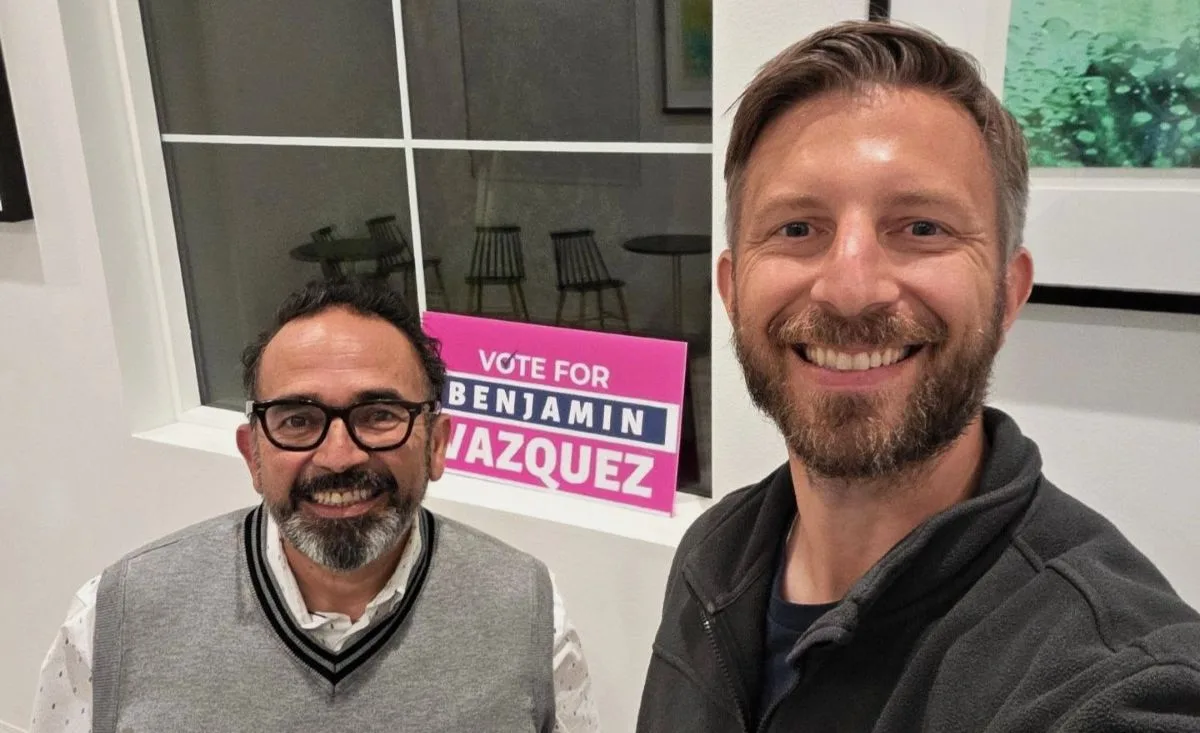
The latest Santa Ana election results point to a significant shift in the city’s political landscape. Based on the posted vote totals, Dan Shimmel defeated incumbent Mayor Valerie Amezcua, while Benjamin Vazquez, Sandra De Anda, and Isuri Ramos won their respective city council races.
In addition, Assembly candidate Jessie Lopez currently leads former Santa Ana Councilman David Penaloza by roughly 1,100 votes, and while ballots remain to be counted, Penaloza faces an increasingly difficult path to overtake the lead.Usually the later votes are by younger voters, who in this election tranded to vote for DSA-backed candidates.
The outcome appears to cement a stronger progressive bloc across Santa Ana politics, one that aligns on a number of issues including housing protections, labor concerns, police oversight, immigrant rights, and skepticism toward certain law enforcement technologies. Whether supporters view that as progress or critics see it as a warning sign, the election marks one of the most consequential political realignments the city has experienced in years.
Why Did These Candidates Win?
The most surprising result may have been the mayoral race.
For decades, Santa Ana politics has often been analyzed through the lens of neighborhood ties, local networks, and the city’s heavily Latino electorate. The defeat of an incumbent Latina mayor by Dan Shimmel, a relatively unknown political figure compared to long-time city officeholders, will likely generate significant debate among local observers.
Several factors may have contributed:
- Voter dissatisfaction with City Hall’s handling of ongoing financial challenges.
- A well-organized progressive political coalition that appears to have coordinated messaging across multiple races.
- Strong labor union involvement and voter mobilization efforts.
- Housing affordability concerns and renter-focused issues.
- Immigration concerns that became highly visible during the closing weeks of the campaign.
Many local observers believe immigration-related controversies may have had an especially powerful impact. Reports involving federal immigration enforcement activity near detention facilities and county jail operations became major discussion points during the final stretch of voting. Social media influencers and activists frequently framed local races through the broader national debate over immigration policy.
Mayor Amezcua found herself increasingly criticized by activists despite her long Democratic record. Some progressive voices attempted to portray her as too moderate on public safety issues and too willing to cooperate with law enforcement institutions. Whether that characterization was fair or not, it appears to have resonated with enough voters to influence the outcome.
The election also illustrates the growing strength of younger voters and second-generation immigrant families. Political engagement frequently increases when communities perceive external threats or major policy changes affecting family members. That dynamic may have helped drive turnout among voters already inclined to support progressive candidates.
A New Governing Majority Emerges
Assuming the new officeholders govern in line with positions they have previously expressed, Santa Ana could soon have one of the most progressive governing coalitions in Orange County.
The emerging bloc could include:
- Mayor-elect Dan Shimmel.
- Councilman Benjamin Vazquez.
- Councilwoman-elect Sandra De Anda.
- Councilwoman-elect Isuri Ramos.
- Councilman Jonathan Hernandez.
- Councilmember Thai Viet Phan.
Outside City Hall, Assemblywoman-elect Jessie Lopez and Orange County Supervisor Vicente Sarmiento are generally viewed as political allies on many policy issues.
This alignment could make it easier to advance progressive policies because elected officials would face less internal opposition than in previous years.
Public Safety May Become the First Major Battleground
One of the biggest questions facing Santa Ana is how the new political alignment will approach law enforcement.
Critics of the incoming coalition argue that Santa Ana already struggles with gang activity, property crime, narcotics trafficking, homelessness, illegal street racing, and sideshow-related issues. Those critics worry that further restrictions on proactive policing tools could make it harder for officers to address crime.
Issues likely to generate debate include:
- Police drone programs.
- Flock automated license plate reader cameras.
- Enforcement of public narcotics use.
- Homelessness-related policing strategies.
- Specialized crime suppression efforts.
Supporters of these technologies argue they allow officers to solve crimes more quickly, locate suspects, recover stolen vehicles, and gather evidence without increasing physical confrontations.
Opponents argue that such systems create privacy concerns and can disproportionately affect certain communities.
If future votes result in limits on drones or camera systems, critics will likely argue that investigators are losing tools that many other Orange County agencies increasingly consider standard equipment.
The debate will ultimately come down to competing priorities: privacy and civil liberties versus investigative effectiveness and crime prevention.
Could Santa Ana Lose Police Officers?
Another question is whether the political environment could affect police recruitment and retention.
Law enforcement agencies throughout Southern California continue to compete aggressively for experienced officers. When officers perceive a city government as unsupportive, retirement rates and lateral transfers can increase.
Critics of the new council majority argue that stronger civilian oversight and more aggressive scrutiny of officer conduct could encourage some personnel to seek employment elsewhere.
Supporters counter that accountability measures improve public trust and ultimately strengthen departments.
What is clear is that police staffing remains a challenge throughout California. Any additional recruiting pressures could make it even more difficult and expensive for Santa Ana to maintain staffing levels.
Among Orange County agencies that have consistently recruited lateral officers and experienced law enforcement personnel are:
- Irvine Police Department.
- Huntington Beach Police Department.
- Newport Beach Police Department.
- Anaheim Police Department.
- Orange Police Department.
- Costa Mesa Police Department.
- Tustin Police Department.
These agencies often market competitive salaries, strong benefits, newer equipment, and opportunities for career advancement. One can expect that there will be a huge exodus, particuarly of younger Santa Ana police officers, who will likely seek greener pastures in cities like Irvine, Tustin and Newport Beach that are much better managed than Santa Ana.
Measure N Keeps Taxes High
Voters also approved Measure N, preserving Santa Ana’s local sales tax rate.
Supporters argued that the revenue is necessary to maintain city services, address budget pressures, and avoid deeper service cuts.
Critics argued that Santa Ana residents already face substantial economic challenges and that continuing one of Orange County’s highest sales tax rates could further burden working families.
Potential implications include:
- Higher consumer costs.
- Additional city revenue.
- Reduced pressure for immediate budget cuts.
- Continued debate over spending priorities.
The measure provides City Hall with additional financial resources. However, it does not automatically solve the city’s long-term structural financial challenges.
Even worse, many local residents have already resorted to spending their hard-earned money in cities other than Santa Ana.
The Rent Control Debate Is Not Going Away
Housing policy will likely remain another major area of focus.
Supporters of Santa Ana’s rent stabilization policies argue that protections are necessary to prevent displacement and keep housing accessible for lower-income residents.
Critics point to economic research suggesting that rent control can reduce housing production, discourage investment, and contribute to long-term supply shortages.
Several studies examining rent-control policies in various jurisdictions have found mixed results. While some tenants receive immediate benefits, economists frequently note potential unintended consequences such as reduced housing availability and slower new construction.
Critics of Santa Ana’s approach argue that the city should focus more heavily on increasing housing supply rather than imposing additional regulations.
With a stronger progressive majority now emerging, the pressure may instead be for expanded tenant protections and additional housing regulations.
The Financial Question Nobody Can Avoid
Perhaps the biggest challenge facing Santa Ana has nothing to do with ideology.
It is math.
The city continues to face ongoing concerns regarding pension obligations, labor costs, infrastructure demands, and service delivery expenses.
The incoming political coalition has generally enjoyed strong support from organized labor. That support creates an important governing challenge.
Labor organizations understandably seek higher wages, improved benefits, and stronger worker protections for their members. City officials, meanwhile, must balance those goals against long-term financial sustainability.
The difficult question facing the new majority is whether it can simultaneously:
- Increase spending.
- Expand city services.
- Support larger labor agreements.
- Maintain existing programs.
- Avoid new taxes.
- Stabilize city finances.
History suggests accomplishing all of those objectives at the same time is extraordinarily difficult.
What Happens Next?
The election results suggest that Santa Ana voters wanted change.
What remains uncertain is what kind of change they ultimately voted for.
Supporters of the new coalition see an opportunity to reshape City Hall around immigrant rights, tenant protections, labor interests, and greater oversight of government institutions.
Critics fear reduced emphasis on public safety, resistance to law enforcement technologies, continued tax burdens, and policies they believe could worsen the city’s long-term financial position.
The new governing majority will soon move from campaigning to governing. At that point, voters will begin measuring results rather than promises. Whether this political realignment becomes a model for progressive urban governance or a cautionary tale about ideology and city management may ultimately define Santa Ana politics for years to come.
And if Shimmel proves not to be up to the task of leading Santa Ana one may assume that Councilman Vazquez will likely be gunning for the Mayor’s seat in two years.