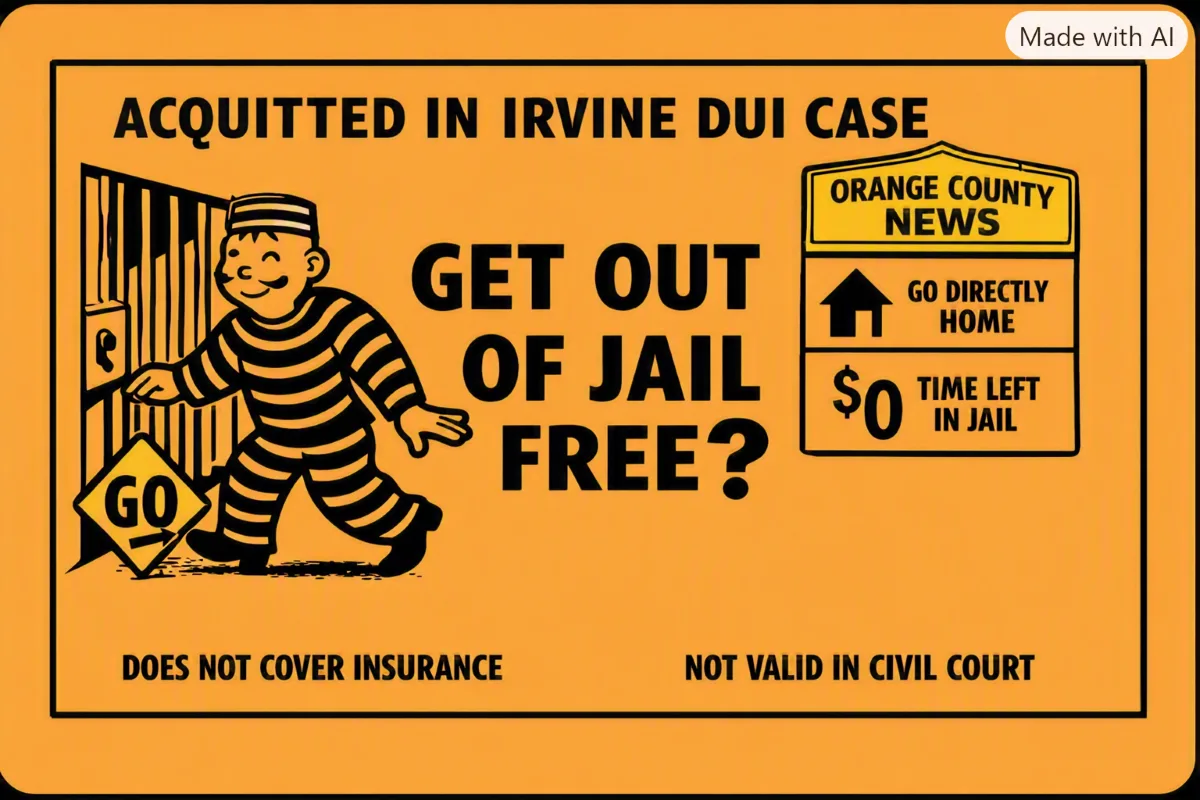
A 38‑year‑old Los Angeles man, Jim Christopher Rosado, walked out of custody this week after an Orange County jury acquitted him of second‑degree murder for the 2021 DUI crash in Irvine that killed his niece, 18‑year‑old Vanessa Ramirez.

While jurors convicted him of the lesser felony of injuring Ramirez’s friend while driving under the influence, the five‑year sentence imposed Wednesday was effectively erased by the time Rosado already served in local jail awaiting trial.
This case, which began with a desperate 3 a.m. call from two stranded teens in Oceanside, ended with a split verdict that raises difficult questions about DUI prosecutions, family responsibility, and public safety on Southern California freeways.
The prosecutor on this case was Deputy District Attorney Elise Levy. The defense attorney was T. Edward Welbourn, a veteran Orange County criminal defense lawyer. Welbourn countered that Rosado was not impaired and had simply fallen asleep after a long drive to rescue his niece.
Why the Prosecution Failed to Secure a Murder Conviction
Prosecutors pursued a second‑degree murder charge based on implied malice, arguing Rosado knew the dangers of driving intoxicated because of prior DUI advisements and warnings on his license application. But jurors ultimately rejected that theory. Several factors likely contributed:
- Implied malice standards — California law requires proof that the defendant subjectively understood the danger and consciously disregarded human life. Jurors often struggle with this threshold unless impairment is overwhelming and behavior is extreme.
- Defense fatigue argument — Rosado’s attorneys argued he had driven for hours without incident and simply fell asleep at the wheel. Fatigue‑based crashes, even deadly ones, rarely meet the implied‑malice bar.
- Mixed toxicology evidence — While methamphetamine, amphetamine, and morphine/heroin markers were detected, the defense emphasized the lack of direct evidence of impairment at the moment of the crash.
- Family dynamics — Jurors may have been influenced by testimony that Rosado was trying to help his niece and her friend get home safely, not partying or acting recklessly for personal pleasure.
In short, prosecutors could not prove Rosado’s mindset met the legal definition of implied malice, even though his driving — reportedly over 90 mph and erratic — was undeniably dangerous.
Southern California DUI Crash Trends
DUI fatalities remain a persistent problem across the region:
- Orange County averages 60–80 DUI‑related deaths per year, according to CHP and OTS data.
- Los Angeles County regularly exceeds 200 DUI fatalities annually, driven by population density and freeway volume.
- Methamphetamine‑related DUI crashes have risen sharply, with CHP reporting double‑digit percentage increases since 2018.
- Early‑morning crashes (midnight–6 a.m.) account for nearly 40% of DUI fatalities, a pattern that mirrors the timing of the Rosado crash.
These numbers underscore how common — and preventable — these tragedies are.
Will Rosado’s Auto Insurance Be Affected?
Even though Rosado is being released, the consequences for his auto insurance will continue for years:
- DUI convictions trigger mandatory SR‑22 filings in California, often for three years.
- Insurers typically classify DUI injury crashes as high‑risk, leading to premium increases of 150%–300%.
- Because the crash involved a fatality, Rosado may face non‑renewal, forcing him into high‑risk insurers with significantly higher rates.
- Civil judgments (if any arise) can also affect future insurability.
In short, acquittal on murder does not erase the financial fallout.
Will This Incident Affect Rosado’s Ability to Work?
A felony DUI causing injury is a serious conviction that can impact employment:
- Background checks will show the felony, which may limit opportunities in transportation, healthcare, education, government, and any job requiring driving.
- Employers may view the fatal crash — even without a murder conviction — as a liability risk.
- If Rosado’s prior work involved driving, he may be barred from returning to that field.
While he is legally free, the practical consequences will follow him long after release.
Can the Victim’s Family Still Sue in Civil Court?
Yes. A criminal acquittal does not prevent civil litigation.
- Wrongful death lawsuits can still be filed because civil court uses a lower burden of proof (“preponderance of evidence”).
- Families often pursue civil claims even when criminal charges fail.
- As of this writing, no publicly reported civil lawsuit has been filed by Vanessa Ramirez’s family, but they remain fully entitled to do so.
Civil court may ultimately be where accountability is sought.
Safer Ways to Get Home Than Relying on a Possibly Impaired Family Member
This tragedy began with two teens stranded after a party. Their instinct to call family was understandable — but relying on someone who may be exhausted, impaired, or unprepared for a long drive can be deadly. Safer alternatives include:
- Rideshare services — Uber and Lyft offer late‑night coverage across Southern California.
- Designated drivers — Families can pre‑plan safe rides before teens go out.
- Public transit connections — Limited but available in some corridors.
- Safe‑ride programs — Some cities and campuses offer emergency ride services.
- Family safety rules — Parents can establish strict guidelines: no late‑night long‑distance pickups, mandatory check‑ins, and backup ride plans.
The key is having a plan before a crisis happens at 3 a.m.
Community Impact
The Rosado case highlights the complexities of DUI prosecutions in Orange County, the long‑term consequences for drivers, and the devastating impact on families.
As DUI crashes continue to rise across Southern California — especially those involving methamphetamine — communities must focus on prevention, safer transportation options, and accountability through both criminal and civil systems.