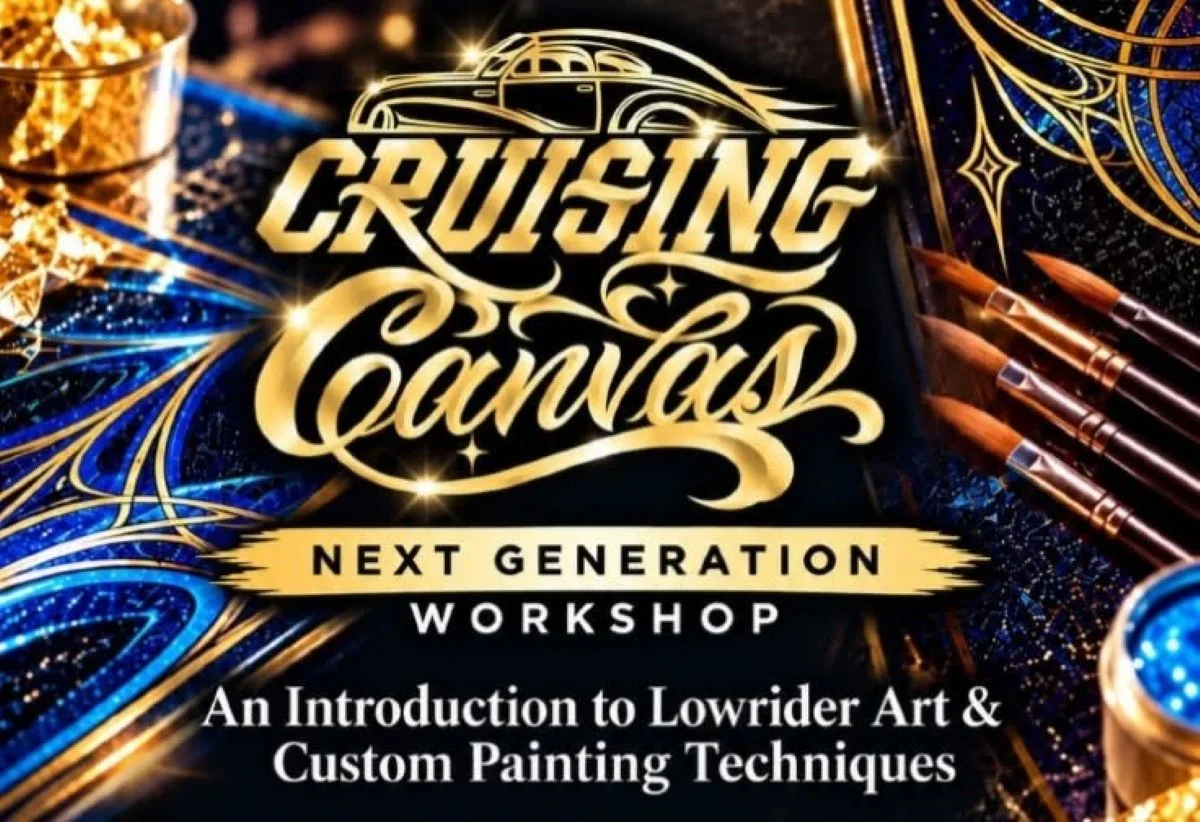
The City of Santa Ana Arts & Culture Office is helping introduce a new generation to one of Southern California’s most recognizable cultural traditions through a free youth workshop focused on lowrider art and custom painting techniques.
According to a recent announcement, the “Cruising Canvas: Next Generation Workshop” will take place on Saturday, Nov. 14, from 1 p.m. to 3 p.m. at OCCCA in Santa Ana. The workshop is designed primarily for youth ages 18 and under, although organizers indicate younger artists will also be accommodated. Participants will receive instruction in lowrider-inspired art techniques, all materials will be provided free of charge, and attendees will receive art supplies to take home. The project is supported in part by the City of Santa Ana Arts & Culture program.
The workshop arrives at a time when lowrider culture is experiencing renewed visibility throughout California, with museums, art exhibits, car shows, educational programs, and community organizations increasingly recognizing the movement’s artistic and cultural significance.

Cruising Has Deep Roots in California
Cruising has been part of California car culture for generations. The practice traces its roots to post-World War II Southern California, when customized automobiles became symbols of personal expression, community pride, and craftsmanship. In many Latino communities, particularly throughout Los Angeles, Orange County, the Inland Empire, and San Diego, lowriders evolved into a unique cultural tradition that combined automotive engineering, visual art, music, family gatherings, and neighborhood identity.
By the 1960s and 1970s, lowrider clubs and cruising routes had become fixtures in many California cities. Boulevard cruising allowed enthusiasts to showcase elaborate paint jobs, chrome detailing, custom upholstery, pinstriping, murals, hydraulics, and artistic innovations that often required hundreds or even thousands of hours of labor.
For many participants, cruising was never simply about automobiles. It became a community gathering place where families, artists, musicians, entrepreneurs, and car enthusiasts connected across generations.
California Moved To Protect Cruising
For decades, many California cities adopted anti-cruising ordinances that allowed law enforcement agencies to cite drivers for repeatedly passing through designated areas.
That changed in 2024 when California enacted Senate Bill 92. The legislation declared cruising to be a culturally significant activity and prohibited local governments from maintaining or enforcing blanket anti-cruising ordinances. Supporters argued that cruising represents an important aspect of California history, particularly within Latino communities, and deserved the same respect afforded to other forms of cultural expression.
The law did not legalize reckless driving, sideshows, speeding, excessive noise violations, DUI offenses, or other traffic-related crimes. Instead, it removed local prohibitions that specifically targeted lawful cruising activity.
Easter Cruising Continues To Create Tension In Santa Ana
Despite the changes in state law, controversy has continued in Santa Ana.
The city’s Easter Sunday cruising tradition draws participants from throughout Southern California and has long been one of Orange County’s most visible lowrider gatherings. While proponents view the event as a family-oriented cultural celebration, city officials and law enforcement agencies have frequently expressed concerns regarding traffic congestion, illegal parking, unsafe driving behaviors, and crowd-control issues.
In recent years, participants have reported that citations continued to be issued during Easter cruising events for a variety of alleged traffic, parking, and vehicle code violations. City officials have maintained that enforcement efforts target specific violations rather than the act of cruising itself.
That distinction remains an important part of California’s cruising law. While cities generally cannot prohibit lawful cruising, law enforcement agencies retain authority to enforce existing traffic, parking, safety, registration, equipment, and vehicle code requirements.
Now that Santa Ana’s City Council is populated by anti-police City Council Members one can expect they might finally loosen up on Easter Cruising.
Lowriding Is Also An Art Form
Events such as the Cruising Canvas workshop highlight an often-overlooked aspect of lowrider culture: the artistry.
Many custom vehicle builders work in disciplines that overlap with traditional fine arts, including:
- Airbrush illustration
- Murals and graphic design
- Custom paint layering
- Metal fabrication
- Pinstriping
- Hand lettering
- Automotive restoration
- Upholstery design
- Industrial design
A professionally painted show-quality lowrider can involve months of work and thousands of dollars in materials and labor. Custom painters often employ techniques that blend influences from Mexican-American art traditions, California surf culture, street art, tattoo design, and classic automotive aesthetics.
For young artists interested in careers involving graphic design, illustration, custom painting, automotive design, fabrication, or the skilled trades, workshops like this can provide an introduction to techniques that have been passed down through generations of California artists and craftsmen.
Workshop Information
Youth interested in participating should note the following details:
- Event: Cruising Canvas: Next Generation Workshop
- Date: Saturday, Nov. 14
- Time: 1 p.m. to 3 p.m.
- Location: OCCCA, Santa Ana
- Cost: Free
- Materials: Provided at no cost
- Eligibility: Youth 18 and under, with accommodations for younger participants
- RSVP: Required through Eventbrite
- Parent or guardian release form required
As California continues to recognize lowriding as a significant part of the state’s cultural heritage, Santa Ana’s latest youth art workshop offers an opportunity for young residents to learn the creative skills behind a tradition that has shaped generations of Southern California communities.