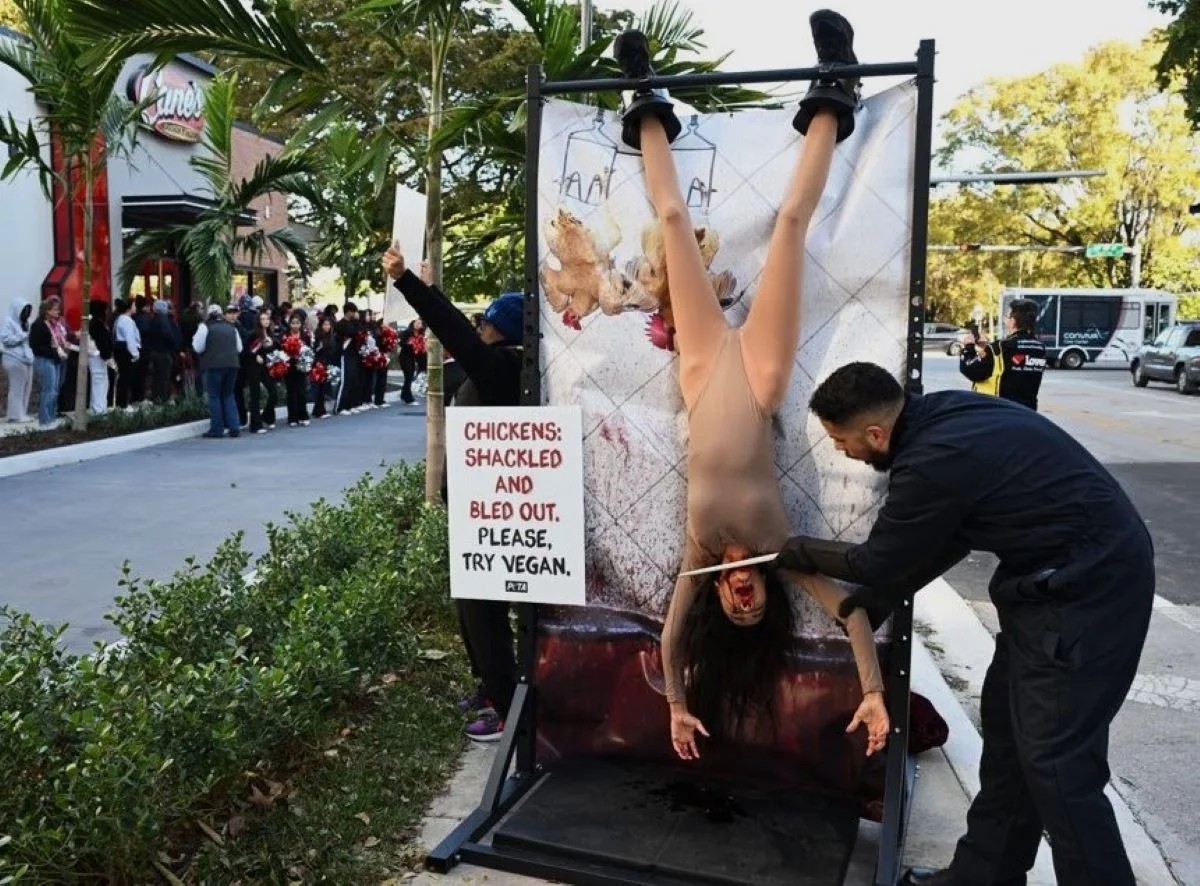
PETA supporters are aiming to deliver a shocking message to those attending the grand openings of Raising Cane’s in Santa Ana and Costa Mesa next week.
PETA plans to hang a woman upside down and have her throat “slit” to demonstrate how chickens are killed for those “chicken fingers.”
The pro-vegan displays are designed to illustrate the point that every chicken raised for their flesh meets a terrifying end, and that human beings and chickens are the same in all the ways that matter, including their experience of pain and fear.
“PETA asks anyone thinking of eating chicken to think about how these curious, social birds are killed before they end up in a fast food bag,” says PETA President Tracy Reiman. “It is cruelty to animals to ignore the suffering of chickens and other animals, and it’s so easy to go vegan.”
PETA offers a free vegan starter kit for anyone thinking of making the switch.

How these Protests Might Backfire on PETA
PETA’s “slit throat” protests, including the scheduled demonstrations in Santa Ana (Feb 17) and Costa Mesa (Feb 24), are designed to be intentionally shocking but have faced significant criticism for their potential impact on public perception of safety and human rights.
While PETA maintains a creed of nonviolence and states that their demonstrations are peaceful educational tools, experts and activists have raised several concerns regarding these specific graphic displays:
- Gendered Violence Imagery: Critics argue that using women to simulate graphic violence—such as being hung upside down with their throats “slit”—can be exclusionary and harmful. Some academic analysis suggests these campaigns may denigrate women to reassert specific identities, potentially reinforcing hurtful hegemonic images.
- Desensitization & Psychological Impact: Public displays of simulated violence have been condemned by child psychologists and community leaders as traumatizing and insensitive, particularly when staged in family-oriented public spaces.
- False Equivalency: Organizations and scientists have criticized PETA for equating animal agriculture with human tragedies (such as the Holocaust or slavery), arguing that such comparisons trivialize serious human rights issues and can be detrimental to the wellbeing of both humans and animals.
- Controversy vs. Effectiveness: While these stunts successfully generate media attention, some vegans and animal rights activists believe they push people away from the movement by associating it with extremism and unethical imagery rather than constructive dialogue.
There is no documented evidence or official police report directly linking these specific protests to a subsequent increase in physical attacks on women. However, the use of graphic imagery remains a central point of ethical debate regarding the social responsibility of activist groups.
As of 2025, PETA claims to have 10.5 million supporters globally. However, independent surveys often show a more critical public; for instance, a large-scale study found that 42% of Americans have heard of PETA but explicitly choose not to support them.
Compared to groups like the ASPCA, PETA consistently ranks lower in “perceived impact” on animal well-being, as many Americans view their methods as “extreme”.
Only 1% to 4% of Americans identify as vegan as of early 2026. Approximately 3% to 6% of Latinos (Hispanics) in the United States identify as vegan or strictly meat-free. While individual studies vary, research suggests that Latinos are more likely than non-Hispanic White consumers to adopt plant-based lifestyles.
If you don’t wanna eat meat, then DON’T eat it. People can make their own choice on what they’re craving for. That Demonstration was beyond foolish, & pointless. If vegans thinks they could get an obesed kid to eat crops from the ground throughout it’s life, have fun with that.
God bless peta’s passion.
Self-important kids with too much time on their hands putting on a bit of street theater. BORING!