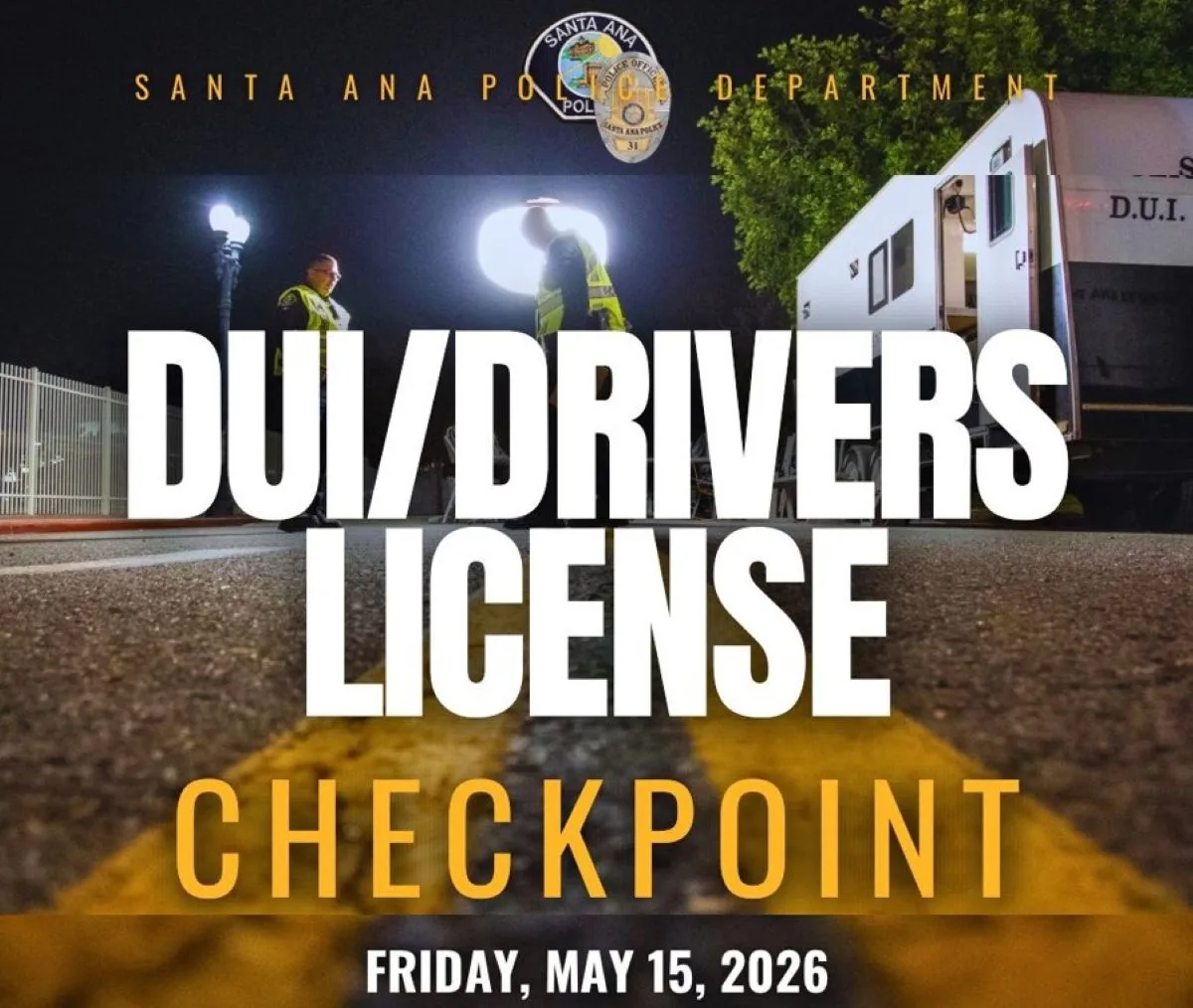
On Friday, May 15, 2026, the Santa Ana Police Department will conduct a driving under the influence (DUI) and driver’s license checkpoint.

The checkpoint will begin at 6:00 p.m. and conclude at 1:00 a.m. at an undisclosed location in the City of Santa Ana.
Drivers charged with a first-time DUI face an average of $13,500 in fines and penalties, as well as a suspended license.
The Santa Ana Police Department (SAPD) determines its DUI checkpoint locations using historical data linked to impaired driving arrests and traffic collisions. Per California state mandates, police departments must choose visible, high-traffic major thoroughfares and publicize the operations ahead of time.
In Santa Ana, checkpoints and targeted traffic saturation patrols most frequently occur along the following corridors:
1. Major East-West Thoroughfares
- 1st Street: Frequently targeted on the stretch between Sullivan Street and Raitt Street.
- 5th Street: Historically deployed near the 2400 block of W. 5th Street (near standard commercial zones).
- McFadden Avenue: Concentrated operations regularly target the 1500 block of E. McFadden Avenue.
- Edinger Avenue: Often set up between Main Street and Raitt Street.
2. High-Volume North-South Corridors
- Bristol Street: High-density checkpoints frequently block lanes from 17th Street down to Callen’s Common.
- Harbor Boulevard: Specifically active between Westminster Avenue and Edinger Avenue, as well as intersections near North Harbor Blvd and Hazzard Ave.
- Main Street: Regularly patrolled and checked from 17th Street south to Dyer Road.
- Raitt Street: Monitored frequently at the intersection of West Alton Avenue in the South Patrol District.
3. High-Incident Enforcement Corridors
- Grand Avenue: The 600 block of N. Grand Avenue is heavily utilized due to historical high pedestrian and vehicle traffic incidents.
- Downtown Santa Ana (DTSA): The area surrounding 4th Street and Lacy Street sees regular deployment due to the high density of nightlife venues and bars.
Legal Penalties and Financial Consequences if you get Busted at this Checkpoint
Drivers passing through the Santa Ana Police Department DUI checkpoint on May 15, 2026 face severe criminal, professional, and financial penalties. For Commercial Driver’s License (CDL) holders, the stakes are profoundly higher than for standard motorists.
1. Criminal and CDL Penalties
- Lower Legal Limit: The blood alcohol concentration (BAC) limit for commercial drivers is 0.04%, which is half the standard 0.08% limit for non-commercial motorists.
- Mandatory One-Year CDL Disqualification: A first-time DUI conviction triggers a mandatory one-year suspension of your CDL under California Vehicle Code § 15302.
- Personal Vehicle Rule: This one-year CDL ban applies even if you were driving your personal vehicle on your day off at a 0.08% BAC level.
- No Restricted CDL: The California DMV does not issue restricted commercial licenses. You cannot get a hardship permit to drive a commercial vehicle during the suspension.
- Hazardous Materials: If you are operating a commercial vehicle carrying hazardous materials at the time of the checkpoint stop, the CDL suspension increases to three years.
- Lifetime Ban: A second DUI offense at any point results in a permanent, lifetime ban from holding a CDL.
- Standard Criminal Penalties: Suspects also face up to 6 months in county jail, 3 to 5 years of informal probation, and mandatory DUI education classes.
2. Total Out-of-Pocket Financial Toll
As stated by the Santa Ana Police Department, a first-time DUI arrest averages $13,500 in total costs. This figure is a aggregate of:
- Court-ordered fines and penalty assessments ($390 to over $3,000).
- Vehicle towing, impound fees, and California DMV license reinstatement fees.
- DUI school enrollment costs.
- Mandatory Ignition Interlock Device (IID) installation and monthly monitoring fee.
3. Impact on Employment
- Immediate Job Loss: Because you cannot legally operate a commercial vehicle without an active CDL, a suspension acts as a professional termination for truck, delivery, or transit drivers.
- Zero-Tolerance Policies: Most commercial transport fleets maintain strict zero-tolerance protocols and will terminate an employee upon an active DUI charge or conviction.
- Unemployability: A permanent criminal record with a DUI conviction flags background checks indefinitely, making future commercial driving placement nearly impossible.
4. Impact on Auto Insurance
- Skyrocketing Premiums: A DUI conviction forces a “high-risk” classification. Personal auto insurance premiums in California surge by an average of 127% to 186%, translating to thousands of extra dollars annually.
- Commercial Coverage Denial: For corporate or owner-operator commercial policies, insurance underwriters will frequently deny coverage entirely or drop the driver from the employer’s fleet policy, preventing you from operating legally.
- SR-22 Requirement: To reinstate a regular personal driver’s license, you must file an SR-22 certificate of financial responsibility for a minimum of 3 years, escalating baseline costs.
- Loss of Discounts: Insurance companies are legally mandated to strip your “Good Driver” discount for 10 years following a DUI conviction in California.