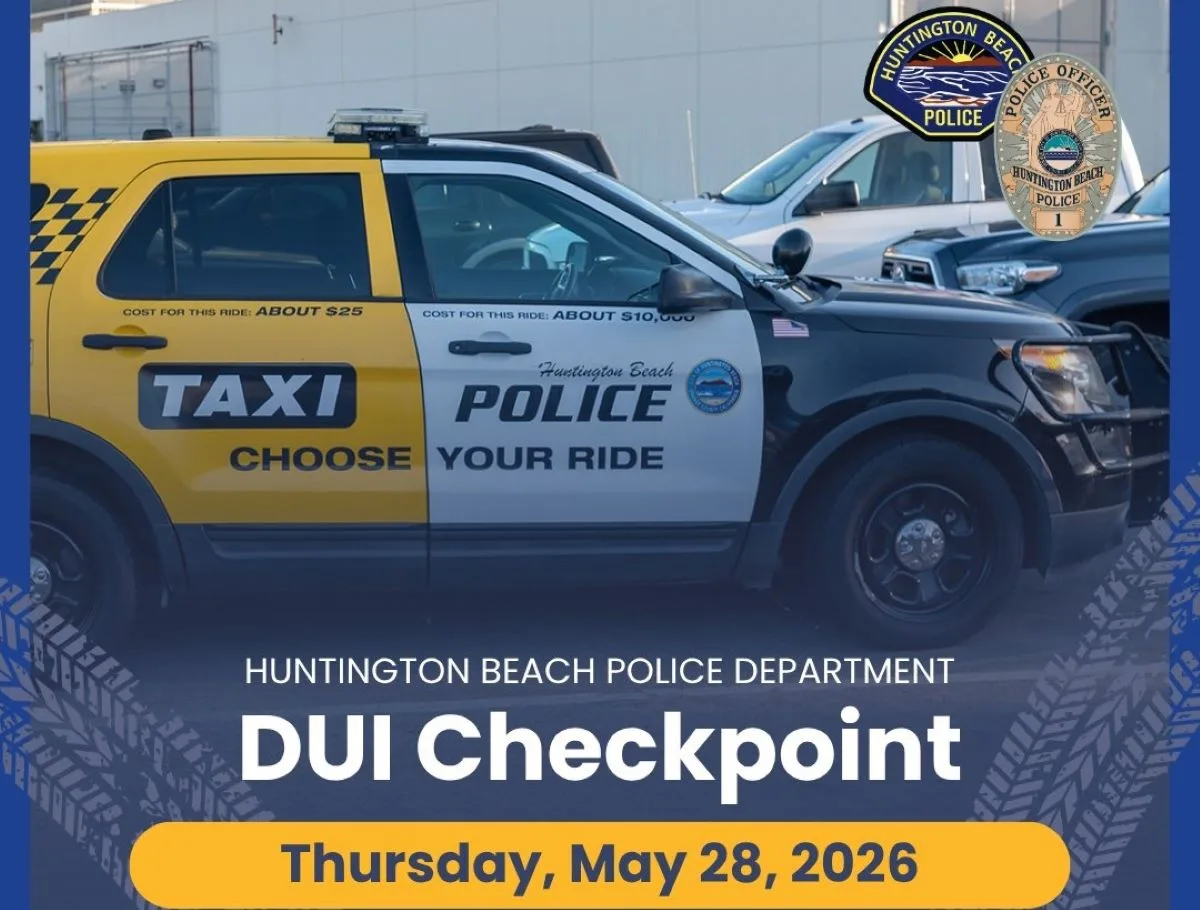
The Huntington Beach Police Department will hold a CDL/DUI Checkpoint on Thursday, May 28, 2026, from 6:00 p.m. to 2:00 a.m. at an undisclosed location within the city limits.

Checkpoint locations are chosen based on DUI crash and arrest history. The primary purpose of checkpoints is not to make arrests but to promote public safety by deterring impaired driving.
During the checkpoint, officers will look for signs that drivers are under the influence of alcohol and/or drugs.
Based on community tracking and historical data, the department frequently targets intersections where high volumes of traffic funnel through the city:
- Beach Boulevard: This is the most common artery for checkpoints. Specific frequent setups include the intersections at Beach Blvd & Warner Ave, Beach Blvd & Slater Ave, and near shopping centers like the Newland Plaza strip on Beach Blvd & Utica Ave.
- Major Arterials & Entertainment Corridors: Checkpoints are periodically placed on other primary multi-lane streets that handle traffic flow from Downtown Huntington Beach and the Pacific Coast Highway (PCH), such as Adams Avenue, Harbor Boulevard, and Edinger Avenue.
The HBPD is committed to keeping the traveling public safe.
The safety of our community is and always will be our mission. We are looking for impaired drivers because driving under the influence is dangerous and puts others on the road at risk.
The HBPD reminds the public that impaired driving is not just from alcohol. Some prescription medications or over-the-counter drugs may interfere with driving. Always follow directions for use and read warning labels about driving or “operating heavy machinery,” which includes driving a car. While medicinal and recreational marijuana are legal, driving under the influence of marijuana is illegal.
If you plan on drinking or taking medications that may impact your ability to drive safely, plan on staying at home.
Drivers charged with a first-time DUI face an average of $13,500 in fines and penalties, as well as a suspended license.
Funding for this program was provided by a grant from the California Office of Traffic Safety through the National Highway Traffic Safety Administration.
Drivers busted at the Huntington Beach Police Department (HBPD) checkpoint face severe criminal penalties and substantial, long-term premium hikes on auto insurance.
Legal Penalties for a First-Time DUI
A first-time DUI in California is classified as a misdemeanor. Under state laws, offenders face a structured combination of court-ordered and California DMV administrative penalties:
- Financial Fines: Base fines range from $390 to $1,000. However, total penalty assessments, court fees, and towing costs average $13,500 to $20,000.
- License Suspension: The court and DMV impose a 6-month driver’s license suspension. You have exactly 10 calendar days from the arrest to request an administrative DMV hearing to contest the suspension.
- Ignition Interlock Device (IID): Under the extended California pilot program, drivers must install an IID breathalyzer in their vehicle for 6 months to maintain restricted driving privileges.
- Mandatory DUI School: Defendants must enroll in a licensed alcohol and drug education program for 3 to 9 months, depending on their blood alcohol concentration (BAC) at arrest.
- Probation & Jail Time: First-time offenders face 3 to 5 years of informal, unsupervised probation. While the law technically allows for up to 6 months in county jail, courts usually grant probation instead for standard first offenses.
Impact on Auto Insurance
A DUI conviction heavily disrupts your insurance standing, shifting you into a high-risk driver category.
- Massive Rate Hikes: California drivers see an average premium increase of 148% to 186%. For most drivers, this translates to paying two to three times their current rate, or roughly $3,000+ extra per year.
- Loss of Discounts: A DUI conviction immediately revokes your California “Good Driver” discount for 10 years.
- SR-22 Requirement: To reinstate a suspended license, your insurance provider must file an SR-22 Financial Responsibility Certificate with the DMV. This document serves as proof that you carry the state’s mandatory liability limits.
- Policy Dropping: Many standard insurers will outright non-renew or cancel your policy at the end of your term, forcing you to use specialized, high-risk non-standard insurance carriers.
- Duration: The violation remains on your official DMV driving record for 10 years. Surch