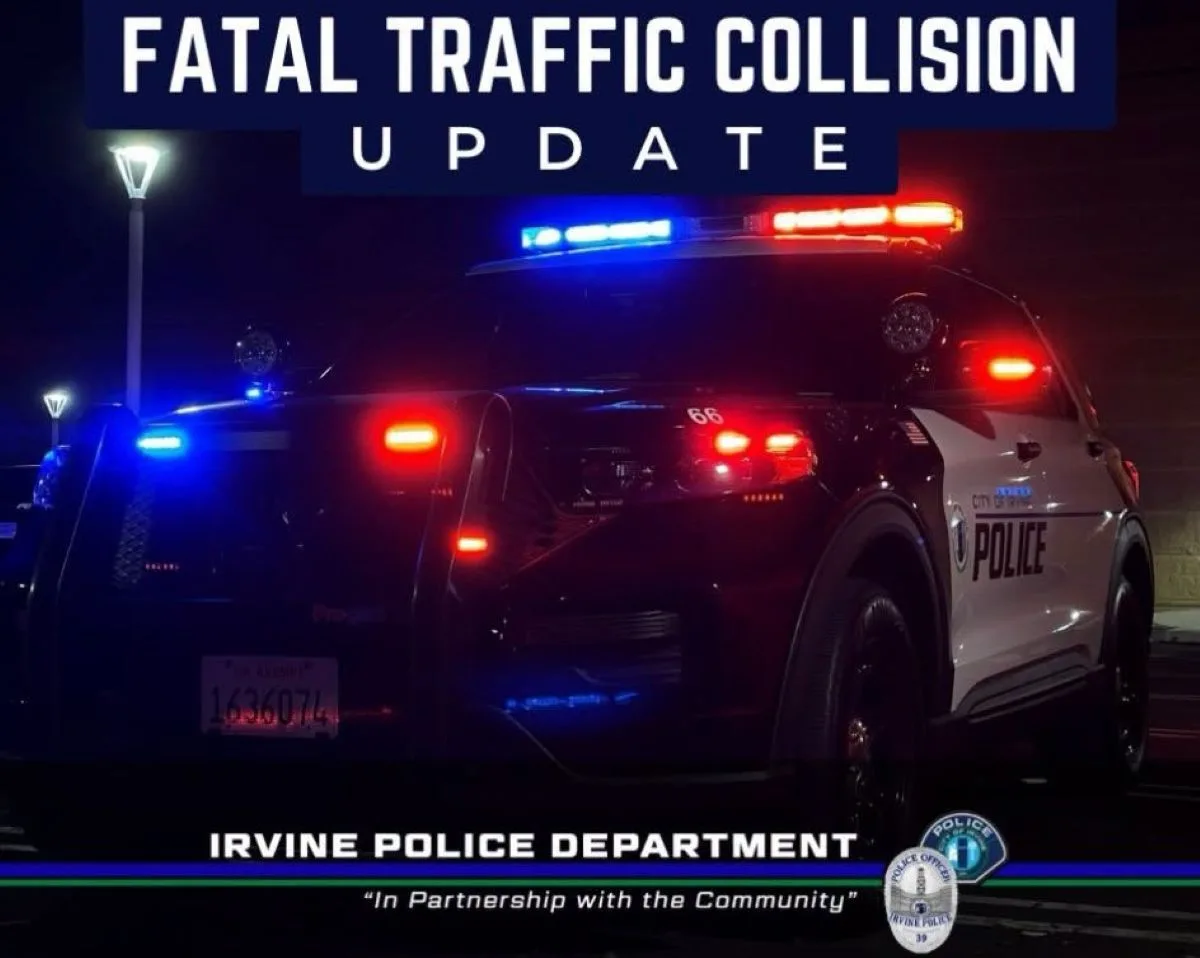
An already tragic Irvine traffic fatality has taken an unusual turn after the wreckage of a McLaren involved in a September crash that killed two people suddenly caught fire again while being stored at a secured tow facility.

According to the Irvine Police Department, the front section of the destroyed McLaren spontaneously ignited on October 14 at a Costa Mesa storage yard contracted by the city to hold vehicles involved in collision investigations. Preliminary findings from investigators indicate no one was present or interacting with the vehicle when the fire began. Both the original crash investigation and the subsequent fire investigation remain active.
A Devastating Crash
The vehicle was involved in a horrific single-vehicle collision shortly after midnight on September 13 at the intersection of Culver Drive and Deerfield Avenue in Irvine.
According to investigators, the 2019 McLaren was stopped northbound at a traffic signal before accelerating at what police described as a high rate of speed when the light turned green. The driver reportedly lost control, struck a curb and then slammed into a tree. The impact was so violent that the exotic sports car split into two pieces before catching fire. Two occupants died at the scene.
The victims were later identified by authorities as 27-year-old James Wesley Simon Wehr of Irvine and 22-year-old Alexis Helena Kramer of Florida. Investigators said evidence indicates Wehr was driving the vehicle at the time of the collision.
Why Would a Wrecked Vehicle Catch Fire Weeks Later?
The latest development has left many residents wondering how a vehicle could suddenly ignite more than a month after a crash.
Police noted that the collision, the vehicle’s separation into multiple sections, and the original fire caused extensive damage to the McLaren’s structure and electrical system.
While investigators have not announced a definitive cause, experts will likely examine several possibilities commonly associated with seriously damaged vehicles:
- Electrical short circuits caused by damaged wiring.
- Failure of battery components or energy-storage systems.
- Residual heat damage that weakened insulation and electrical connections.
- Chemical reactions involving damaged batteries, fluids or vehicle materials.
- Delayed thermal runaway events in battery-related systems.
- Crash damage that exposed electrical components to moisture or environmental conditions over time.
The possibility of electrical-system involvement may receive particular scrutiny because investigators specifically noted extensive damage to the vehicle’s electrical components.
Could the Second Fire Complicate the Investigation?
Potentially.
Major collision investigators often rely on physical evidence recovered from a vehicle to reconstruct exactly what occurred. Components such as steering parts, suspension systems, braking equipment, onboard computers and data-recording modules can provide valuable clues about vehicle speed, driver actions and possible mechanical issues.
Any additional fire damage could make some evidence more difficult to analyze, particularly if investigators had not yet completed all forensic examinations. However, in high-profile fatal crashes, investigators typically document wreckage extensively through photographs, measurements, scans and evidence collection early in the investigative process. As a result, the secondary fire may not prevent investigators from reaching conclusions about the collision.
The Irvine Police Department’s Major Accident Investigation Team has already stated that the crash investigation is expected to take months as detectives examine speed, roadway conditions, vehicle conditions and any other factors that may have contributed to the deadly wreck.
Surveillance Video Raises More Questions Than Answers
Police released surveillance footage from the tow yard showing the beginning of the fire. According to investigators, video evidence supports the preliminary finding that the blaze started spontaneously, with no person present near the vehicle at the time. Authorities have emphasized that no definitive cause has been determined.
That finding appears to rule out vandalism or accidental human involvement, at least based on the evidence currently available to investigators.
Investigation Continues
More than a month after the fatal crash, many questions remain unanswered. Investigators have not yet released their findings regarding the cause of the collision, nor have they determined what triggered the unusual tow-yard fire.
For now, both investigations remain ongoing as authorities work to determine not only why a high-performance McLaren crashed with such catastrophic consequences, but also why the wreckage unexpectedly burst into flames weeks later while sitting untouched in a secured storage facility.