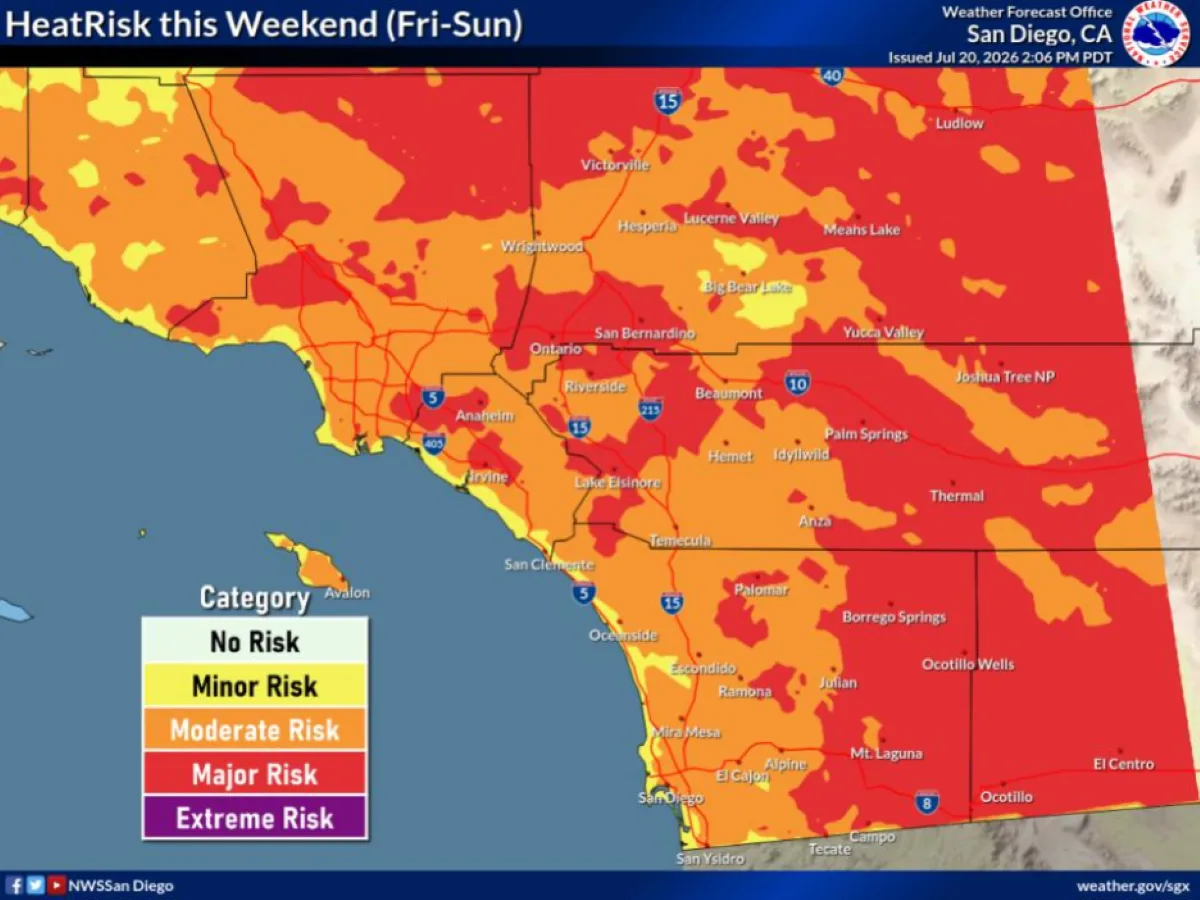
Southern California employers must implement immediate safety measures as a dangerous multi-day heatwave brings triple-digit temperatures to the region from July 22 through July 27, 2026. The National Weather Service has issued widespread heat advisories and extreme heat watches.

Temperatures are projected to peak on Thursday, reaching 95 to 100 degrees Fahrenheit in parts of Orange County and escalating up to 114 degrees in high desert communities like the Morongo Basin.
State safety regulators stress that heat illness is a fully preventable yet potentially fatal workplace hazard that requires strict compliance with California’s dual indoor and outdoor safety standards.
Orange County Seven-Day Weather Outlook
The National Weather Service San Diego Office has placed Orange County under an active heat advisory beginning Wednesday, July 22. A regional warming trend is pushing local temperatures up to 10 degrees above historical seasonal normals.
- Wednesday, July 22: Highs climbing to 95 degrees; heat advisory takes effect.
- Thursday, July 23: Peak of the heatwave with widespread temperatures touching 100 degrees.
- Friday, July 24: Continued intense heat with high temperatures holding near 98 degrees.
- Saturday, July 25 – Monday, July 27: Extended extreme heat with sustained temperatures from 95 to 98 degrees across coastal and inland valleys.

Compliance Standards for Indoor and Outdoor Workplaces
California labor laws require distinct operational protocols depending on the work environment to ensure comprehensive employee safety.
- Outdoor Environments (Title 8, Section 3395): Employers must provide continuous access to fresh drinking water and shaded rest areas. Shade structures must be physically erected and available when outdoor temperatures exceed 80 degrees. When temperatures reach or exceed 95 degrees, high-heat procedures take effect. This mandates continuous employee monitoring, structured rest breaks, and reliable team communication methods.
- Indoor Environments (Title 8, Section 3396): Regulations apply to enclosed settings like warehouses, restaurants, and manufacturing plants. Once internal workplace temperatures hit 82 degrees, employers must provide fresh water, structured recovery breaks, and dedicated cool-down zones maintained below 82 degrees. If temperatures hit 87 degrees (or 82 degrees in high-radiant heat areas), businesses must initiate formal engineering controls or distribute personal heat-protective gear.
Crucial Safety Training Resources
Every covered employer must maintain a comprehensive, written heat illness prevention plan that details emergency response protocols and acclimatization steps. Complete information, compliance guides, and printable training materials can be accessed on the Cal/OSHA Heat Illness Prevention Page and through the state’s dedicated safety portal at 99calor.org. Employers looking to build active safety cultures can also request a voluntary partnership by emailing the state at HIPNetwork@dir.ca.gov to join the official Heat Illness Prevention Network.
Severe Financial Penalties for Corporate Violations
While employees do not face personal citations or fines for experiencing heat-related distress on the job, employers face severe civil and regulatory penalties for failing to provide required safety nets. Cal/OSHA enforces steep financial penalties calculated per individual infraction:
- General and Regulatory Violations: Up to $16,285 per infraction for administrative, recordkeeping, or poster display failures.
- Serious Violations: Up to $25,000 for allowing a workplace hazard to exist that could reasonably cause death or severe physical harm.
- Willful or Repeat Violations: Fines ranging from a minimum of $11,632 up to a maximum of $162,851 per violation.
- Real-World Impact: Single site inspections frequently result in multiple bundled citations spanning water, shade, and training deficiencies. Regulators recently issued a targeted $276,425 citation to a Southern California business that failed to provide sufficient drinking water and mandatory heat safety training to its outdoor workforce.
Exemptions from Heat Illness Regulations
While the outdoor standard covers all open-air industries, certain limited exemptions apply specifically to the indoor heat illness framework under Title 8, Section 3396:
- Brief Indoor Exposure: Workplaces are exempt from indoor monitoring if employees are exposed to interior temperatures between 82 and 95 degrees for less than 15 minutes during any given one-hour period. This short-duration exception explicitly excludes local delivery vehicles lacking functional air conditioning and standard intermodal shipping containers. [
- Emergency Operations: Active emergency response operations, such as search and rescue missions or direct firefighting deployments, are exempt from standard indoor structural mandates.
- State Correctional Facilities: Specific local and state correctional institutions housing inmates maintain targeted operational exemptions from the standard indoor standard.
Workers seeking confidential workplace safety counseling can connect with a bilingual representative by calling Cal/OSHA directly at 833-579-0927. All employees in the state are fully protected by these regulations regardless of their immigration status. Businesses requiring direct technical guidance can access free, non-punitive compliance assistance by contacting the Cal/OSHA Consultation Services Branch at 800-963-9424.