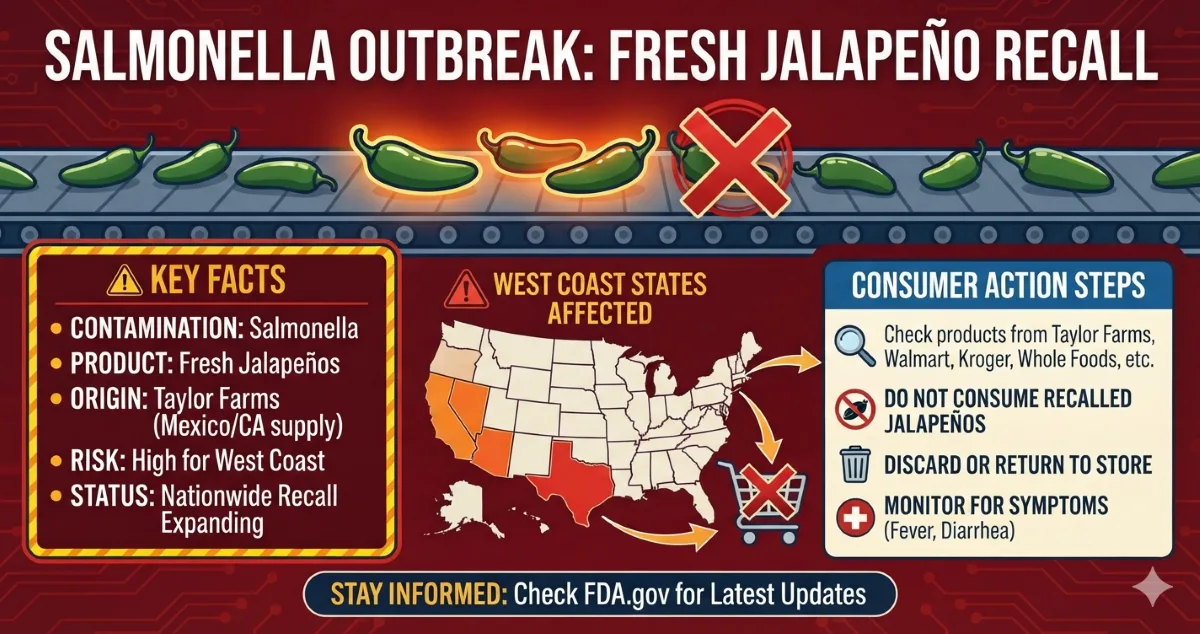
Taylor Fresh Foods is voluntarily recalling select prepared food products containing jalapeño peppers due to potential Salmonella contamination. The California-based agriculture giant, headquartered in Salinas, issued the voluntary recall on August 9, 2026, after learning that its supplier, Coast Citrus Distributors, recalled fresh peppers linked to a multistate Salmonella outbreak.

While the federal investigation has identified over 300 illnesses across 27 states—including California—the specific prepared food products manufactured by Taylor Farms were distributed primarily to 26 states across the Midwest, South, and East Coast. To date, no illnesses have been connected directly to Taylor Farms’ jalapeño-containing products.
Because Taylor Farms is a massive fresh produce supplier based in California’s Salinas Valley, any major recall triggers immediate concern for Golden State shoppers. The underlying fresh jalapeño recall by Coast Citrus Distributors involves peppers imported from a grower in Sinaloa, Mexico. These raw peppers were distributed to wholesalers and restaurant chains nationwide, prompting major establishments like Chipotle and Qdoba to remove them from their inventory.
For Southern California grocery shoppers in regions like Orange County, the specific prepared retail products listed in this Taylor Farms recall—such as pre-packaged salsas, guacamoles, and dips sold at Target, Walmart, Trader Joe’s, and Whole Foods—were directed to retail distribution centers in 26 specific states. Notably, California is not on the distribution list for these specific Taylor Farms finished items. Local residents shopping at the Costa Mesa, Irvine, or Fullerton locations of these national chains will likely find their prepared deli items unaffected, though individual stores maintain strict protocols to block any questionable inventory at registers.
Recalled Products and Retailers
The recalled items feature “Best If Used By” dates up to and including August 16, 2026. They involve branded and unbranded prepared foods sold at seven major grocery banners:
- Target (Taylor Farms/Unbranded): Taco Dip, Mango Pico De Gallo, Spicy Guacamole, Authentic Guacamole, and Pico de Gallo.
- Walmart (Freshness Guaranteed): Hot and Mild Pico De Gallo.
- Whole Foods Market: Salsa Fresca Medium, Salsa Roja Medium, Mild and Spicy Pico de Gallo, and Pineapple Mango Salsa Mild.
- Trader Joe’s: Fiesta Style Salad Shrimp.
- Kroger: Private Selection Spicy Roast Beef Sandwich, Spicy Jarlsberg Dip, and Spicy Pimento Cheese Dip.
- Hannaford & Stop & Shop: Diced Jalapeños, Rice and Bean Burritos, and Pico de Gallo Salsa.
Health Risks and Consumer Instructions
Salmonella is an organism that can cause severe, sometimes fatal infections in young children, elderly individuals, and those with weakened immune systems. Healthy individuals typically experience fever, diarrhea, nausea, vomiting, and abdominal pain.
Consumers who have purchased any of the affected products should throw them away immediately and not consume them. Full refunds are available at the original location of purchase. For any questions regarding the recall, consumers can reach the Taylor Farms customer care team at 855-455-0098, Monday through Friday, from 8:00 AM to 5:00 PM Pacific Time.
Recalled Products: UPC Codes and State Distribution
The following comprehensive breakdown details the specific Universal Product Codes (UPCs) and geographic distribution networks impacted by the Taylor Fresh Foods voluntary recall:
| Retailer | Affected Products & Sizes | Exact UPC Code | Impacted States |
|---|---|---|---|
| Hannaford | Diced Jalapenos (3.75oz) Rice and Bean Burrito (12.5oz) | 030223082712 030223082736 | ME, NY MA, ME, NH, NY, VT |
| Kroger | Private Selection Spicy Roast Beef Sandwich (8.53oz) Spicy Jarlsberg Dip (10oz) Spicy Pimento Cheese Dip (10oz) | 011110678171 030223114826 030223116448 | AL, AR, GA, LA, MS, SC, TN, TX IL, IN, KS, KY, LA, MI, MO, NE, OH, TX, WV IL, IN, KS, KY, LA, MI, MO, NE, OH, TX, WV |
| Stop & Shop / Hannaford | Pico de Gallo Salsa (7oz) | 688267575778 | MA, ME, NY |
| Target | Taco Dip (20oz) Mango Pico De Gallo (11oz) Spicy Guacamole (13oz) Pico de Gallo (16oz) Authentic Guacamole (13oz) | 030223073581 030223073543 030223073574 030223073536 030223073567 | FL, OH, TX OH, TX OH, TX TX TX |
| Trader Joe’s | Fiesta Style Salad Shrimp (11.11oz) | 000000818377 | TX |
| Walmart | Hot (or Spicy) Freshness Guaranteed Pico De Gallo (10oz) Mild Freshness Guaranteed Pico De Gallo (10oz) | 681131276351 681131276344 | FL, IL, LA, MN, NE, OK, WI FL, IL, LA, MN, NE, OK, TX, WI |
| Whole Foods | Salsa Fresca Medium (12oz) Pico de Gallo Mild (10oz) Pico de Gallo Spicy (10oz) Salsa Verde Mild (12oz) Salsa Roja Medium (12oz) Pineapple Mango Salsa Mild (10oz) | 030223075080 030223075097 030223075608 030223075639 030223075646 030223075653 | IL, TX IL, TX IL, TX IL, TX IL, TX IL, TX |
How Local Restaurants Navigate Produce Recalls and Supply Chain Transparency
While grocery stores utilize consumer-facing barcodes (UPC codes), local restaurants rely on highly sophisticated, commercial supply chain traceability frameworks. This backdrop is underscored by strict compliance with the FDA’s Food Traceability Final Rule (FSMA Section 204), which went into full enforcement on January 20, 2026. This federal standard mandates that any business holding or processing items on the Food Traceability List—including fresh peppers and fresh-cut produce—must provide digital traceability spreadsheets to health officials within 24 hours of an emergency request.
Major national restaurant footprints and sophisticated local operators mitigate risks through distinct supply chain protocols:
- Automated Cascade Alert Systems: Fast-casual leaders demonstrate the power of internal data infrastructure. In the current fresh jalapeño outbreak, Chipotle’s internal automated recall system successfully bypassed slow-moving regulatory announcements. By analyzing internal purchasing databases, they identified contaminated pepper batches days before federal agencies issued public warnings. Their automated hubs flooded affected store managers with digital notifications until the locations confirmed that the targeted ingredients were completely destroyed.
- Critical Tracking Events (CTEs) & Lot Separation: To prevent cross-contamination or sweeping inventory loss, commercial kitchens enforce strict physical control. Restaurants log distinct Key Data Elements (KDEs) whenever raw produce is received, transformed (such as being chopped for house-made guacamole), or served. Under USDA guidelines, kitchens must keep produce in its original supplier packaging as long as possible. They are explicitly trained to avoid commingling similar produce items arriving from different distribution lots or distinct agricultural field
- The “Guac Signal” and Alternative Sourcing: Major commercial suppliers issue direct, high-priority notifications to restaurant distribution partners. When food safety risks are flagged, a localized warning—internally known in the industry as a “guac signal”—is triggered immediately across electronic data interchange systems. Restaurants maintain secondary and tertiary contracts with regional agricultural providers. This allows kitchen operations to seamlessly pivot to completely alternative growers and maintain menu continuity the moment an primary lot is flagged.