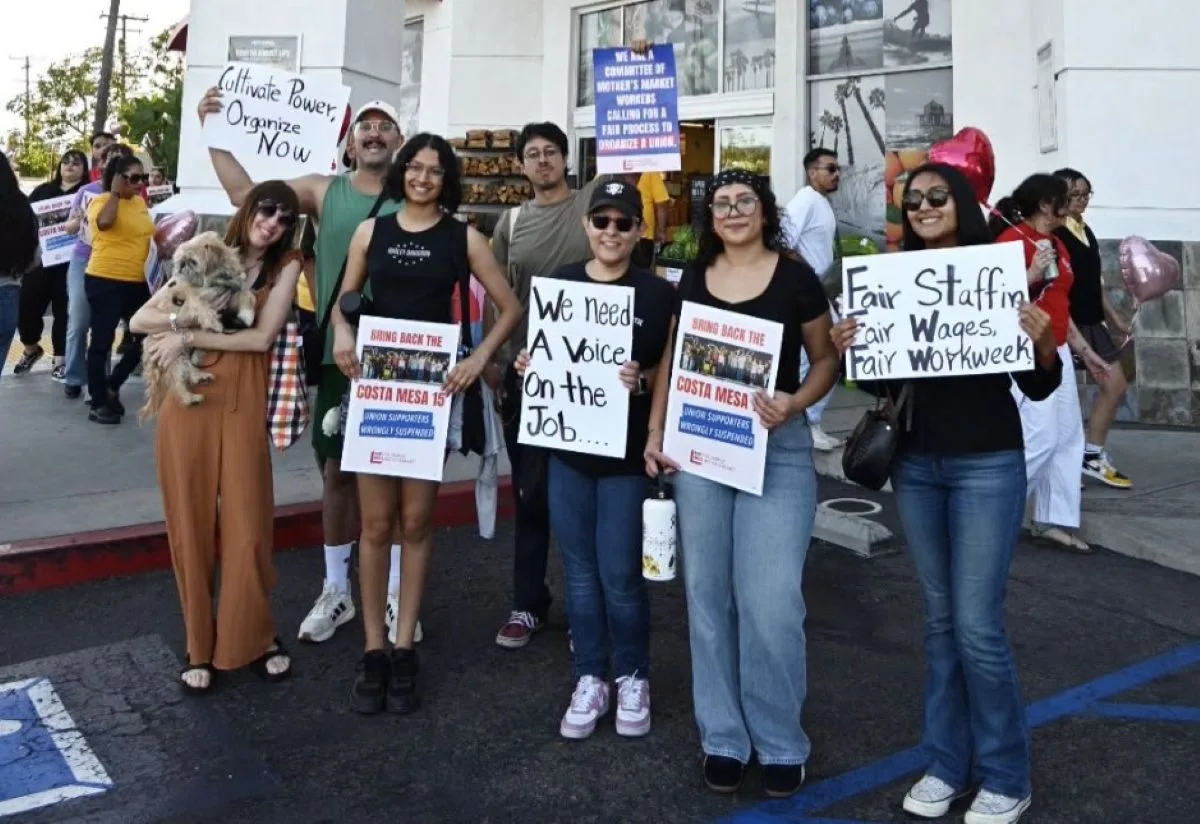
The ongoing labor dispute at Southern California’s natural foods pioneer has reached a boiling point. Four months into a public campaign to organize, Mother’s Market & Kitchen management abruptly suspended 15 prominent union supporters from its flagship store on Newport Boulevard and 19th Street in Costa Mesa, California.

The mass suspension of the employees, primarily front-of-house workers in their twenties, has triggered fierce pushback from local politicians, union officials, and community advocates.
The workers, dubbed the “Costa Mesa 15” by labor organizers, were reportedly sidelined without immediate reason or explanation. All 15 affected employees are members of the organizing committee who had publicly signaled their involvement by appearing in promotional materials, signing a scheduling petition to remedy volatile working environments, or signing union authorization cards.
Escalating Tensions and Community Backlash
Local media reports reveal that the United Food and Commercial Workers (UFCW) Local 324 is aggressively targeting Mother’s Market. The union drive, localized under the banner “Hearts United,” has already spilled over from Costa Mesa into other storefronts across Orange County and Signal Hill. Employees have voiced growing frustrations over severe understaffing, lack of workplace respect, and erratic schedules.
According to reports from the Los Angeles Times Daily Pilot, some workers faced heavy cuts to their shifts immediately leading up to the suspensions. For instance, Jacob Ramos, a 21-year-old cashier and active local Instagram creator, discovered his shifts were slashed in half just days before being forced out.
The corporate pushback ignited a high-energy “March on the Boss” demonstration at the Costa Mesa storefront. Costa Mesa Councilmember Manuel Chavez joined workers on the picket line to demand that CEO Dorothy Carlow intervene and reinstate the staff immediately.
- Manuel Chavez, Costa Mesa Councilmember: “The workers are asking for nothing but respect and a right to be at the table. I stand with the workers—they’re why I shop here. Give them their jobs back!”
- Jose Perez, UFCW 324 President: “Southern California is one of the most expensive places to live in the world. Absolutely no one should get fired for asking for a raise. These young workers are sick of being stepped on by Wall Street.”
- Jacob Ramos, Suspended Cashier: “As young people, management thinks they can step on us. They think they can order us around at work, outside of work, and now they’re trying to squash our union. We’re not gonna take it.”
The union confirmed it is actively preparing to file formal Unfair Labor Practice (ULP) charges with the National Labor Relations Board (NLRB) alleging unlawful workplace retaliation. This is not an isolated event; a separate ULP charge was recently levied against a Mother’s Market location in Huntington Beach following the firing of another prominent activist.
The Financial Conflict: Private Equity vs. Rising Store Prices
The battle lines at Mother’s Market highlight a classic economic clash between private equity goals and local labor demands. The specialty health chain—founded by yoga enthusiasts in 1978—was acquired in 2016 by Mill Road Capital, a private equity firm that utilizes capital from pension funds and institutional investors to acquire mid-market businesses.
Critics argue that private equity structures inherently pressure portfolio brands to maximize profit margins, sometimes at the expense of payroll. Conversely, customers are left wondering what a unionized workforce means for their grocery bills. Because Mother’s Market specializes in premium organic produce, supplements, and specialized niche products, its baseline pricing is already notably higher than a standard grocery outlet.
Allowing a union to successfully bargain at Mother’s Market could cause shelf prices to rise further through several economic mechanisms:
- Direct Wage and Benefit Increases: Successful union contracts typically mandate higher baseline hourly wages, structured raises, and expanded healthcare coverage, which increases a grocer’s core operating costs.
- Predictive Scheduling Mandates: Organizers are demanding schedules be set two weeks in advance. While fair to the worker, this limits a store manager’s agility to cut hours on slow days, raising fixed weekly labor costs.
- Operational Rules: Union agreements often introduce stricter regulations regarding overtime, peer-to-peer job coverage, and break times, reducing fluid cross-training efficiency.
Could these compounding factors sink the company? It is highly unlikely to bankrupt Mother’s Market completely, but it will fundamentally pressure its business model. Grocery margins are famously thin, usually hovering between 1% and 3%. While specialized organic markets enjoy slightly higher margins, they are incredibly sensitive to labor inflation.
Because Mill Road Capital has spent a decade scaling Mother’s to 11 locations across Southern California, their primary strategy to absorb rising labor costs would be passing those costs directly to the consumer. However, if shelf prices rise too high, affluent Orange County shoppers may migrate to larger organic competitors.
Orange County’s Competitive Grocery Landscape
Mother’s Market operates in a heavily saturated regional grocery arena. While it targets a premium organic niche, it constantly fights for market share against standard supermarket giants and major national organic players.
The top supermarket chains dominating Orange County by sales volume and regional footprint include:
- Kroger (Ralphs & Food 4 Less): Kroger holds massive market share across Southern California, with its Ralphs banner serving as a primary mainstream supermarket anchor in the region.
- Albertsons Companies (Vons & Albertsons): Operating as the second major traditional grocery force in the county, Albertsons maintains a dense network of suburban storefronts.
- Trader Joe’s: A dominant force in California retail, this Monrovia-based chain commands incredible sales-per-square-foot efficiency by capturing budget-conscious health shoppers.
- Whole Foods Market (Amazon): The direct heavyweight competitor to Mother’s Market, leveraging Amazon’s supply chain to anchor organic grocery sales in upscale OC neighborhoods.
- Sprouts Farmers Market: A rapidly growing value-organic competitor that directly undercuts boutique health food stores on fresh produce pricing.
- Stater Bros. Markets: A prominent Southern California regional chain that commands strong loyalty for traditional groceries throughout the Inland Empire and eastern Orange County.
As UFCW Local 324 rallies community allies to boycott or protest outside Mother’s Market locations, the coming weeks will determine whether Mill Road Capital compromises with the “Costa Mesa 15” or digs in for a prolonged legal showdown before the NLRB.