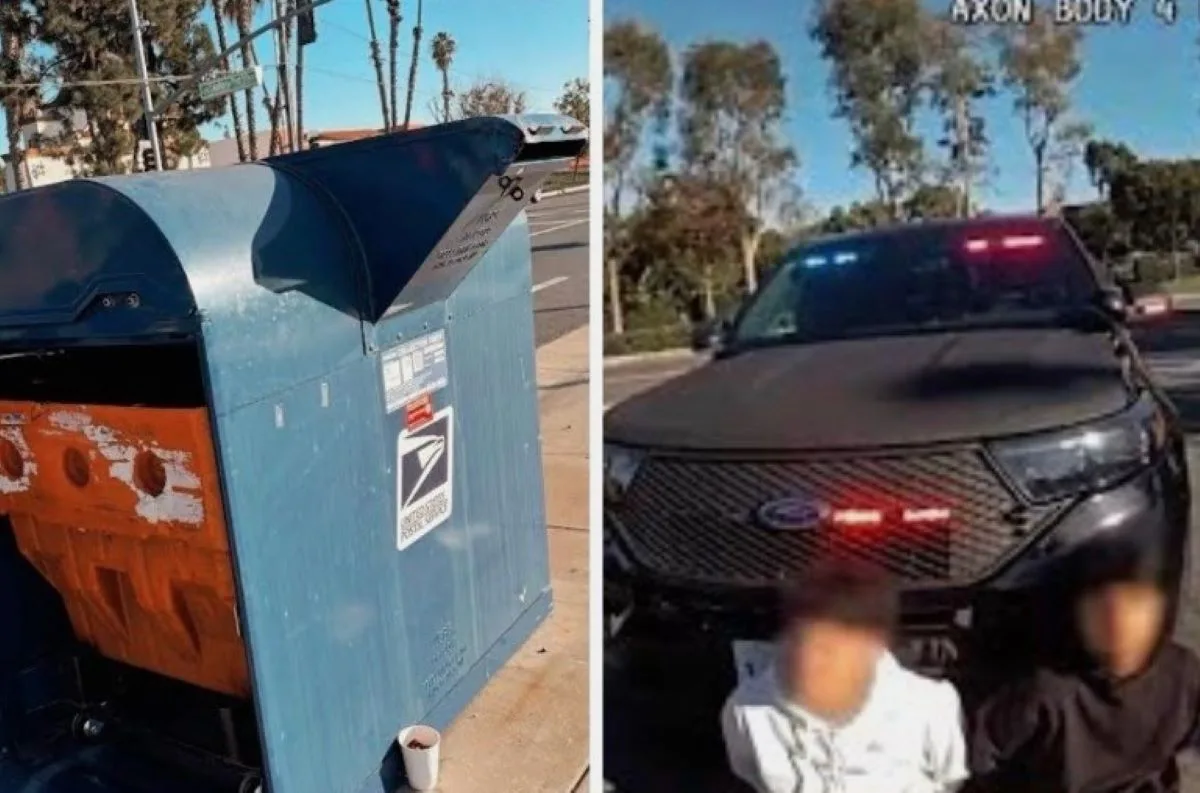
A recent series of mail thefts led officers from the FVPD’s Special Investigations Unit to two suspects, according to Orange County Supervisor Janet Nguyen.
A search of the suspects’ vehicle found 40+ stolen identity profiles.
Both of the suspects were arrested on multiple felony charges.

Check Washing
Pictures released by the FV police indicate that the suspects were engaged in something called “check washing.”
That check is evidence of a common crime called “check washing,” where thieves chemically alter stolen checks to steal money.
Here’s how it works and what is likely “up with that check” found in the suspects’ vehicle:
- Theft: The suspects likely stole the check from a USPS drop box or residential mailbox.
- Washing: Criminals use common household chemicals like acetone or bleach to erase the ink in the “Pay to the Order of” (payee) and the dollar amount fields of the check. The goal is to leave the original signature intact.
- Rewriting: Once the ink is removed, the thieves rewrite the check to themselves or an accomplice for a much larger amount of money. For example, a $50 check for a utility bill might become a $5,000 check made out to a fraudulent account.
- Cashing/Depositing: The altered check is then deposited via an ATM or mobile deposit, and the funds are quickly withdrawn before the victim or bank realizes the fraud.
The presence of a partially faded or stained check in the image suggests that the suspects possessed items used in this type of mail and identity theft scheme, which can lead to significant financial losses for victims.

Penalties faced by the adult suspect
The adult suspect currently faces the following potential penalties across local, state, and federal jurisdictions:
State Penalties (California)
The suspects were booked on multiple felony charges, which in California are often “wobbler” offenses that can be prosecuted as either misdemeanors or felonies based on the severity and criminal history.
- Identity Theft (PC 530.5): Since the search revealed over 40 stolen identity profiles, the suspects may face multiple counts. A felony conviction for a single count of identity theft carries up to 3 years in county jail and a fine of up to $10,000. Each profile used or possessed with intent to defraud can be charged as a separate count.
- Mail Theft (PC 530.5(e)): Under state law, mail theft is typically a misdemeanor punishable by up to one year in county jail and a $1,000 fine.
- Fraud and Forgery: Recovered “washed” checks can lead to forgery charges (PC 470), which carry up to 3 years in jail for felony counts.
- Contributing to the Delinquency of a Minor: The adult suspect faces this additional charge, which is a misdemeanor punishable by up to one year in jail and a $2,500 fine.
Federal Penalties
Because the FVPD collaborated with the U.S. Postal Inspection Service (USPIS), federal charges are a high possibility.
- Mail Theft (18 U.S.C. § 1708): This is a federal felony. If convicted in federal court, suspects face up to 5 years in prison and fines of up to $250,000 per count.
- Aggravated Identity Theft (18 U.S.C. § 1028A): If the stolen identities were used to commit other federal felonies (like bank fraud or mail fraud), there is a mandatory minimum 2-year prison sentence that must be served consecutively to any other sentence.
- Mail Fraud (18 U.S.C. § 1341): If the “washed” checks were used in a scheme to defraud, penalties can reach up to 20 years in federal prison.
Local Penalties
- Administrative/Municipal: While primarily handled by the state, local prosecution in Orange County often includes restitution orders, requiring the suspects to pay back the full financial value of any stolen or forged items to the victims.
- Fountain Valley Municipal Court: Local proceedings may also impose probation terms that include staying away from specific USPS locations or known victims.
Additional Penalties for the adult suspect for Check Washing
State Penalties (California)
The act of altering or possessing a washed check falls under specific forgery and fraud statutes, separate from the initial mail theft:
- Forgery (PC 470): Forgery occurs when a person signs someone else’s name, fakes a signature, or alters a document (like a check) with intent to defraud. This is a “wobbler” offense.
- Felony Conviction: Penalties can include 16 months, two years, or three years in county jail, and a fine of up to $10,000.
- Misdemeanor Conviction: Punishable by up to one year in county jail and a fine of up to $1,000.
- Note: The value of the check often dictates the charge (felony if over $950), but if tied to an identity theft conviction, it can be a felony regardless of the amount.
- Check Fraud (PC 476): This specific statute makes it a crime to possess, use, or pass an altered or fictitious check with the intent to defraud. The penalties are the same as for general forgery.
Federal Penalties
Federal prosecutors take an aggressive stance against these organized schemes, often layering multiple charges:
- Mail Fraud (18 U.S.C. § 1341): Using the mail system as part of a scheme to defraud (which includes stealing checks from mailboxes) is a federal felony.
- Conviction can result in up to 20 years in federal prison and fines up to $250,000 per count.
- If the fraud impacts a financial institution, the penalty increases to up to 30 years in prison and a fine up to $1 million.
- Aggravated Identity Theft (18 U.S.C. § 1028A): If the check washing scheme used the stolen identity profiles found in the vehicle, an additional mandatory 2-year prison sentence is added on top of any other sentences.
- Forfeiture and Restitution: Federal law typically requires the forfeiture of any property gained from the scheme and orders full restitution to all victims involved.
Penalties faced by the juvenile suspect
Penalties for juveniles in California focus on rehabilitation rather than retribution, though significant sanctions can still apply depending on the severity of the charges.
The juvenile currently faces the following potential outcomes and penalties:
Juvenile Court Sanctions
If the case remains in juvenile court, the minor may be declared a ward of the court. Potential sanctions include:
- Formal Probation: This can involve being allowed to remain at home or in a group home under strict conditions, such as mandatory school attendance, curfews, counseling, and substance abuse treatment.
- Detention: The minor may be committed to a local juvenile hall, probation camp, or ranch for a period determined by the judge.
- Restitution and Fines: The court may order the juvenile to pay for financial losses suffered by victims of the identity and mail theft.
- Community Service: The minor may be required to complete a set number of community service hours.
- Confinement (State Level): For more serious felony counts, a minor could be committed to a state-level juvenile facility until age 21 or 25, depending on the specific charges.
Eligibility for Diversion
As a first-time non-violent felony offender, the juvenile might be eligible for:
- Deferred Entry of Judgment (DEJ): If the minor admits to the offenses, the case may be put on hold for 12–36 months. If they complete all court-ordered programs and requirements during that time, the charges are dismissed and the arrest record may be sealed.
Adult Court Transfer (Rare)
Under California law (WIC 707), a prosecutor can request a “transfer hearing” to try a minor as an adult if they are at least 16 years old and the offenses are particularly serious.
- If transferred, the juvenile would face the same potential prison sentences as the adult suspect (up to 3 years per state identity theft count and up to 5 years for federal mail theft).
- However, mail and identity theft are generally not among the specific “serious or violent” felonies (like robbery or murder) that typically trigger such transfers.
Administrative Penalties
- No Bail: Unlike the adult system, there is no bail in the juvenile system; a judge decides whether the minor stays in custody based on risk factors.
- Record Sealing: Juvenile records are often eligible for expungement or sealing after the case is closed, which can help prevent the conviction from affecting future employment.