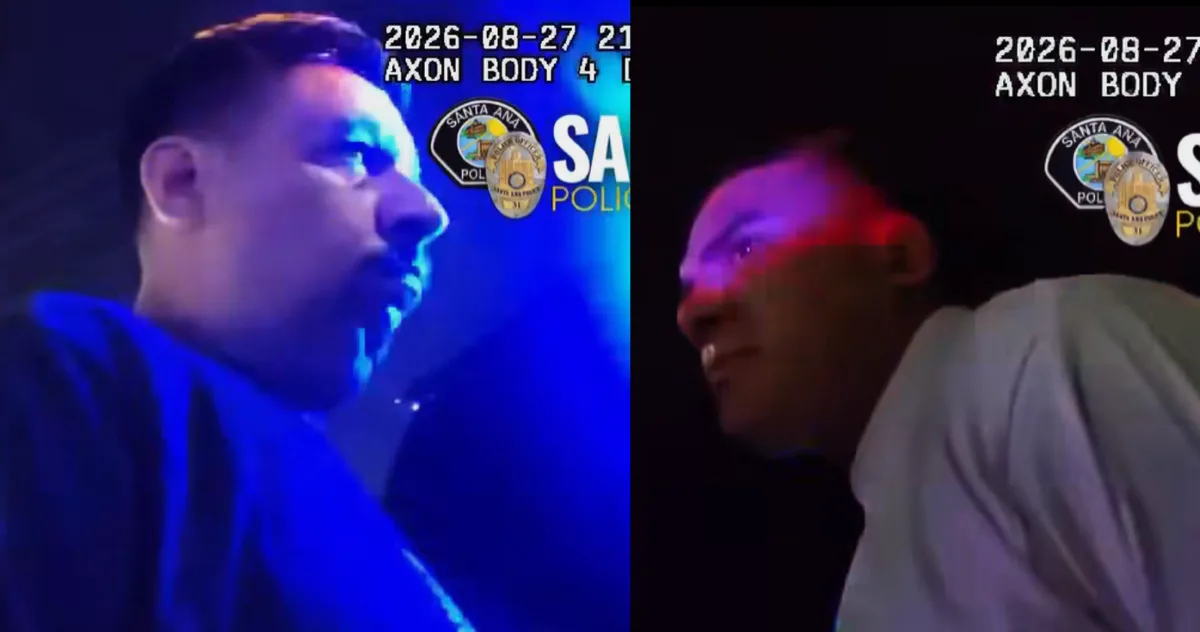
Last night’s Santa Ana Police Department #FirearmFriday update highlights yet another example of individuals who simply cannot stay out of trouble.

According to the Santa Ana Police, officers conducting proactive enforcement attempted to contact two men near a parked vehicle. One suspect immediately fled on foot, while the driver stayed behind but refused to cooperate.
Officers spotted a firearm on the vehicle’s floorboard, detained the driver, and later located the fleeing passenger — who was confirmed to be on active probation.
Both men were arrested and booked at the Santa Ana Jail for multiple firearm‑related offenses.
Both suspects are mature men. It seems they made it to middle age and just cannot escape their foul tendencies.
Criminal Charges Facing the Suspects
Based on the facts released by police, the suspects are likely facing several charges under California law, including:
- Felon in Possession of a Firearm — if either suspect is prohibited from possessing firearms due to prior convictions or probation terms
- Carrying a Loaded Firearm in a Vehicle — Penal Code §25850
- Possession of a Concealed Firearm — Penal Code §25400
- Resisting or Evading Officers — for the fleeing passenger
- Violation of Probation — which can trigger immediate custody and additional penalties
Depending on prior criminal history, these charges can carry jail time, probation extensions, fines, and firearm prohibitions.
Auto Insurance Impact
Any arrest involving a vehicle — especially one tied to weapons possession, resisting officers, or probation violations — can severely damage auto insurance status. Insurers typically classify such incidents as:
- High‑risk behavior, triggering premium increases of 40–200%
- Policy cancellation, especially if the driver is convicted of a felony
- SR‑22 requirements, forcing the driver into expensive high‑risk insurance for three years
For probationers, a new arrest inside a vehicle often leads insurers to treat them as uninsurable.
Probationer Recidivism in Orange County, CA
Orange County probation data shows that probationer recidivism rates often hover between 20–30%, depending on offense category and supervision level. Firearm‑related violations and drug‑related violations tend to have higher re‑offense rates.
Santa Ana PD’s repeated arrests of probationers during routine enforcement checks reflect a broader countywide challenge: individuals on probation frequently reoffend when they continue associating with criminal networks or ignore supervision terms.
Santa Ana City Council Members Who Have Supported Defunding or Reducing Police Resources
Several Santa Ana City Council members have publicly supported efforts to reduce police funding or shift resources away from traditional law‑enforcement operations. These include:
- Jessie Lopez — has advocated for limiting SAPD’s authority in specific situations, shifting resources toward non‑police interventions, and reducing certain types of arrests.
- Benjamin Vazquez — has publicly supported measures intended to reduce arrests of homeless individuals for minor infractions.
- Thai Viet Phan — has been anti-police in specific budget contexts. She generally cannot be relied upon by the pro-police members of the Santa Ana City Council.
- Johnathan Ryan Hernandez — widely known for advocating police‑reform measures, supporting reallocations of SAPD funds, and pushing for non‑police crisis response models
Public records and council meeting discussions show these members have advocated for reallocating portions of SAPD’s budget toward social programs, alternative response teams, or non‑police interventions.

Jessie Lopez’s Run for State Assembly
Councilmember Jessie Lopez is currently running for State Assembly. Her history of opposing certain police funding measures raises questions about how she might influence statewide public‑safety policy if elected. Some residents worry that:
- She may support legislation reducing law‑enforcement budgets
- She may back policies limiting police tools such as drones, proactive enforcement, or specialized units
- She may prioritize non‑police interventions even in cases involving violent offenders or repeat probation violators
Those 3 politicians can go to hell, they’re making Santa Ana worse again
Looks like the parking lot of the Motel 6 on Dyer Rd. across from the 7-11 where all the tweakers hang out. From here, recall the days not all that long ago when the Dyer/Hotel Terrace hotels were the destination of choice for business travelers and tourists alike. Reflect on the bleak degradation and social decay you see today. Then, drive less than a mile away to the border of Irvine’s city limits to see a stark illustration of just how important city policy and local leadership is. Keep this in mind when you vote. Santa Ana leaders think just because we’re not as wealthy as Irvine residents are, we don’t deserve safe clean streets. They think we’re fools and will vote on name recognition, party lines, and tribal affiliations. Prove them wrong by voting them out.