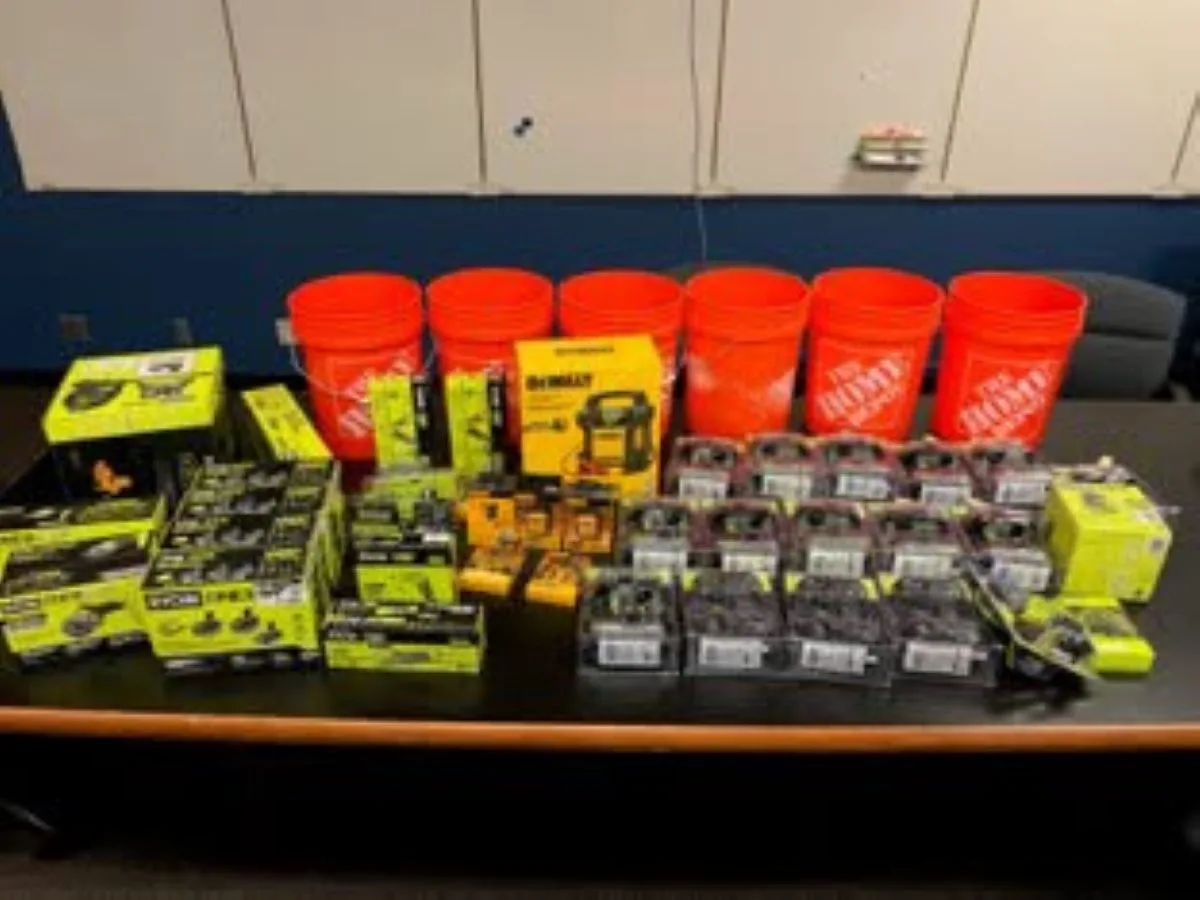
The Huntington Beach Police Department announced the arrest of a suspect believed responsible for a series of commercial burglaries targeting a local home improvement retailer.

According to police, HBPD Property North detectives, working alongside the department’s Crime Analysis Unit, identified the suspect, arrested the individual this week, and recovered more than $5,000 in stolen merchandise that was subsequently returned to the store. The suspect reportedly admitted involvement in several of the thefts.
The recovered property visible in the department’s photo appears to include power tools, batteries, tool accessories, and other high-demand construction and home improvement products. Such merchandise has become a frequent target for retail theft crews throughout Southern California due to its strong resale value and ease of concealment.
What Charges Could the Suspect Face?
HBPD has not publicly disclosed the exact charges, but based on the facts released, prosecutors could potentially consider several California offenses depending on the evidence developed during the investigation.
Possible charges may include:
- Commercial burglary under California Penal Code 459.
- Organized retail theft under California Penal Code 490.4 if multiple thefts were coordinated or repeated.
- Grand theft if the value of stolen property in individual incidents exceeded statutory thresholds.
- Possession of stolen property under Penal Code 496.
- Conspiracy-related charges if additional suspects were involved.
The fact that detectives linked the suspect to “a series” of burglaries is significant. California law allows prosecutors to aggregate evidence from multiple incidents, particularly when a pattern of conduct exists.
How Much Prison Time Could the Suspect Face?
Without the suspect’s criminal history or charging documents, any sentence estimate is necessarily speculative.
However, commercial burglary is generally punishable by up to three years in county jail for a felony conviction. Multiple burglary counts can substantially increase exposure. If prosecutors allege organized retail theft or if the suspect has qualifying prior theft convictions, penalties could become more severe. California voters also approved Proposition 36 in 2024, which expanded felony consequences for certain repeat theft offenders.
If this suspect is indeed responsible for numerous burglaries over an extended period, the cumulative sentencing exposure could be significantly greater than a single theft case.
Why Returning to the Crime Scene Is a Bad Idea
One detail that stands out in many retail theft investigations is that repeat offenders often return to the same store multiple times.
From a criminal investigation standpoint, repeatedly targeting the same location can be a major mistake because:
- Stores are more likely to recognize repeat offenders.
- Loss prevention teams often begin documenting patterns after early incidents.
- Additional surveillance footage accumulates with each visit.
- Detectives can compare incidents and establish a common suspect profile.
- Crime analysts can identify behavioral patterns, vehicles, associates, and timelines.
In this case, HBPD specifically credited both detectives and its Crime Analysis Unit. That suggests investigators may have used surveillance footage, incident comparisons, analytics, and investigative databases to connect multiple crimes to a single suspect.
Simply put, every additional return visit creates another opportunity for identification and arrest.
Retail Theft at Southern California Home Improvement Stores: A Five-Year Trend
Retail theft has become a growing concern across California, particularly at big-box retailers and home improvement stores.
According to the California Legislative Analyst’s Office, reported retail theft declined through 2021 but rebounded significantly between 2021 and 2023. Over the longer period from 2014 to 2023, reported retail theft increased roughly 11 percent statewide.
Industry surveys paint an even more dramatic picture. The National Retail Federation reported that retailers experienced a 93 percent increase in shoplifting incidents in 2023 compared with 2019 levels. Retailers also reported a 90 percent increase in losses from shoplifting during the same period.
California officials have devoted significant resources to combating organized retail crime. State authorities reported more than 4,500 organized retail crime investigations, over 5,100 arrests, and the recovery of approximately $75 million in stolen merchandise since the creation of the CHP Organized Retail Crime Task Force in 2019.
The Trend
The overall trend during the past five years has been:
- Sharp reductions during the COVID-19 shutdown period.
- Significant increases beginning in 2021.
- Growth in organized retail theft crews.
- Increased targeting of power tools, batteries, and construction-related products.
- Expanded law enforcement task forces and enforcement efforts.
Why Home Improvement Stores Are Frequent Targets
Home improvement retailers have become some of the most attractive targets for professional shoplifters and organized theft crews.
Factors include:
High Resale Value
Power tools, batteries, generators, construction lasers, plumbing equipment, and specialty hardware often retain substantial resale value.
Easy Online Resale
Stolen tools can quickly be sold through online marketplaces, swap meets, social media platforms, or informal contractor networks.
Large Store Footprints
Big-box home improvement stores can exceed 100,000 square feet, making surveillance more challenging than in smaller retail environments.
High Inventory Volume
Thousands of products move through these stores daily, making it easier for suspects to blend in with legitimate customers.
Demand From Construction Trades
Professional-grade tools and batteries are always in demand, creating a lucrative secondary market.
Industry reports consistently identify power tools, hardware, batteries, and home improvement products among the most frequently stolen organized retail crime items nationwide.
Theft Prevention Tips for Home Improvement Retailers
Retailers can reduce losses through a combination of technology, training, and operational controls.
Recommended measures include:
- Expand high-definition camera coverage.
- Use AI-assisted video analytics.
- Lock or secure high-value tools and batteries.
- Employ dedicated loss prevention personnel.
- Utilize electronic article surveillance systems.
- Conduct regular inventory audits.
- Share intelligence with neighboring retailers.
- Train employees to identify repeat offenders.
- Maintain strong relationships with local law enforcement.
- Preserve surveillance footage immediately after suspected thefts.
Many successful retail investigations begin when store employees identify patterns and provide detectives with detailed video evidence and incident histories.
Final Thoughts
The HBPD announcement highlights how modern retail theft investigations increasingly rely on more than eyewitness accounts. Detectives today combine surveillance footage, crime analysis, data comparison, and traditional investigative work to identify suspects involved in repeated commercial burglaries.
The recovery of more than $5,000 in stolen merchandise represents a positive outcome for the victim business. But the case also serves as a reminder that repeat offenders who continue returning to the same store often create the very trail of evidence that ultimately leads to their arrest. As retail theft remains a persistent challenge across Southern California, retailers that invest in prevention, documentation, and partnerships with law enforcement put themselves in the best position to deter crime and improve the odds of recovering stolen property.