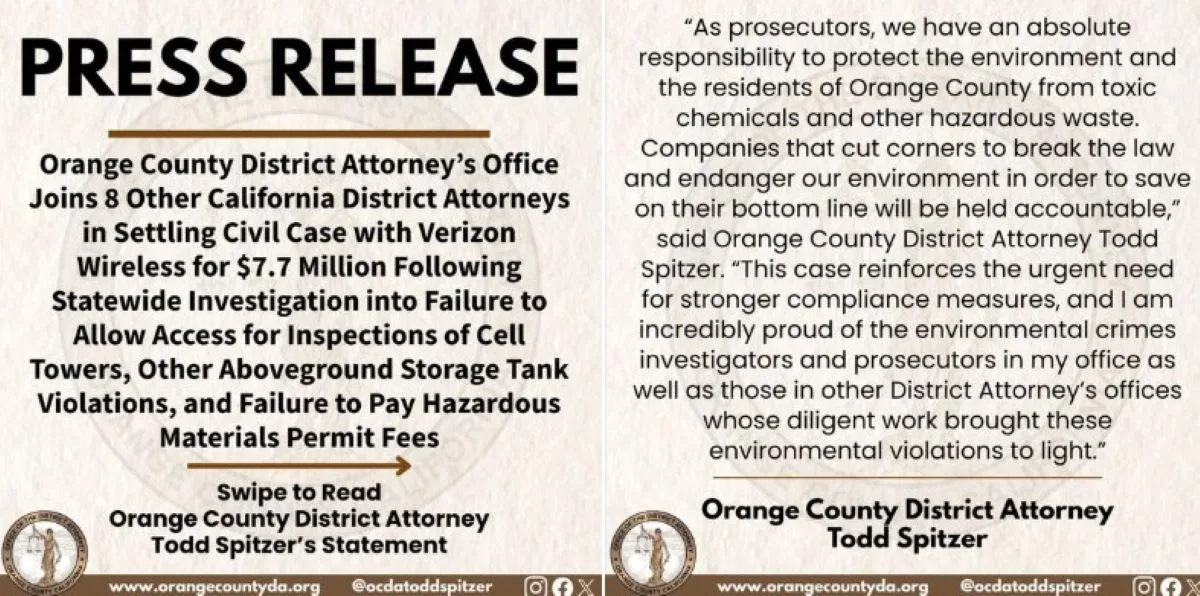
SANTA ANA – Orange County District Attorney Todd Spitzer, along with 8 other District Attorneys across California, announced the Orange County District Attorney’s Office has reached a $7.7 million settlement with Cellco Partnership DBA Verizon Wireless, a Delaware Corporation. This settlement resolves allegations that the company violated state environmental laws regulating hazardous materials release and response plans, hazardous materials permits, and above ground petroleum storage tanks.
Verizon Wireless is the largest provider of mobile telephone services in the United States. The company owns and operates thousands of cell sites throughout the state where hazardous materials and above ground petroleum storage tanks are used to power emergency generators and backup systems. These materials can potentially cause fires and explosions, release toxic chemical air contaminants, and are potentially corrosive. For these reasons, items stored at these locations above a threshold quantity are classified as hazardous and require permits along with detailed reporting and proper hazardous materials management under California law.
Reporting documents are designed to minimize health and safety impacts resulting from accidental release of hazardous materials. These requirements exist to ensure that first responders, environmental regulators, and public safety officials have accurate information about hazardous materials stored at commercial sites in the event of an emergency. The plan must include an inventory of hazardous materials, a site map, an emergency response strategy, and an employee training guide.

“As prosecutors, we have an absolute responsibility to protect the environment and the residents of Orange County from toxic chemicals and other hazardous waste. Companies that cut corners to break the law and endanger our environment in order to save on their bottom line will be held accountable,” said Orange County District Attorney Todd Spitzer. “This case reinforces the urgent need for stronger compliance measures, and I am incredibly proud of the environmental crimes investigators and prosecutors in my office as well as those in other District Attorney’s offices whose diligent work brought these environmental violations to light.”
The investigation, which was led by the District Attorney Offices of Orange County, San Bernardino County, and the Los Angeles City Attorney, found that Verizon failed to properly report hazardous materials, train on hazardous materials, allow on-site inspections, and pay permit fees for multiple site locations going back to 2019.
After prosecutors notified Verizon of these violations, they cooperated fully with prosecutors and took steps to pay all owed permit fees, correct all outstanding violations and implement policies and procedures to ensure future compliance.
Under the stipulated final judgment, Verizon will pay a total of $7,700,000. This includes: $7,125,000 in civil penalties, $375,000 in Supplemental Environmental Compliance Projects, and $200,000 in investigative costs.
The Orange County District Attorney’s Office was joined by the District Attorneys of Los Angeles, Imperial, Riverside, San Bernardino, San Diego, and Ventura counties along with the Los Angeles City Attorney’s Office in this lawsuit.
About Verizon
Verizon’s official corporate headquarters are located in New York City at 1095 Avenue of the Americas, New York, NY 10036. The company also maintains a large operational headquarters in Basking Ridge, New Jersey.
While there are currently no major reports of similar multi-million dollar statewide settlements in other states, the January 2026 California settlement addressed issues that are common across Verizon’s national infrastructure:
- Systemic Cell Tower Issues: The California violations, dating back to 2019, involved “systemic failures” at hundreds of cell tower sites regarding the management of lead-acid batteries and above-ground petroleum tanks used for backup power.
- Settlement Impact: Verizon agreed to pay $7.7 million to resolve allegations that it failed to report hazardous materials accurately, neglected to pay required permit fees, and restricted access for regulatory inspections.
- National Oversight: Environmental compliance for these materials (batteries and fuel) is typically managed at the state or local level. While the $7.7 million settlement was a “statewide” action involving nine California prosecutors, Verizon was required to implement new policies to ensure compliance going forward, which may affect their standard operating procedures nationwide.
Out of State companies often violate California’s tough compliance standards
It is common for out-of-state companies to violate California’s specific compliance standards. California often maintains the strictest regulations in the United States, and its “long-arm” jurisdiction means any business selling products, employing staff, or handling the data of California residents must comply, regardless of where their headquarters are located.
The frequency of these violations often stems from several key factors:
1. Stricter-than-Federal Standards
Many companies operate under the assumption that federal compliance (like EPA or OSHA) is sufficient. However, California frequently sets more rigorous bars:
- Hazardous Materials: California’s hazardous waste laws (RCRA) include items not classified as hazardous by federal standards, such as certain electronics (e-waste) and common corrosive solids.
- Emissions: The California Air Resources Board (CARB) enforces stricter vehicle and factory emission standards than the national average.
2. Environmental “Right-to-Know” (Proposition 65)
Proposition 65 requires businesses to provide warnings if their products expose Californians to chemicals known to cause cancer or reproductive harm.
- Out-of-State Impact: Approximately 75% of businesses that settle Prop 65 lawsuits are headquartered outside of California.
- National Reach: Because companies cannot easily predict which individual unit will be sold in California, many choose to place Prop 65 labels on all products sold nationwide to avoid potential lawsuits.
3. Data Privacy (CCPA/CPRA)
The California Consumer Privacy Act (CCPA) applies to any for-profit business that collects personal data from California residents and meets specific revenue or data-volume thresholds.
- Global Enforcement: In 2022, French retailer Sephora was fined $1.2 million for CCPA non-compliance, demonstrating that even international companies are subject to these rules if they do business with Californians.
4. Labor and Employment Laws
California labor laws are among the most protective in the country. Common pitfalls for out-of-state employers include:
- Unique Mandates: Requirements for “suitable seating,” specific meal and rest break timing, and unique overtime calculations that differ from other states.
- Remote Work: If an out-of-state company hires a single remote employee living in California, they must typically follow California’s labor and tax codes for that employee.