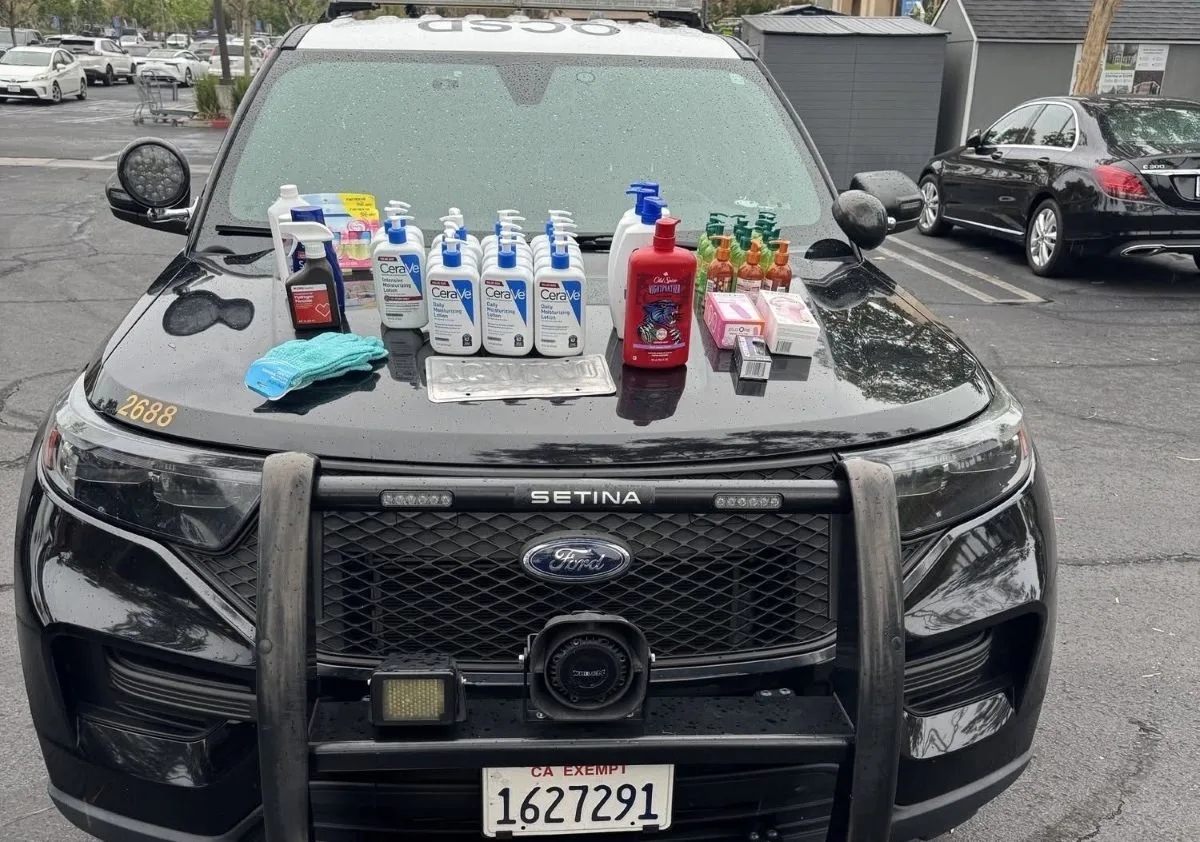
Two Inland Empire parolees made a series of reckless mistakes that led to their arrest in the same shopping center — highlighting ongoing recidivism problems and the persistent trend of IE offenders targeting Orange County retailers despite the OCDA’s aggressive prosecution policies.

What Happened
Deputies with OCSD – Rancho Santa Margarita Police Services were patrolling the Lowe’s parking lot Sunday afternoon when they spotted a vehicle displaying a stolen license plate.
Inside was a male parolee from Hemet, who admitted he had been switching license plates before committing retail thefts.
Deputies also found a large quantity of new hygiene products in the vehicle — items consistent with organized retail theft crews — though the exact store of origin wasn’t immediately clear. The vehicle was towed and the man was arrested.
Hours later, deputies responded to an audible burglary alarm at Staples in the same shopping center. Inside the closed and locked business, they found a female parolee from Hemet asking to be let out.
She claimed she had been charging her phone in the restroom when the store closed, but employees reported conducting a full walkthrough before locking up.
Deputies quickly learned she was associated with the male parolee arrested earlier and also discovered she had an active warrant for her arrest. She too was taken into custody.
Likely Criminal Charges
Based on the facts, both suspects are likely facing multiple charges, including:
- Possession of a stolen license plate — a misdemeanor or felony depending on intent.
- Petty or grand theft — depending on the total value of stolen merchandise.
- Burglary — entering a closed business with intent to steal.
- Conspiracy — acting together to commit theft or burglary.
- Parole violations — which can trigger immediate custody time.
- Possession of stolen property — tied to the hygiene products found in the vehicle.
- Trespassing — for remaining inside a closed business.
Given OCDA’s stance on organized retail theft and parole violations, custody time is extremely likely for both suspects.
Parolee Recidivism in Southern California
Southern California continues to struggle with high recidivism rates among parolees. Statewide data shows:
- Roughly 50–60% of parolees reoffend within three years.
- Property crimes — especially retail theft — are among the most common repeat offenses.
- Many parolees cycle between counties, committing crimes where they believe enforcement is lighter.
The Hemet connection is notable: Riverside County parolees frequently appear in OC retail theft cases, often working in pairs or small crews.
Why Inland Empire Criminals Target Orange County
Despite OCDA’s reputation for aggressive prosecution, IE offenders continue targeting OC retailers for several reasons:
- Higher‑value merchandise — OC stores carry premium brands that can be resold quickly.
- Dense shopping centers — multiple big‑box stores clustered together allow fast, repeated hits.
- Perceived softer store security — many retailers rely on passive loss‑prevention strategies.
- Distance from home — offenders believe crossing county lines reduces the chance of recognition or prior‑case linkage.
- Misconceptions about OC enforcement — criminals often underestimate how quickly OC agencies coordinate across jurisdictions.
But as this case shows, OC deputies are proactive, and OCDA does not hesitate to file felonies.
Why Criminals Make Such Dumb Mistakes
Criminal behavior often includes impulsive, poorly planned decisions. Common factors include:
- Overconfidence — believing they won’t get caught because past crimes went undetected.
- Routine behavior — repeating the same tactics (like switching plates) until they slip up.
- Stress and desperation — especially among parolees with unstable housing or income.
- Cognitive distortions — criminals often rationalize their actions and underestimate risks.
- Lack of situational awareness — such as staying inside a closed store or driving with a stolen plate in plain view.
These mistakes are exactly what lead deputies to quick arrests.
How Much Retail Theft Costs Orange County
Organized retail theft and repeat‑offender shoplifting cost OC businesses tens of millions of dollars annually. Recent countywide estimates show:
- $60–$80 million in annual losses tied to organized theft crews.
- Higher insurance premiums for retailers in high‑theft corridors.
- Increased prices passed on to consumers to offset shrinkage.
- Significant staff time spent on inventory checks, reporting, and security upgrades.
Rancho Santa Margarita, Irvine, Costa Mesa, and Newport Beach remain among the most frequently targeted cities.
Tips for Merchants to Prevent Theft
Retailers can reduce risk by adopting stronger prevention strategies:
- Upgrade surveillance — high‑resolution cameras covering entrances, exits, and high‑value aisles.
- Train employees — recognizing plate‑switching behavior, suspicious loitering, and crew tactics.
- Secure high‑value items — locking cabinets, tether systems, and controlled access displays.
- Coordinate with mall security — sharing intel on suspicious vehicles or repeat offenders.
- Report quickly — immediate calls to police with vehicle descriptions and suspect details.
- Use parking‑lot patrols — especially in centers with multiple big‑box stores.
Bottom Line
Two parolees from Hemet made a series of reckless decisions that led to their arrest — and their mistakes highlight broader issues with recidivism, cross‑county theft crews, and the ongoing financial impact on Orange County retailers. OC deputies’ proactive patrol and fast follow‑up once again show why Orange County remains one of the toughest places in California to commit retail theft.
While the central urban corridor along Florida Avenue struggles with a reputation for crime, poverty, and homelessness, the outlying foothills and surrounding valleys offer a completely different reality. For retirees and remote workers, Hemet provides expansive acreage, and custom mountain-view estates.