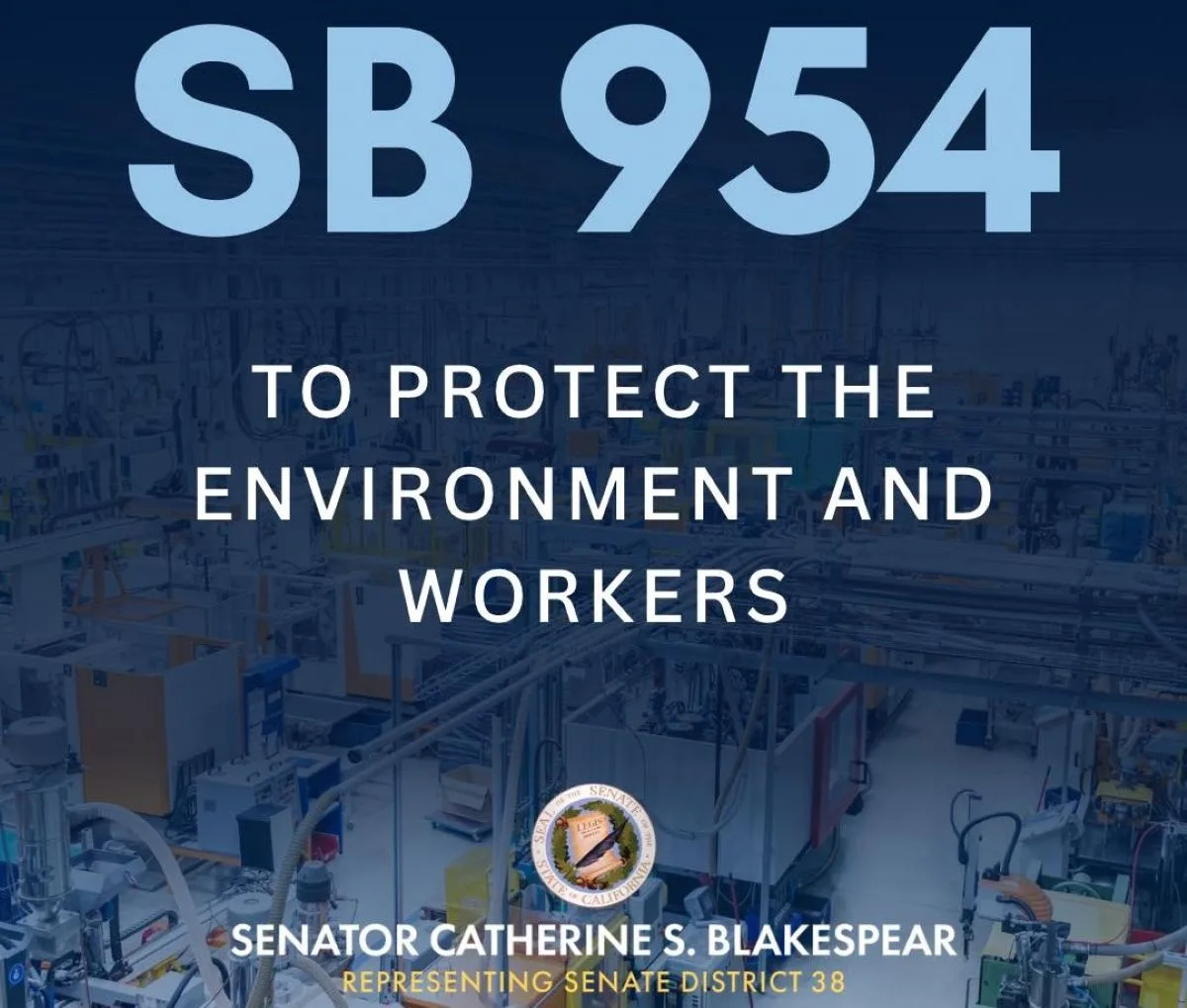
California Senate Bill 954 has officially passed the State Senate on May 25, 2026, in a decisive 22–10 vote. Authored by Senator Catherine Blakespear, the bill marks a significant regulatory shift aimed at reining in sweeping industrial exemptions. It now heads to the State Assembly for legislative review.

The passage of SB 954 arrives at a moment of heightened public urgency, trailing just days after a terrifying, near-catastrophic industrial accident paralyzed a major Orange County community.
The Catalyst: Panic in Garden Grove
The debate surrounding SB 954 transformed dramatically following the recent hazardous materials crisis in Garden Grove. On May 21, 2026, an industrial chemical storage tank overheated and began off-gassing at the GKN Aerospace plant. The tank held 7,000 gallons of methyl methacrylate (MMA)—a volatile, highly toxic, and flammable chemical used in plastic fabrication.
For nearly a week, a one-mile radius was treated as a ticking time bomb. Fire authorities warned that a catastrophic “Boiling Liquid Expanding Vapor Explosion” (BLEVE) or a massive toxic plume was imminent. Over 40,000 residents were evacuated, schools were abruptly closed, and Governor Gavin Newsom declared a local State of Emergency.
While emergency crews stabilized the tank by May 26 after a crack relieved pressure, the incident became a stark, real-world justification for tightening industrial oversight. Senator Blakespear directly cited the Garden Grove evacuation on the Senate floor, calling it a textbook example of “what can go wrong” when heavy industrial operations sit adjacent to neighborhoods.
Reversing the Blanket Exemptions of SB 131
SB 954 was specifically introduced to correct the broad language of a previous budget trailer bill, SB 131. Under SB 131, nearly any facility claiming to engage in “advanced manufacturing” was granted a sweeping exemption from the California Environmental Quality Act (CEQA). This shortcut allowed heavy manufacturing plants to bypass rigorous environmental and community safety reviews.
SB 954 rolls back this blanket approach by introducing strict safety criteria:
- The 1,000-Foot Boundary: Any advanced manufacturing project located within 1,000 feet of a disadvantaged community is explicitly barred from skipping a CEQA environmental review.
- Strict Facility Limits: Only “final tier manufacturing” (the final assembly of market-ready products) can apply for exemptions. High-risk operations like chemical refining, extraction, and heavy recycling are entirely excluded.
- Mandatory Community Agreements: Companies attempting to utilize exemptions must host public hearings, build to LEED Gold standards, and sign binding community benefits agreements.
The Downsides: Economic Pushback and Cost Barriers
While environmental advocates and labor groups celebrate the Senate victory, SB 954 has faced aggressive pushback from California’s business sectors. Detractors cite several notable downsides to the legislation:
- Stifling Job Growth and Investment: The California Manufacturers & Technology Association (CMTA) warns that adding layer upon layer of regulatory barriers will drive advanced manufacturing out of the state. Critics argue that when companies leave California for less-regulated states or countries, it results in local job losses and a net increase in global emissions due to weaker foreign standards.
- Onerous Mandates for Small Projects: The bill ties environmental exemptions to strict labor requirements, such as paying prevailing wages and hiring exclusively from certified “skilled and trained” workforces. Opponents argue these mandates significantly inflate construction and operational costs, potentially pricing out clean-energy startups and smaller innovators.
- Chilling Effect on Innovation: By narrowing the legal definition of “advanced manufacturing,” the state risks deterring green-tech sectors—such as advanced battery production or domestic semiconductor assembly—that California actively needs to meet its climate goals.
What Lies Ahead
Supported by a public sentiment poll showing that 64% of Californians oppose skipping environmental reviews for industrial plants, SB 954 enters the State Assembly with substantial momentum. However, the tension between safeguarding community health and preserving California’s industrial economy will guarantee a fierce battle as the bill moves toward the Governor’s desk.