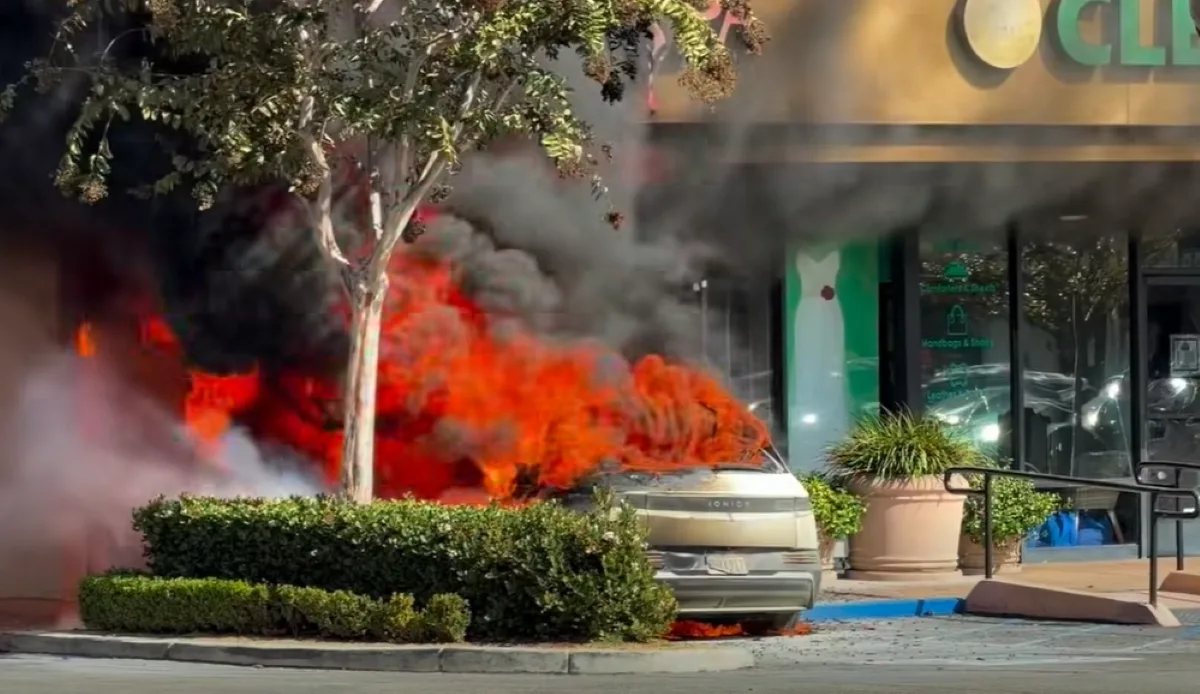
An off-duty Orange County Fire Authority captain is being credited with helping prevent what could have been a much larger commercial fire after an electric vehicle crashed into a nail salon and erupted in flames at a strip mall.

According to the Orange County Fire Authority, off-duty Fire Captain Chris Chang witnessed the aftermath of the crash and immediately ran into the burning nail salon to ensure everyone inside had evacuated safely. His quick actions were soon reinforced by the crew from Engine 12, whose captain and engineer happened to be nearby while following an ambulance transporting a patient from an unrelated emergency call.
After hearing the fire dispatch over the radio, the Engine 12 crew diverted to the scene and joined Captain Chang in establishing a water supply, deploying multiple hoselines, and attacking the fire before it could spread throughout the shopping center.
Video released by the OCFA shows heavy flames and thick black smoke pouring from the electric vehicle as firefighters worked aggressively to contain the blaze. Images from the scene indicate the vehicle came to rest directly in front of the nail salon, causing both crash damage and fire damage to the storefront.
Quick Firefighter Action Likely Prevented a Much Larger Loss
Strip mall fires can become especially dangerous because multiple businesses often share common walls, attic spaces, utility connections, and roof structures.
Based on the video and photographs released by the OCFA, firefighters appear to have stopped the fire before it was able to spread deep into the building’s attic or neighboring tenant spaces.
Had the flames extended into the roof structure, the incident could have damaged multiple businesses and displaced numerous employees and customers for months.
Instead, the rapid response likely limited the damage primarily to:
- The electric vehicle itself
- The nail salon storefront
- Exterior glazing and windows
- Interior furnishings near the point of impact
- Smoke contamination inside the business
- Potential water damage from firefighting operations
Electric Vehicle Fires Remain Relatively Rare But Present Unique Challenges
National studies generally show that electric vehicle fires occur less frequently than fires involving gasoline-powered vehicles. However, when lithium-ion battery packs become involved, the fires can be more difficult to extinguish and may require significantly more water than a conventional vehicle fire.
The National Transportation Safety Board, National Fire Protection Association, and various fire service organizations have documented the unique challenges posed by lithium-ion battery fires, including:
- Thermal runaway reactions
- High heat generation
- Difficulty accessing battery cells
- Re-ignition risks hours or even days after initial extinguishment
- Production of toxic and flammable gases
As electric vehicle ownership continues growing across California and the nation, fire departments have increasingly invested in specialized training and equipment to address these incidents.
How Often Do Electric Vehicles Crash Into Buildings?
There is no dedicated national database tracking how many electric vehicles specifically crash into commercial buildings annually. However, the Storefront Safety Council estimates that vehicles crash into buildings in the United States roughly 100 times every day, resulting in thousands of injuries and hundreds of deaths annually.
Most vehicle-into-building crashes involve restaurants, retail centers, offices, convenience stores, and small commercial businesses.
As electric vehicles account for a growing share of vehicles on American roads, they naturally represent an increasing percentage of these building strikes.
Top Five Reasons Drivers Lose Control of Electric Vehicles
While electric vehicles are generally very safe, experts have identified several common factors that can contribute to crashes:
1. Excessive Speed
Electric vehicles often produce maximum torque instantly, allowing rapid acceleration. Drivers unfamiliar with the vehicle’s performance may accelerate more aggressively than intended.
2. Pedal Misapplication
Drivers occasionally mistake the accelerator for the brake, particularly when parking or maneuvering in shopping centers. This is a leading cause of storefront crashes nationwide.
3. Driver Distraction
Texting, adjusting navigation systems, interacting with large infotainment screens, or other distractions continue to contribute to collision rates across all vehicle types.
4. Medical Emergencies
Sudden medical events, including heart attacks, strokes, diabetic emergencies, or loss of consciousness, can lead to a vehicle leaving the roadway.
5. Loss of Traction or Driver Error
Wet pavement, abrupt steering inputs, panic reactions, and overcorrection can all contribute to a driver losing control.
Safety Tips for Electric Vehicle Drivers
Drivers can reduce their risk of serious crashes and battery-related fires by following several precautions:
- Become familiar with acceleration characteristics before driving in congested areas.
- Use parking assist and collision avoidance systems when available.
- Maintain tires according to manufacturer recommendations.
- Never ignore battery, charging, or electrical system warnings.
- Follow manufacturer guidance after even minor collisions involving battery packs.
- Avoid aggressive acceleration in parking lots and shopping centers.
- Keep software updates current.
- Immediately report crash damage affecting the battery compartment.
Estimating the Damage
While no official damage estimate has been released, commercial property experts would likely place the total loss within a broad range depending on the extent of structural and smoke damage.
Based solely on publicly released images and video:
- Electric vehicle loss: approximately $40,000 to $90,000
- Storefront glass, doors and facade repairs: $15,000 to $50,000
- Interior repairs and tenant improvements: $25,000 to $150,000
- Smoke remediation and cleanup: $10,000 to $75,000
- Business interruption losses: potentially tens of thousands of dollars
The overall incident could easily result in a combined loss ranging from roughly $100,000 to more than $500,000. Those figures are estimates only and would depend on the extent of hidden structural, electrical, and smoke damage.
Potential Impact on the Nail Salon
Even if the building suffered limited structural damage, the business could face significant disruption.
Possible impacts include:
- Temporary closure during repairs
- Lost revenue
- Employee schedule reductions
- Customer cancellations
- Replacement of furniture and equipment
- Deep cleaning and smoke remediation
- Reinspection by building and fire officials
For a small business, even a closure lasting a few weeks can create substantial financial strain.
Property Insurance Considerations
The shopping center owner’s commercial property insurer will likely investigate:
- Structural damage
- Smoke contamination
- Water damage
- Roof and wall impacts
- Potential code upgrade requirements
Insurance companies will also examine whether the vehicle driver’s automobile liability insurance can be pursued for reimbursement through subrogation.
If damages exceed the driver’s policy limits, claims could become more complicated, particularly if there are multiple affected businesses.
Impact on Neighboring Businesses
The neighboring tenants may have avoided direct fire damage, but they could still face losses from:
- Smoke infiltration
- Water intrusion
- Utility interruptions
- Temporary access restrictions
- Reduced customer traffic
- Cleanup operations
Some neighboring businesses could file claims under their own commercial property or business interruption policies if covered losses occurred.
The Driver’s Auto Insurance Could Increase Dramatically
The driver involved in the crash could face a substantial insurance increase if determined to be at fault.
Potential consequences may include:
- At-fault collision designation
- Significant premium increases at renewal
- Loss of claims-free discounts
- Liability claims from multiple businesses
- Potential lawsuits if damages exceed policy limits
California drivers involved in severe at-fault property damage collisions frequently see premium increases lasting three to five years or longer.
If the total damages exceed available liability coverage, the driver could also face personal financial exposure for any uninsured portion of the losses.
The most remarkable aspect of this incident may ultimately be how quickly trained firefighters happened to be in the right place at the right time. Had Captain Chris Chang and the nearby Engine 12 crew arrived just minutes later, the outcome for the nail salon, neighboring businesses, and the entire strip mall could have been far more costly. Their rapid intervention appears to have prevented a vehicle fire from becoming a major commercial structure fire and potentially saved hundreds of thousands of dollars in additional damage.