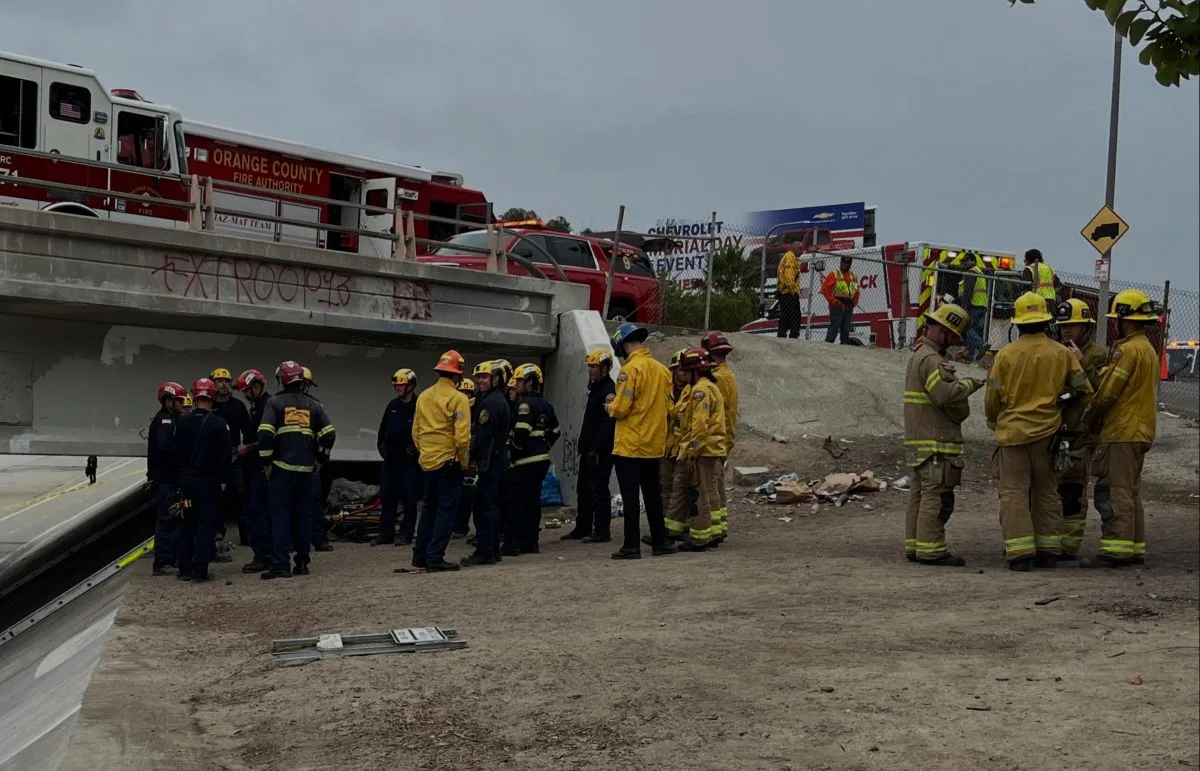
Deputies responded to reports of an individual trapped beneath a self-made hole that collapsed under a bridge at the Santa Ana Riverbed, accroding to the Orange County Sheriff’s North Patrol.

The subject was buried under concrete and debris and unfortunately passed away at the scene.
OCFA, OC Public works and OCSD Behavioral Health Bureau assisted with recovery efforts.
This area is strictly enforced, and individuals found trespassing may be cited or arrested.
Incidents like this highlight the importance of trespassing enforcement.
The incident at the Santa Ana Riverbed underscores the extreme safety risks of “bunkering“—the practice of digging living spaces into river embankments or under infrastructure. These self-made structures are highly unstable because riverbed soil is often loose and subject to shifting from moisture or weight.
The “Bunkering” Phenomenon
In recent years, the Santa Ana Riverbed has seen a history of sophisticated but dangerous underground tunneling:
- Massive Discoveries: In 2017, Orange County officials clearing encampments between Warner and Edinger avenues discovered an underground bunker accessible by a camouflaged wooden hatch. It featured a 10-by-10-foot living space reinforced with wood beams and was tall enough for an adult to stand in.
- Unintended Dangers: In another tunnel discovered during the same period, authorities found over 1,000 stolen bicycles.
- Infrastructure Stress: Fires and digging in these areas can weaken concrete and lead to delamination or cracking of bridge supports, posing a risk not only to those inside but to the structural integrity of the bridges above.
Similar Episodes in Southern California
Incidents involving tunnel collapses or people trapped in underground encampments have been reported across the region:
- Wilmington Tunnel Search (2026): Just recently in May 2026, authorities investigated a trash fire beneath a bridge on the 110 freeway in San Pedro. The fire originated in an “access portal” within the bridge structure, raising concerns about potential tunnel collapses and damage to the freeway’s structural strength.
- East Los Angeles Discovery (2026): In April 2026, a “Good Samaritan” found people living in a hand-dug tunnel near East LA. Despite recent cleanups by city agencies, individuals frequently return to these sites due to the privacy and shelter they provide, despite the risk of cave-ins.
- Sacramento Cave-in (2025): While outside Southern California, a notable partial tunnel collapse occurred at a homeless encampment in October 2025. Multiple agencies conducted a methodical search for a man believed to be trapped; fortunately, no one was inside at the time of the collapse.
- Fountain Valley Water Rescues: In January 2026, rescue crews recovered a body from the Santa Ana River in Fountain Valley after reports of a person yelling for help. These riverbeds are particularly dangerous during storms, as moving water and debris can trap or drown those in underground or low-lying shelters.
Legal Penalties for Bunkering in Orange County
The Orange County Board of Supervisors approved a strict ordinance in November 2025 targeting encampments on county-owned land, parks, and flood control channels.
- Misdemeanor Charges: Violations are typically classified as misdemeanors.
- Fines: Violators can face fines of up to $1,000.
- Jail Time: Penalties can include up to six months (180 days) in county jail.
- Immediate Arrest: Authorities may now arrest individuals immediately for camping in prohibited areas, such as flood control channels, regardless of shelter availability.
Applicable State & Local Codes
Beyond local anti-camping laws, specific activities associated with “bunkering” (illegal excavation) can trigger additional legal consequences:
- Public Nuisance & Health Safety: Failure to abate a public nuisance, such as a hazardous underground structure, can be prosecuted as a misdemeanor.
- Illegal Excavation: Under California law, failing to notify authorities before digging (DigAlert) can result in fines up to $50,000 plus repair costs for any damaged infrastructure.
- Municipal Variations: Cities like Anaheim have their own penalty structures, with fines starting at $250 for a first offense and increasing with subsequent violations.
Recent Policy Shifts
- Removal of Shelter Requirements: Previous legal settlements that required the county to offer shelter before making an arrest have largely been reversed or have expired, allowing for more aggressive enforcement.
- Safety Enforcement: Officials emphasize that these rules are critical for public safety, particularly in flood control channels, where tunnels pose a high risk of collapse or drowning during rain events
I don’t see a photo of this bunker… I’m dying to see this bunker.
Emergency has passed but still 24 (visible) police and fire personnel – all standing around. Why?
They likely used this as a training exercise.
Trespassing in the area is “strictly enforced” but it’s also covered in graffiti, littered with trash, and a guy died who was living there. Sounds like California.