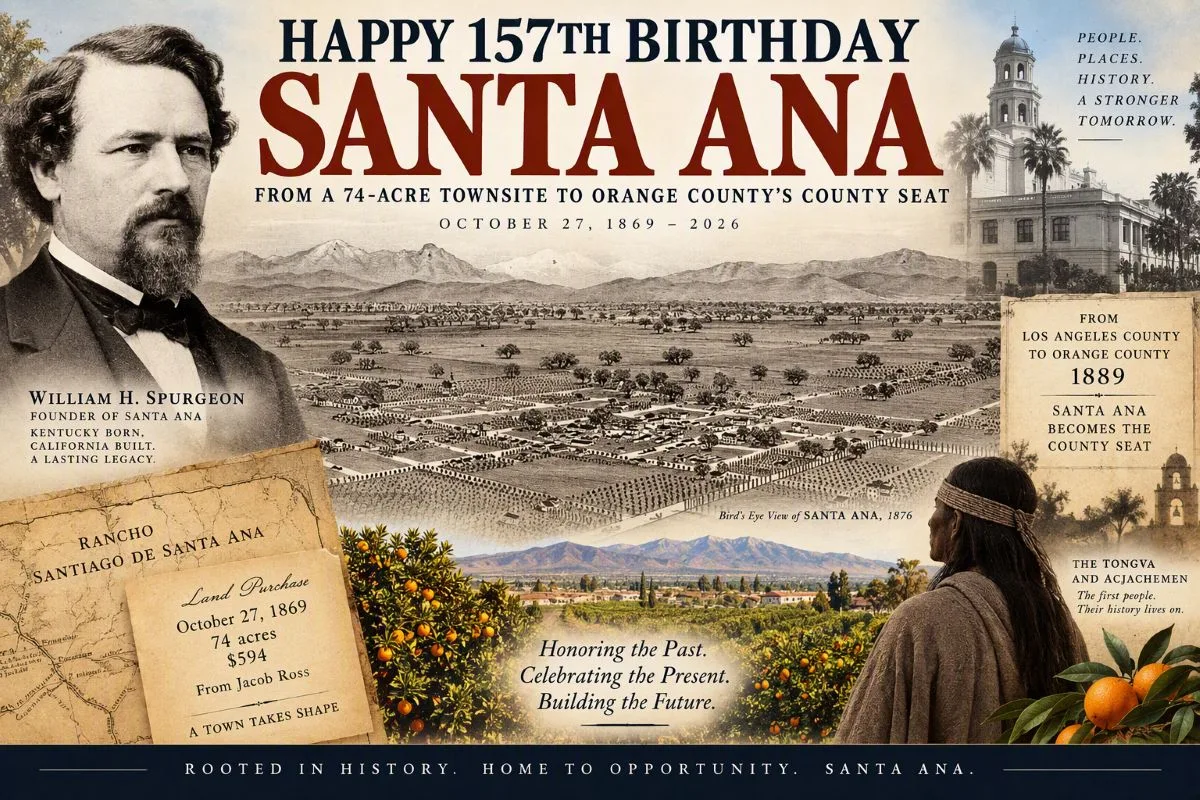
On Oct. 27, 1869, a former gold miner, merchant and civic leader named William H. Spurgeon made a decision that would change the history of Orange County forever. The purchase of just over 74 acres of land led to the creation of Santa Ana, a community that would grow from a small agricultural town into one of California’s largest cities and eventually become the county seat of Orange County.

As Santa Ana celebrates its 157th birthday, it is worth looking not only at the city’s founder but also at the people who lived here long before him, the pioneers who followed, and the political battles that eventually made Santa Ana the center of county government.
William Spurgeon and the Founding of Santa Ana
William Henry Spurgeon was born in Kentucky in 1829 and spent much of his early life traveling across the growing American frontier. Drawn west by the California Gold Rush, he worked as a miner, trader and businessman before eventually searching for a place where he could establish a permanent town.
Spurgeon found that opportunity in the Santa Ana Valley.
On Oct. 27, 1869, he purchased approximately 74 acres for $594 from local rancher Jacob Ross and his associate Ward Bradford. The land lay within the former Rancho Santiago de Santa Ana and occupied what would become downtown Santa Ana.
Spurgeon quickly hired a surveyor to lay out a 24-block townsite. The original boundaries stretched from First Street to Seventh Street and from what is now Broadway to Spurgeon Street. Rather than naming the town after himself, Spurgeon chose the name Santa Ana, borrowing it from the historic rancho and the nearby Santa Ana River.
The choice proved to be a wise one. By the early 1870s, settlers were pouring into the fertile valley, attracted by inexpensive farmland, favorable weather and agricultural opportunity. Santa Ana soon became a commercial center serving farmers throughout the region.
“Did Santa Ana’s Founder Have a Connection to the Alamo?”
While there is no known evidence that William Spurgeon personally knew any of the Alamo defenders, the Kentucky-born founder of Santa Ana grew up in a state that supplied many volunteers to the Texas Revolution. As a child in the years immediately following the Alamo, Spurgeon almost certainly would have heard stories of the battle and the men who fought there, including several fellow Kentuckians whose exploits became part of frontier legend.
A significant number of Alamo defenders had ties to Kentucky, including:
- Davy Crockett, who was born in Tennessee but served in Congress alongside many Kentuckians and was well known throughout Kentucky.
- George C. Kimble, a lawyer from Kentucky.
- Joseph Kerr, who was born in Ohio but had Kentucky connections.
- Several other defenders either were born in Kentucky or had lived there before heading to Texas.
The Land Before Santa Ana
Long before American settlers arrived, the Santa Ana Valley was home to Indigenous peoples who had lived in Southern California for thousands of years.
The area that became modern-day Orange County was inhabited primarily by the Tongva in the northern portions of the county and the Acjachemen in the southern region. Villages, trading routes and cultural centers existed throughout the area long before Spanish explorers arrived.
These Native communities lived from the region’s rivers, wetlands, grasslands and coastal resources. They maintained extensive social and trade networks that connected villages across what is now Orange, Los Angeles, Riverside and San Diego counties.
Many local place names, waterways and historic sites trace their roots to these early inhabitants. Archaeological evidence indicates Native people lived in the broader region for thousands of years before European contact.
What Happened to the Native Peoples?
The arrival of Spanish explorers and missionaries dramatically altered Native life.
Beginning in the late 1700s, Indigenous residents were drawn, pressured or compelled into the Spanish mission system. At Mission San Juan Capistrano and other missions, Native families were baptized and incorporated into colonial society. Disease, displacement and harsh living conditions led to severe population declines.
Yet the story did not end there.
Despite generations of hardship, descendants of the Tongva and Acjachemen peoples remain active in Southern California today. Tribal organizations continue to preserve language, culture, sacred sites and historical memory while advocating for protection of ancestral lands throughout Orange County.
The continued work of organizations such as the Acjachemen Tongva Land Conservancy demonstrates that the first peoples of the region remain an important part of Orange County’s story.
Who Was Jacob Ross?
While William Spurgeon is remembered as Santa Ana’s founder, another pioneer is often overlooked.
Jacob Ross and his family were among the earliest settlers in what would become Santa Ana. In 1868, Ross purchased portions of Rancho Santiago de Santa Ana from descendants of the Yorba family and moved his family to the area. His family became the first permanent settlers of the future city.
Ross eventually sold Spurgeon the parcel that became downtown Santa Ana, making the creation of the town possible. Today, Ross Street serves as a reminder of the family’s foundational role in the city’s history. Ross Street in Santa Ana is named after him.
When Orange County Was Part of Los Angeles County
Many newer residents do not realize that Orange County did not exist when Santa Ana was founded.
In 1869, the entire region belonged to Los Angeles County. Anyone needing county services often faced a difficult journey to Los Angeles along primitive roads that could become impassable during winter storms.
As farming communities multiplied across the Santa Ana Valley, local residents increasingly argued that they needed their own county government. Over the next two decades, numerous efforts were launched to separate the region from Los Angeles County.
William Spurgeon became one of the leading advocates for county division and helped build political support for creating a new county in Southern California.
How Santa Ana Became the County Seat
The movement finally succeeded in 1889 when Orange County officially split from Los Angeles County and became California’s newest county.
Several communities hoped to become the county seat, including Anaheim, which had actually launched some of the earliest county-separation efforts. But Santa Ana possessed significant advantages.
By the late 1880s, Santa Ana had emerged as one of the region’s main population and business centers. Its central location and growing commercial district made it a strong candidate to host county government.
When Orange County was formally established, voters selected Santa Ana as the county seat, a distinction it retains today. William Spurgeon would go on to serve as the first chairman of the Orange County Board of Supervisors, cementing his place in local history.

From a 24-Block Town to Orange County’s Civic Center
Santa Ana City Councilman Phil Bacerra recently shared a bird’s-eye illustration that shows a community that would be almost unrecognizable to modern residents. The 1876 image reveals a modest agricultural town surrounded by fields, orchards and open land, with the Santa Ana Mountains dominating the horizon.
Yet many of the foundations visible in that drawing still shape the city today. Santa Ana remains home to the Orange County Hall of Administration, the county courthouse complex, federal offices, major educational institutions and a diverse population that reflects generations of newcomers who have helped build the community.
What began as a 74-acre townsite purchased for less than $600 has grown into a city of more than 300,000 residents and remains the governmental heart of Orange County.
As Santa Ana celebrates its 157th birthday, the occasion offers an opportunity to remember not only William Spurgeon and the early pioneers but also the Indigenous peoples whose history stretches back thousands of years and whose legacy remains woven into the story of the city we know today.
Thank god for that. LA is a trash heap.