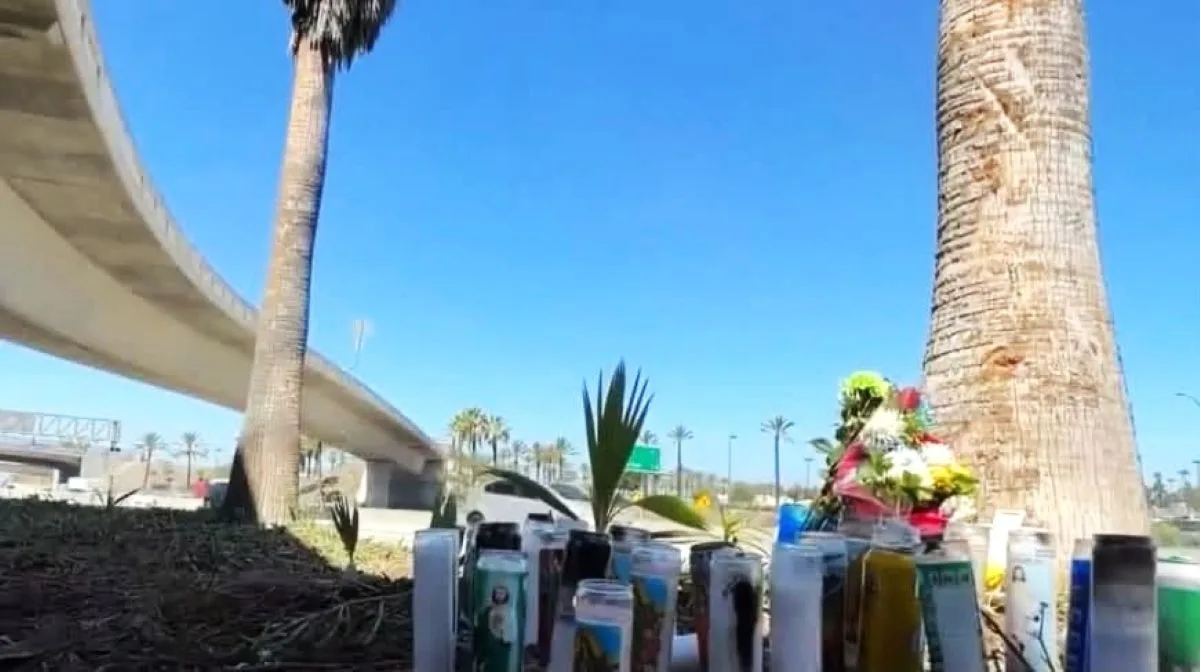
Three Orange County teenagers were killed and a fourth person was seriously injured when a Ford Edge SUV flew off the southbound Santa Ana (5) Freeway near the Lincoln Avenue off-ramp in Anaheim at about 3:15 a.m. on Thursday, September 3, 2026.

The California Highway Patrol (CHP) says the vehicle veered off the road, struck a wood/metal guardrail and a concrete pillar, then continued down a sloped concrete embankment, overturning before coming to rest in a vegetation-covered area.

The Orange County Coroner has identified the three teens who died in the crash as:
- Victor Hugo Delgado, 17, of Santa Ana
- Robert Miguel Gutierrez-Avalos, 16, of Santa Ana
- Levi Jacob Flores, 15, of Garden Grove
Two of the teens were pronounced dead at the scene; two others were transported to a local hospital with major injuries, where one later died. The sole survivor—also a teen—remains hospitalized with serious injuries.
Investigators say it appears none of the occupants were wearing seat belts at the time of the crash, and a witness reported that the driver of a white SUV seemed to miss the off-ramp and lose control while making a late attempt to take the exit, causing the vehicle to fly over the side at high speed and eject two of the teens.
CHP has stated that drugs and/or alcohol have not been ruled out as factors, but the collision remains under active investigation and no definitive cause has been announced.
From what is publicly known, this was a single-vehicle crash. There is no indication that another driver or vehicle was involved, so there is no “other party” at fault at this time and no announced criminal charges against anyone else.
If investigators ultimately determine that the teen driver was impaired or driving with gross negligence, potential charges could include vehicular manslaughter, DUI causing injury or death, or related offenses—but as of now, CHP has only said that impairment has not been ruled out, not that it has been confirmed.
Teenagers More Prone to Fatigue When Driving in the Early Morning
Because the crash occurred around 3:15 a.m., it raises hard questions about teens driving at very early hours. Developmentally, teens have less driving experience, are more prone to fatigue, and are statistically at higher risk in nighttime and early-morning driving conditions.
Late-night driving often combines:
- Fatigue and reduced alertness: Reaction times and judgment are worse at 3 a.m. than in the afternoon.
- Low visibility and complex freeway geometry: Exits, off-ramps, and lane changes are harder to judge in the dark.
- Social pressure and risk-taking: Teens may feel pressure to get home quickly or take chances with speed and late exits.
Many parents and safety advocates argue that teens should not be driving unsupervised at such hours, especially on high-speed freeways. California’s graduated driver licensing already restricts some nighttime driving for younger drivers, but enforcement and family rules vary. A family-imposed rule that minors do not drive between, say, midnight and 5 a.m. unless accompanied by an adult can significantly reduce risk, particularly on routes like the 5 Freeway through Anaheim and Santa Ana.
As for fault, CHP has not publicly named which teen was driving, only that the Ford Edge’s driver veered off the road and missed the off-ramp. In a single-vehicle crash like this, the driver is typically considered at fault for insurance and civil liability purposes, unless a mechanical defect or roadway hazard is later proven. The apparent factors—late exit attempt, high speed, no seat belts, possible impairment—point toward driver error rather than an unavoidable accident, though that conclusion ultimately belongs to investigators and, if it comes to it, the courts.
GoFundMe Page Launched to help the Family of Levi Jacob Flores
At least one verified fundraiser has been created:
- “In Memory of Levi: Help Us Through This Time” – Levi Jacob Flores
- Organized by Valerie Hernandez, this memorial fund is intended to help Levi’s family cover funeral expenses and give them time to grieve. The description remembers Levi as “full of life” and someone who brightened others’ days despite his own struggles. The organizer also extends condolences to the families of Victor Delgado and Robert Gutierrez and thanks the community for its support.
GoFundMe Page Launched to help the Family of Robert Miguel Gutierrez-Avalos
- “Donate for Robert’s Funeral After the Tragic Accident” – Robert Miguel Gutierrez-Avalos
- Organized by Stephanie Avalos. She wrote “My son Robert passed away in a tragic accident on Thursday, September 3, 2026. He was a loving son, brother, nephew, grandson, and a great friend to many. His smile and laugh were very contagious. He was always thinking about others before himself. He was loved and cherished by many people. We would like to give Robert a proper funeral and burial, and we will appreciate any help and anyone willing to donate.”
Impact on the Auto Insurance
On the insurance side, several impacts are likely:
- Liability coverage: The driver’s auto liability policy (or the vehicle owner’s policy) would generally be responsible for injury and wrongful-death claims by passengers.
- Underage driver issues: If the driver was a minor, the policyholder—often a parent—may face increased premiums, non-renewal, or policy cancellation after a fatal loss.
- Medical and funeral costs: Medical payments coverage and liability limits may be quickly exhausted in a multi-fatality crash, leaving families to seek additional compensation through civil claims.
- Future premiums: A single catastrophic claim can dramatically raise premiums for the household and may follow the driver into adulthood if they continue to be insured.
Because the teens were juveniles, some responsibility can fall on parents under California law and in civil practice:
- Parental liability for minors’ driving: Parents who sign a minor’s driver license application can be held jointly liable for damages caused by the minor’s negligent driving, up to certain limits.
- Vehicle ownership and permissive use: If a parent owned the Ford Edge and allowed their teen to drive it, the parent’s policy is typically primary for liability.
- Negligent supervision claims: In extreme cases, plaintiffs may argue that parents were negligent in allowing unsupervised late-night freeway driving, though those claims are fact-specific and not automatic.
None of this changes the core reality: three families have lost their children, and one teen is fighting to recover. Legal and insurance consequences matter, but they sit in the shadow of profound grief.
How Parents can Keep their Teenagers Safe on the Road
For parents looking to prevent similar tragedies, practical steps can make a real difference:
- Set strict nighttime driving rules:
- No solo driving after a set hour (for example, 10 p.m. or midnight).
- Require check-ins and location sharing when teens are out late.
- Enforce seat belt use every single trip:
- Make it non-negotiable that the car does not move until every occupant is buckled.
- Limit passengers for teen drivers:
- More teen passengers mean more distraction and more risk; keep early driving mostly solo or with adults.
- Talk openly about impairment and fatigue:
- Make clear that calling for a ride—at any hour—is always safer than driving tired or after using substances.
- Choose safer routes when possible:
- Avoid complex freeway interchanges and late-night off-ramps until the teen has more experience.
Apps and systems that detect seat‑belt use
- Vehicle telematics apps — Many newer cars already log seat‑belt status for every occupied seat. Apps tied to the vehicle (FordPass, Toyota Connected Services, Hyundai Bluelink, HondaLink) can alert parents when:
- The car is moving and a seat belt is unlatched
- A teen repeatedly drives without buckling
- Hard braking or swerving occurs while unbelted
- Aftermarket OBD‑II trackers — Devices like Bouncie, MotoSafety, and Vyncs plug into the car’s OBD port and can report:
- Seat‑belt status (supported on many vehicles)
- Speeding, harsh turns, late‑night driving
- Real‑time location and trip logs
- Insurance telematics apps — Some insurers offer teen‑driver monitoring apps that track:
- Belt usage
- Phone use while driving
- Aggressive driving
- Curfew violations
These systems don’t just monitor—they create a digital paper trail that parents can use to enforce rules or intervene early.
Apps that enforce rules and reduce risk
- Life360 — Driving analysis, crash detection, phone‑use monitoring.
- Hum by Verizon — Vehicle diagnostics + driving behavior + seat‑belt alerts (supported on many cars).
- OnStar Guardian — Crash detection, driving behavior, emergency response.
These apps don’t replace seat‑belt sensors, but they reinforce safe habits by flagging risky trips.
In‑dash inward‑facing cameras
nward‑facing cameras are becoming mainstream because automakers use them for driver‑monitoring systems (DMS). Parents can leverage them too.
Factory systems
- GM Super Cruise DMS
- Ford BlueCruise DMS
- Tesla cabin camera
These cameras can detect:
- Whether the driver is looking at the road
- Drowsiness
- Distraction
- In some models, whether the driver is belted
Parents can review logs or receive alerts through the vehicle’s connected‑services app.
Aftermarket inward‑facing dash cams
- Garmin Dash Cam Tandem
- Nextbase 522GW + Rear Cabin Cam
- BlackVue DR900X-2CH IR
These cams record:
- Whether the driver and passengers are wearing seat belts
- If teens are distracted, using their phones, or letting friends ride unbelted
- Late‑night driving patterns
- Speed and GPS location
Some models send real‑time alerts to a parent’s phone when unsafe behavior is detected.
Community Impact
This crash on the 5 Freeway in Anaheim—killing Santa Ana teens Victor Hugo Delgado and Robert Miguel Gutierrez-Avalos and Garden Grove teen Levi Jacob Flores—will likely become a touchpoint in local conversations about teen driving, freeway safety, and parental rules around late-night trips. No parent expects a 3 a.m. drive to end like this.