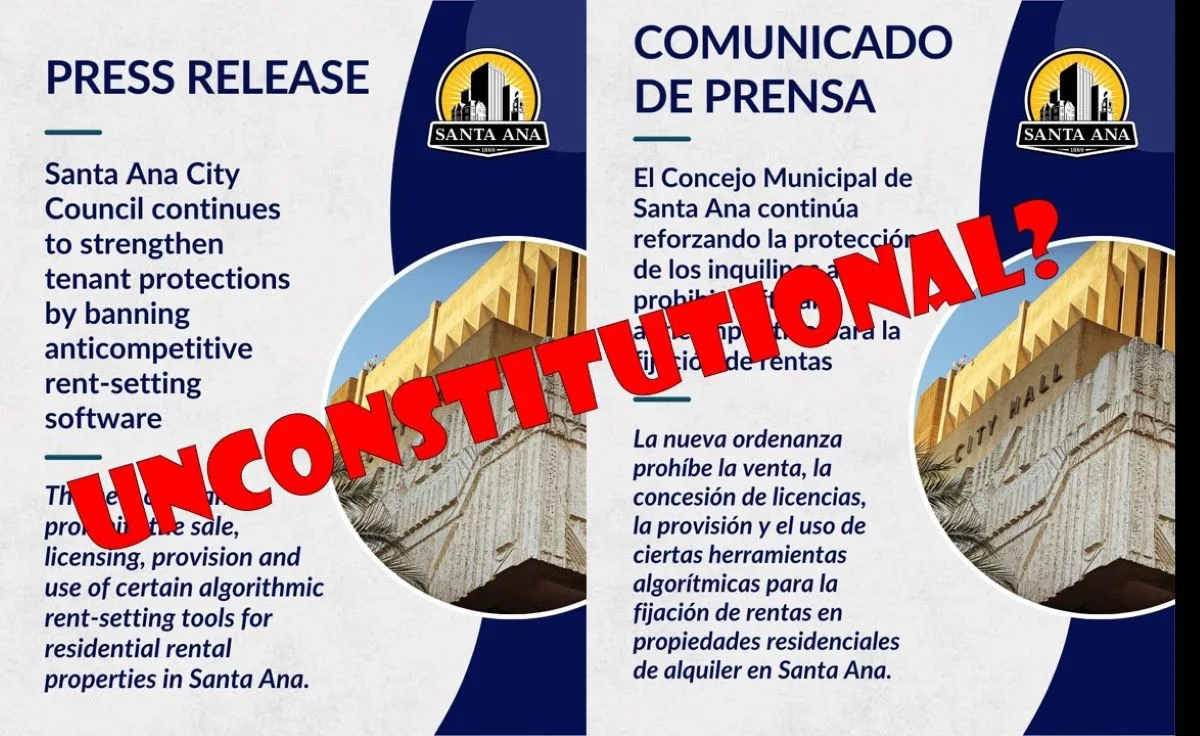
The Santa Ana City Council voted to take a possibly unconstituional step to protect renters with a new ordinance banning rent-setting computer software that can artificially inflate rents.
The ordinance, approved on Tuesday, Feb. 17, for a first reading and set for a final vote on March 3, prohibits the sale, licensing, provision and use of certain algorithmic rent-setting software for residential rental properties. It addresses the growing use of algorithmic devices that set rental rates in the private housing market using nonpublic competitor data, including real-time rents, lease renewals and occupancy levels.
“This ordinance is about protecting renters and keeping our housing market fair,” Mayor Valerie Amezcua said. “By prohibiting the sale and use of these rent-setting systems, we’re standing up for working families, promoting accountability, and ensuring our housing market works for residents — not just profit margins.”
A 2023 survey by the U.S. Census Bureau found that more than 55 percent of the 79,691 occupied homes in Santa Ana are rented rather than owned, and about 53 percent of renters spend more than 30 percent of their income on housing. At the same time, the median household income in Santa Ana has not increased as fast as the growth in rental housing prices, which puts extra financial pressure on low-income and working-class families.

Immigration has Played a Role in California’s Rising Rental Housing Costs
Some reports, including from the U.S. Department of Housing and Urban Development (HUD), indicate that a sharp rise in immigration has played a measurable role in pushing housing demand, particularly in the rental market.
HUD identified California and New York as states where immigration-driven demand has had the most pronounced effect. Because roughly 90% of recent immigrant-headed households are renters, this adds significant pressure to an already limited supply of units.
Since undocumented immigrants typically seek lower-cost rental housing, their presence can increase competition and prices for the most affordable units, which primarily affects working-class residents
Potential for Litigation
It is highly likely that Santa Ana will face a lawsuit, as similar bans in other cities have already triggered significant legal battles. While the city maintains the ordinance is legally sound, the Apartment Association of Orange County and software providers like RealPage have a history of challenging such measures on constitutional grounds.
Santa Ana officials have acknowledged that legal threats are often part of the process when advancing such policies.
- Precedent in Other Cities: RealPage sued the City of Berkeley in 2025, arguing that a similar ban violated its First Amendment rights to provide advice and recommendations. Berkeley initially paused its ban to avoid a costly legal fight before moving forward again.
- Existing Local Conflict: The city is already embroiled in litigation with the Apartment Association of Orange County (AAOC) over its broader rent control laws. A judge recently ruled that the structure of Santa Ana’s Rental Housing Board was unconstitutional because it was intentionally biased toward tenants.
Constitutional Arguments
Opponents typically challenge these bans using three main constitutional arguments:
- First Amendment (Freedom of Speech): Companies like RealPage argue that their software provides “recommendations” and “advice,” which they claim is protected speech.
- Fourteenth Amendment (Due Process): Landlords argue that these bans represent a “taking” of property rights or an “unconstitutional overreach” by restricting how they determine market rates.
- Commerce Clause: Critics may argue that local bans interfere with interstate commerce, as the software is used by national firms across state lines.
Legal Justifications for the Ban
The City of Santa Ana and other proponents believe the ordinance is constitutional based on:
- Police Powers: California courts generally uphold local ordinances intended to protect public welfare, health, and safety, including rent-related regulations.
- Antitrust Alignment: The ordinance is designed to align with the U.S. Department of Justice’s ongoing antitrust actions against RealPage, which allege the software enables illegal price-fixing.
- State Law Support: California recently passed AB 325, which amends the Cartwright Act to prohibit the use of AI pricing technology in agreements that restrain trade, providing a stronger legal foundation for local bans.
Countries with the best-subsidized housing programs—such as Finland, Denmark, Austria, and Singapore—frequently rank among the happiest and most content in the world.