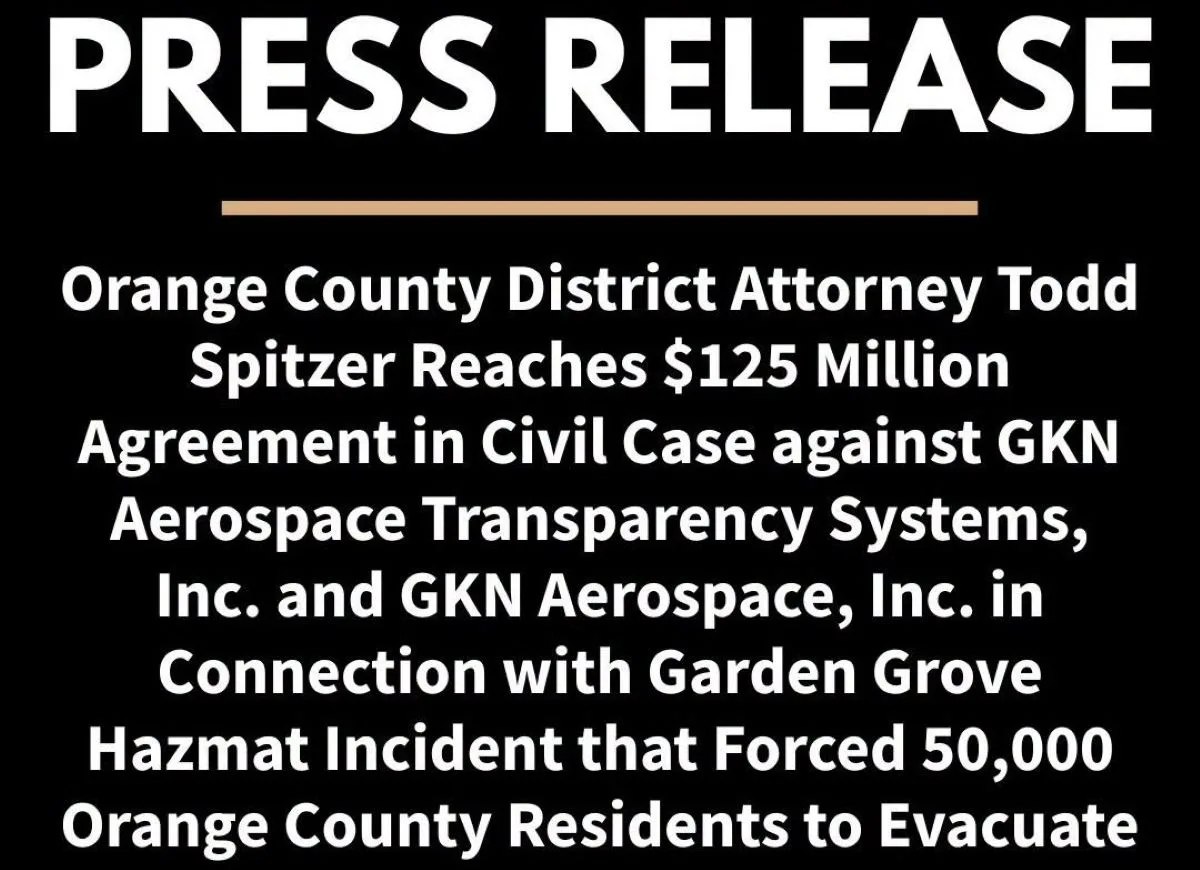
Nearly five months after a hazardous chemical emergency forced the evacuation of more than 50,000 Orange County residents over Memorial Day weekend, the Orange County District Attorney’s Office has announced a proposed $125 million settlement with GKN Aerospace Transparency Systems, Inc. and GKN Aerospace, Inc. related to the Garden Grove hazmat incident. The agreement still requires approval by an Orange County Superior Court judge before it becomes final.

The proposed settlement is one of the largest environmental and public safety recoveries in Orange County history and includes compensation for displaced residents, reimbursement of taxpayer-funded emergency response costs, long-term safety oversight, and civil penalties.

What Happened in Garden Grove?
The incident began on May 21, 2026, at GKN Aerospace’s facility on Western Avenue in Garden Grove when a large storage tank containing approximately 7,000 gallons of methyl methacrylate (MMA) began overheating and releasing vapors. The chemical is a flammable liquid used in manufacturing acrylic plastics and aerospace components.
According to emergency officials, a malfunctioning cooling system and failed valve prevented responders from safely reducing pressure inside the tank. As temperatures continued rising, authorities feared the tank could rupture, spill its contents, or experience a catastrophic boiling liquid expanding vapor explosion (BLEVE).
The threat prompted evacuation orders covering a roughly nine-square-mile area stretching across portions of:
- Garden Grove
- Anaheim
- Cypress
- Stanton
- Westminster
- Buena Park
More than 50,000 residents were ordered from their homes, with many displaced for several days. California declared a state of emergency, and federal emergency assistance was authorized as authorities worked around the clock to prevent a disaster. [en.wikipedia.org], [ktla.com]
The crisis finally eased when officials discovered a crack in the tank wall had relieved pressure sufficiently to eliminate the immediate explosion risk. Evacuation orders were fully lifted on May 26, 2026. [ktla.com], [en.wikipedia.org]
What Is Included in the Proposed Settlement?
According to the District Attorney’s Office, the agreement includes:
- Up to $100 million in claims for residents and businesses forced to evacuate
- $8.47 million to reimburse emergency response and abatement costs
- A seven-year independent monitoring and safety compliance program
- Approximately $1.4 million in monitoring costs paid by GKN
- $15 million in civil penalties designated for consumer protection enforcement
The claims program would compensate residents and businesses for expenses such as hotel stays, transportation costs, meals, lost wages, and loss of use resulting from the evacuation. An estimated 13,000 to 17,000 households were impacted.
Will GKN Aerospace Be Allowed to Reopen?
At this point, the answer appears to be yes.
The proposed settlement does not require closure of the facility. Instead, it imposes a seven-year injunction that includes independent oversight, safety monitoring, and compliance requirements. The District Attorney’s Office specifically negotiated enhanced safety measures intended to allow continued operation under stricter scrutiny
GKN has publicly stated that it intends to resume operations and has been working with regulators on restarting the Garden Grove facility. Community advocates have expressed concerns about reopening, but recent state legislation addressing methyl methacrylate storage largely applies to new facilities rather than existing sites such as GKN’s Garden Grove operation.
Unless regulators or a court take additional action, the facility is expected to continue operating under enhanced oversight and monitoring requirements.
What Is Methyl Methacrylate and Where Else Is It Used?
One important lesson from the GKN incident is that methyl methacrylate is not unique to aerospace manufacturing.
MMA is commonly used to manufacture:
- Acrylic plastics
- Aircraft canopies
- Aircraft windows
- Medical devices
- Industrial coatings
- Composite materials
- Specialty manufacturing products
The chemical is stored and used at numerous industrial facilities throughout California, including facilities in Orange County. Experts have noted that MMA historically fell outside some of California’s most stringent accidental-release prevention programs, creating regulatory gaps that became evident during the Garden Grove emergency.
Following the incident, California enacted new legislation expanding oversight of facilities that store explosive or highly reactive chemicals, including MMA.
What Should Cities Do Now?
The Garden Grove incident exposed the reality that hazardous industrial operations often sit near densely populated neighborhoods. Local governments across Orange County should consider several proactive measures:
- Conduct comprehensive inventories of hazardous materials stored within city limits.
- Review proximity between chemical storage facilities and residential neighborhoods, schools, hospitals, and senior housing.
- Require regular emergency preparedness exercises involving fire departments and neighboring jurisdictions.
- Improve public alert systems and evacuation planning.
- Increase transparency by making facility safety information readily available to residents.
- Require independent safety audits for facilities storing large volumes of hazardous chemicals.
- Coordinate with county, state, and federal agencies to identify high-risk facilities before an emergency occurs.
State lawmakers have already responded by tightening regulations on certain chemical storage operations, but local governments remain the first line of defense when potentially dangerous facilities operate within their communities.
The Bottom Line
The proposed $125 million settlement represents a significant financial recovery for residents, businesses, taxpayers, and public agencies affected by the Garden Grove chemical emergency. Yet the agreement also highlights a larger issue: hazardous chemicals like methyl methacrylate are stored and used at industrial facilities throughout Orange County every day.
For local officials, the GKN incident serves as a warning that prevention is far less costly than emergency response. While the settlement may help compensate those impacted, the real test will be whether Orange County’s cities use the lessons learned from the 2026 Garden Grove crisis to ensure a similar evacuation never happens again.