A previously deported Mexican national who was found with a significant quantity of methamphetamine and ammunition in Orange County has been sentenced to 10 years in federal prison as part of a federal initiative targeting narcotics trafficking and repeat criminal offenders.

According to federal prosecutors, Juan Jose Guerra-Renteria, 46, a Mexican national who had previously been deported from the United States in 2006 and again in 2020, was sentenced on October 8, 2026, after pleading guilty to possession with intent to distribute methamphetamine, being a felon in possession of ammunition, and illegal reentry into the United States following deportation.
Judge Monica Ramirez Almadani imposed a sentence of 120 months in federal prison on the drug trafficking and ammunition offenses and 29 months on the immigration charge, to be served concurrently.
The case was investigated under Operation Guardian Angel, a federal enforcement initiative aimed at identifying violent offenders, drug traffickers, and previously removed criminal aliens operating within local communities.
Federal authorities said that during a traffic stop in Orange County on October 14, 2025, law enforcement officers discovered more than 211.9 grams of methamphetamine and 56 rounds of .45-caliber ammunition in Guerra-Renteria’s possession.
Because of multiple prior felony convictions, federal law prohibited him from possessing ammunition. Prosecutors also determined that he had unlawfully returned to the United States after his 2020 deportation without obtaining authorization from federal immigration authorities.
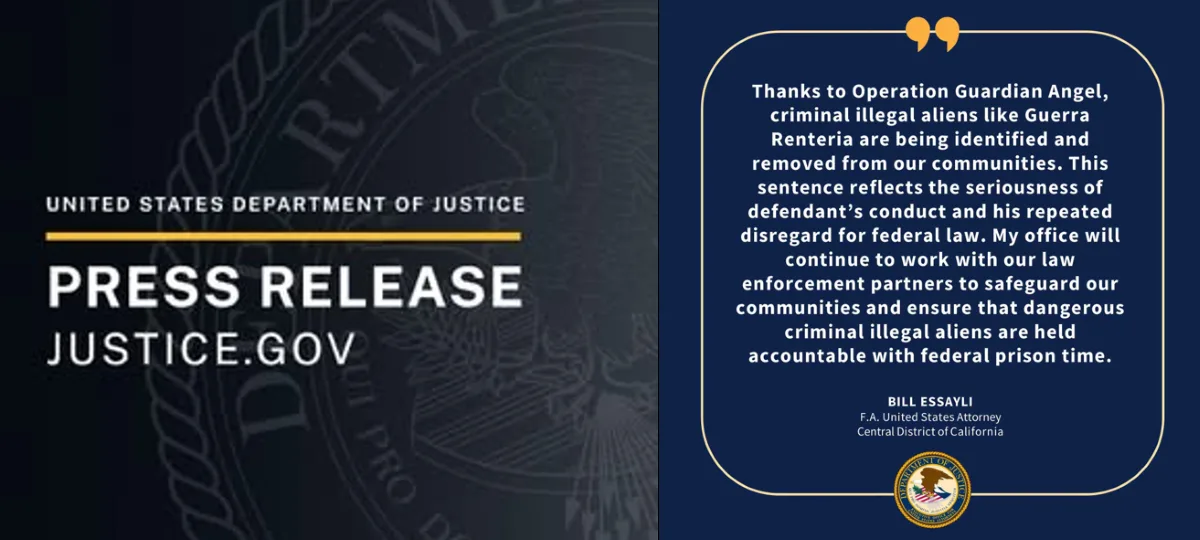
First Assistant United States Attorney Bill Essayli said the sentence reflects the seriousness of the offenses and the defendant’s repeated violations of federal law.
Federal Data Shows Rising Number of Non-Citizens Sentenced in Federal Court
While comprehensive California-specific conviction data by nationality is limited, federal sentencing statistics show a significant increase in the number of non-U.S. citizens sentenced in federal courts over the last three fiscal years. According to the U.S. Sentencing Commission:
- 21,502 non-U.S. citizens were federally sentenced in FY 2023. [ussc.gov]
- 21,303 non-U.S. citizens were federally sentenced in FY 2024. [ussc.gov]
- 28,886 non-U.S. citizens were federally sentenced in FY 2025, a substantial increase from the previous two years. [ussc.gov]
The commission also reported that approximately 66% of non-U.S. citizens sentenced in federal court during FY 2025 were citizens of Mexico.
Southern California continues to be one of the nation’s busiest federal districts for immigration and cross-border drug trafficking prosecutions due to its proximity to the U.S.-Mexico border.
Most Methamphetamine in the United States Comes from Mexico
Federal drug enforcement agencies have consistently reported that Mexico-based criminal organizations are the primary suppliers of methamphetamine entering the United States. The DEA states that Mexican drug trafficking organizations dominate methamphetamine production and distribution for the U.S. market. [
According to federal assessments:
- Mexico-based drug trafficking organizations are the primary source of methamphetamine sold in the United States. [dea.gov], [gao.gov]
- Most methamphetamine seized in the United States originates from large-scale clandestine laboratories in Mexico. [dea.gov], [gao.gov]
- Methamphetamine seizures along the Southwest border have increased dramatically over the past decade as Mexican cartels expanded production and smuggling operations. [dea.gov]
The Dangers of Methamphetamine Use
Methamphetamine is a highly addictive stimulant that can have devastating consequences for users, families, and communities.
Common effects of meth use include:
- Severe addiction and dependency
- Psychosis, paranoia, and hallucinations
- Violent or erratic behavior
- Increased risk of overdose
- Heart attack and stroke
- Extreme weight loss and physical deterioration
- Significant mental health disorders
- Long-term cognitive impairment
Federal and public health officials have repeatedly warned that meth addiction can fuel criminal activity as users seek ways to finance their drug habits. Crimes commonly associated with drug addiction include:
- Theft
- Burglary
- Shoplifting
- Vehicle theft
- Identity theft and fraud
- Robbery
- Drug trafficking and distribution
Law enforcement agencies frequently report that property crimes increase in areas experiencing significant narcotics activity, with repeat offenders often cycling through arrests, incarceration, release, relapse, and reoffending. The federal government has identified drug trafficking and drug-related crime as major drivers of criminal justice caseloads nationwide.
The Guerra-Renteria case highlights the intersection of illegal reentry, narcotics trafficking, and repeat criminal conduct that federal authorities say Operation Guardian Angel was created to address. Investigators from Homeland Security Investigations, the Bureau of Alcohol, Tobacco, Firearms and Explosives, and the Orange Police Department participated in the investigation, while Assistant United States Attorney Kevin Y. Fu prosecuted the case.
For Orange County residents, the sentence serves as another reminder of the ongoing challenges posed by methamphetamine trafficking networks that continue to smuggle large quantities of the drug into the United States from Mexico and distribute it throughout California communities.