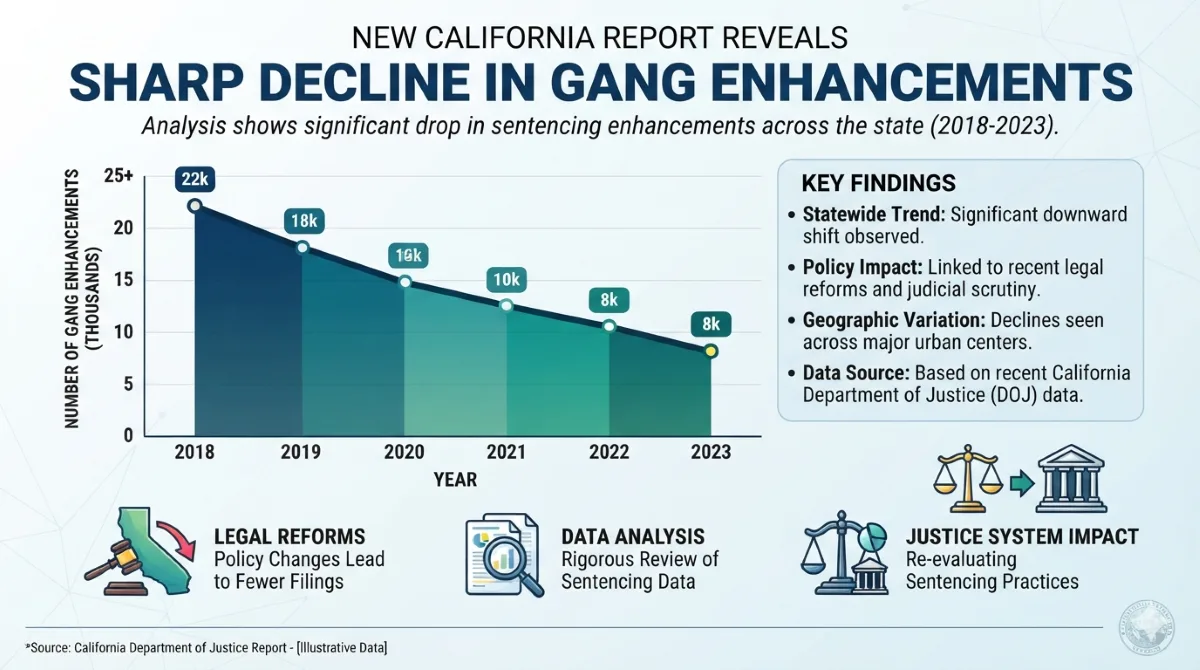
A new policy brief from the California Policy Lab (CPL) and the Committee on Revision of the Penal Code reveals dramatic shifts in how gang enhancements are applied in California — and the findings carry major implications for law enforcement agencies in Orange County, where gang‑related crime continues to impose significant social and economic costs.

Gang Enhancements Are Down 84% — But Demographic Disparities Remain
The study shows an 84% decline in the number of people entering prison with gang enhancements over the past decade, dropping from over 1,000 admissions in 2014 to fewer than 200 in 2025. This mirrors broader reductions in California’s prison population and a shift in prosecutorial practices following AB 333, which narrowed the definition of a “criminal street gang” and allowed separate trials on enhancements.
But the decline doesn’t mean gang enhancements are applied evenly:
- Hispanic individuals make up 72% of admissions receiving gang enhancements but only 47% of the general prison population.
- Young adults aged 18–25 comprise 67% of gang enhancement admissions but only 27% of overall admissions.
- Nearly half of all people who received a gang enhancement between 2014–2025 were Hispanic youth aged 18–25.
These disparities highlight the need for targeted prevention and community‑based interventions — especially in counties like Orange County, where gang activity remains a persistent public‑safety challenge.
What the Study Means for Orange County Law Enforcement
Orange County has long battled entrenched gang networks, with cities such as Santa Ana, Anaheim, Fullerton, and Garden Grove reporting consistent gang‑related arrests tied to drug trafficking, assaults, weapons possession, and organized theft rings.
Gang‑Related Crime in Orange County: The Local Picture
Based on regional law‑enforcement data and statewide trends:
- 20–30% of violent crime in Orange County involves documented gang members.
- Methamphetamine distribution — a major driver of gang revenue — remains heavily tied to gang networks.
- Youth recruitment continues to be a major factor, especially in neighborhoods with high poverty rates and limited after‑school programming.
Gang‑related crime imposes significant costs on Orange County communities:
- Direct costs: policing, investigations, prosecutions, incarceration, and probation.
- Indirect costs: lost productivity, trauma‑related healthcare, property damage, and reduced neighborhood economic activity.
- Estimated societal cost: Gang‑related crime can cost communities hundreds of millions of dollars annually, with violent offenses carrying the highest economic burden.
How Orange County Agencies Should Respond
Several strategic adjustments for local law enforcement are called for although the CPL Study did not include these:
1. Focus on High‑Risk Youth Populations
With young adults 18–25 dramatically overrepresented in gang enhancement data, Orange County agencies should expand:
- Youth diversion programs
- School‑based intervention partnerships
- Community mentorship initiatives
2. Strengthen Intelligence‑Driven Policing
Even as gang enhancements decline, gang activity persists. Agencies should invest in:
- Enhanced data‑sharing across jurisdictions
- Improved gang‑network mapping
- Targeted enforcement on violent offenders and drug traffickers
3. Expand Collaboration With Social‑Service Providers
The study underscores that gang involvement is often tied to:
- Poverty
- Family instability
- Neighborhood exposure
- Lack of economic opportunity
Law enforcement should partner with nonprofits, schools, and mental‑health providers to address root causes.
4. Prepare for Fewer Enhancement‑Based Prosecutions
AB 333’s narrower gang definition means prosecutors may rely less on enhancements and more on:
- Underlying violent‑crime charges
- Drug‑trafficking statutes
- Firearm‑related enhancements
This shift requires updated training for officers on evidence collection, gang‑criteria documentation, and courtroom testimony.
Why Kids Join Gangs — And How Parents Can Prevent It
Gang recruitment in Orange County mirrors statewide patterns. Youth often join gangs due to:
- Peer pressure
- Family instability
- Economic hardship
- Community exposure
- Identity and belonging
Parents can play a powerful role in prevention:
- Open communication about risks and consequences
- Structured activities such as sports, arts, and clubs
- Monitoring social circles to identify early warning signs
- Community engagement through local nonprofits and police outreach
- Stable home environment with consistent supervision and emotional support